

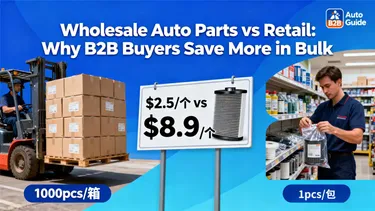
Wholesale Auto Parts vs Retail: Why B2B Buyers Save More in Bulk
Learn the difference between wholesale auto parts vs retail. See how B2B buyers save more with bulk engine parts orders. Linkteco delivers OEM-quality wholesale.
For B2B buyers—auto repair shops, fleet managers, parts distributors, or even small garages—choosing between wholesale and retail auto parts isn’t just a matter of “how much to buy.” It’s a strategic decision that impacts your annual costs, profit margins, and ability to serve clients efficiently.
Retail auto parts are designed for individual consumers or hobbyists buying 1–2 parts at a time (e.g., a DIYer replacing a single oil filter). Wholesale auto parts, by contrast, cater to businesses purchasing in bulk (5+ units) with pricing, terms, and support tailored to B2B needs.
This guide breaks down the core differences between wholesale and retail, explains why bulk buying delivers outsized savings for B2B buyers, and shares actionable steps to qualify for wholesale discounts—with real-world examples from Linkteco’s engine parts lineup.
What Is the Difference Between Wholesale and Retail Auto Parts?
Wholesale and retail auto parts serve entirely different audiences, with distinct supply chain structures, pricing models, and service levels. Below’s a clear breakdown of their key differences:
Factor | Wholesale Auto Parts | Retail Auto Parts |
Primary Audience | B2B buyers: Repair shops, fleet managers, distributors, large garages. | B2C buyers: DIYers, small hobbyists, individuals fixing a single vehicle. |
Typical Order Volume | Bulk (5+ units per part; often 50–1,000+ units for core engine parts like pistons). | Small (1–2 units per part; e.g., 1 water pump, 2 spark plugs). |
Pricing Model | Tiered discounts: Lower per-unit costs as order volume increases. No markup for “convenience.” | Fixed per-unit price: Higher cost to cover retail overhead (storefronts, individual shipping). |
Supply Chain | Direct from manufacturer (e.g., Linkteco) or authorized distributors—fewer middlemen. | Through retail channels (auto parts stores, online marketplaces like Amazon)—2–3 middlemen. |
Customization | Available: Manufacturers offer custom parts (e.g., branded gaskets, modified pistons) for bulk buyers. | None: Only pre-packaged, off-the-shelf parts. |
Support | B2B-focused: Dedicated account managers, technical support, extended warranties. | Basic: General customer service, short warranties (30–90 days). |
Delivery | Scheduled bulk shipping (7–25 days for global orders; optimized for inventory replenishment). | Expedited individual shipping (1–3 days; costly for large orders). |
The biggest misconception? “Wholesale parts are lower quality.” This is false—reputable wholesale suppliers like Linkteco use the same materials and manufacturing standards as retail brands (e.g., forged steel pistons, multi-layer steel gaskets) but cut out retail overhead to lower costs.
Why Wholesale Pricing Gives B2B Buyers an Edge
Wholesale pricing isn’t just “cheaper”—it’s designed to align with B2B buyers’ goals: reducing per-unit costs, stabilizing budgets, and maximizing profit margins. Here’s why it works:
1. No Retail Overhead Markup
Retail parts include hidden costs that wholesale buyers avoid:
- Storefront expenses: Rent, utilities, and staff for physical auto parts stores (added to retail prices).
- Individual packaging: Retail parts come in branded, single-unit packaging (e.g., a blister pack for 1 oil filter) that costs 5–10% more than bulk packaging.
- Marketplace fees: Online retailers (e.g., Amazon, eBay) charge 15–20% fees, which are passed to buyers in higher prices.
Wholesale parts skip these costs. For example, Linkteco ships bulk pistons in industrial cardboard crates (no single-unit packaging) and sells directly to B2B buyers—cutting out 2–3 middlemen and their markups.
2. Tiered Bulk Discounts Reward Volume
Wholesale pricing is tiered: the more you buy, the more you save. This is critical for B2B buyers who need consistent inventory (e.g., a repair shop that uses 50 oil filters monthly).
Linkteco’s tiered pricing for core engine parts illustrates the savings:
Order Volume | Pistons (per unit) | Gaskets (per unit) | Oil Filters (per unit) |
Retail (1–2 units) | $150 | $25 | $12 |
Wholesale (5–49 units) | $110 | $18 | $8 |
Wholesale (50–99 units) | $95 | $15 | $6 |
Wholesale (100+ units) | $85 | $12 | $5 |
At 100+ units, B2B buyers save 43% on pistons, 52% on gaskets, and 58% on oil filters compared to retail—adds up to tens of thousands in annual savings for high-volume buyers.
3. Simplified Inventory Management
Wholesale bulk orders let B2B buyers reduce “stockout risk” and administrative work:
- Fewer orders: Instead of placing 10 retail orders for oil filters monthly, a shop can place 1 wholesale order for 50 units—cutting down on invoices, shipping delays, and staff time.
- Stable pricing: Wholesale contracts lock in prices for 6–12 months, protecting buyers from retail price fluctuations (e.g., a 10% hike in retail oil filter prices due to supply chain issues).
For example, a fleet manager with 20 trucks can order 100 oil filters wholesale once quarterly, instead of 20 retail orders monthly—saving 16 hours of administrative work per year.
4. B2B-Exclusive Perks
Wholesale suppliers offer benefits that retail can’t match, designed to support business operations:
- Extended warranties: Linkteco’s wholesale parts come with 12–24 month warranties (vs. 30–90 days for retail), reducing the cost of defective parts.
- Technical support: Dedicated engineers help with part selection (e.g., confirming if a piston fits a Ford F-150 2020) or troubleshooting—critical for repair shops serving diverse clients.
- Custom bundles: Suppliers create tailored packages (e.g., “engine rebuild kits” with pistons + gaskets + bearings) at a 15–20% discount vs. buying parts separately.
Case Examples: Savings on Pistons, Gaskets, and Filters
Real-world math shows how wholesale bulk buying impacts B2B budgets. Below are three common engine parts, with retail vs. wholesale savings calculated for a mid-sized repair shop (50+ units annually per part):
1. Pistons (4-Cylinder Engine)
- Retail scenario: The shop replaces pistons in 10 cars yearly, buying 4 pistons per car (40 total units) at $150/unit.
- Total annual cost: 40 × 150 = 6,000.
- Wholesale scenario: The shop buys 50 pistons (Linkteco’s minimum order quantity for pistons) at $95/unit (tier 2 pricing).
- Total annual cost: 50 × 95 = 4,750.
- Savings: $1,250/year (21%).
- Bonus: The extra 10 pistons act as backup inventory for emergency repairs—avoiding retail rush shipping costs (20–50 per order).
2. Head Gaskets
- Retail scenario: The shop replaces 25 head gaskets yearly at $25/unit.
- Total annual cost: 25 × 25=625.
- Wholesale scenario: The shop buys 50 head gaskets at $15/unit (tier 2 pricing).
- Total annual cost: 50 × 15=750.
- Wait—why higher upfront cost? Because the shop uses 50 gaskets over 2 years, reducing long-term costs:
- 2-year retail cost: 50 × 25=1,250.
- 2-year wholesale cost: $750.
- Savings: $500 over 2 years (40%).
3. Oil Filters
- Retail scenario: The shop changes oil in 200 cars yearly, buying 200 oil filters at $12/unit.
- Total annual cost: 200 × 12=2,400.
- Wholesale scenario: The shop buys 200 oil filters at $5/unit (tier 4 pricing).
- Total annual cost: 200 × 5=1,000.
- Savings: $1,400/year (58%)—enough to hire a part-time staff member for a week or invest in new tools.
Combined, these three parts deliver $3,150 in annual savings for a single repair shop—proof that wholesale bulk buying isn’t just “cheaper,” but a driver of profitability.
How to Qualify for Wholesale Discounts (MOQ, bundles, contracts)
Qualifying for wholesale auto parts discounts is easier than many B2B buyers think—suppliers like Linkteco design requirements to be accessible, even for small-to-medium businesses. Here’s how to get started:
1. Meet Minimum Order Quantities (MOQ)
MOQs are the smallest number of units you need to buy to access wholesale pricing. Reputable suppliers keep MOQs reasonable:
- Linkteco’s MOQs: 5 units for gaskets/filters, 50 units for pistons/crankshafts, 10 units for engine blocks.
- Workaround for small shops: Partner with other local garages to split a bulk order (e.g., two shops buying 25 pistons each to meet a 50-unit MOQ).
2. Choose Pre-Bundled Packages
Suppliers offer “value bundles” that combine complementary parts at a discount—these often have lower MOQs than individual parts. For example:
- Linkteco’s “Engine Rebuild Bundle”: 4 pistons + 1 head gasket + 4 oil filters (MOQ: 10 bundles) at 18% off vs. buying parts separately.
- Bundles simplify inventory: A repair shop can stock 10 bundles and cover most 4-cylinder engine rebuilds without ordering parts individually.
3. Sign a Long-Term Contract
Suppliers reward consistent buyers with better pricing. A 6–12 month contract (e.g., “I’ll buy 100 oil filters quarterly”) can unlock:
- Extra 5–10% off tiered pricing.
- Priority shipping during supply shortages (e.g., getting oil filters first when there’s a global steel shortage).
- Waived MOQs for emergency orders (e.g., ordering 10 pistons last-minute without paying retail).
Linkteco’s contract terms are flexible—even small shops can sign a 6-month contract for 50 oil filters monthly to access these perks.
4. Prove B2B Status
Suppliers require basic documentation to confirm you’re a business (not a retail buyer):
- Business license or tax ID (e.g., EIN in the U.S., VAT number in the EU).
- Proof of industry affiliation (e.g., a repair shop’s ASE certification, a fleet’s vehicle registration).
This step prevents retail buyers from abusing wholesale pricing—and ensures B2B buyers get the support they need.
FAQ
1. Can small repair shops (1–2 mechanics) buy wholesale auto parts?
Yes—small shops qualify for wholesale pricing if they meet MOQs or sign flexible contracts. For example:
- A 1-mechanic shop that uses 50 oil filters yearly can buy 50 units at Linkteco’s wholesale price (5/unit)insteadof50retailunits(12/unit)—saving $350/year.
- Small shops can also partner with distributors who offer “micro-wholesale” (MOQs of 5–10 units) for core parts like gaskets or filters.
2. Is retail ever cheaper than wholesale for auto parts?
Only in two rare scenarios:
- 1–2 unit orders: If you need 1 oil filter for an emergency repair, retail (12+5 shipping = 17)ischeaperthanbuying5wholesale(25 + 10shipping=35).
- Retail sales/promotions: Occasional retail discounts (e.g., “20% off oil filters”) may match wholesale prices for small quantities—but never for bulk orders (50+ units).
For B2B buyers who need 5+ units yearly, wholesale is always cheaper.
3. Are wholesale parts harder to return than retail parts?
No reputable wholesale suppliers have B2B-friendly return policies:
- Linkteco accepts returns of unused parts within 90 days (vs. 30 days for retail) and covers return shipping for defective parts.
- Bulk returns are streamlined: Instead of returning 50 individual parts, you can ship one crate back with a single invoice.
Retail returns are often more tedious—you may need to return each part separately with its own packaging.
4. Do I need to buy from a local wholesale supplier, or can I buy globally?
Global suppliers like Linkteco are often more cost-effective than local ones—here’s why:
- Global manufacturers have lower production costs (e.g., Linkteco’s factories in Asia use economies of scale to reduce per-unit costs).
- International shipping for bulk orders is cheaper per unit (e.g., 100 to ship 50 pistons globally=2/unit, vs. 50 to ship 10 pistons locally=5/unit).
Linkteco also handles customs clearance and provides tracking for all global orders—so you don’t have to navigate international logistics.
Conclusion
For B2B buyers, wholesale auto parts vs. retail isn’t a choice—it’s a no-brainer. Wholesale eliminates retail overhead, rewards bulk buying with tiered discounts, and provides B2B-exclusive support (extended warranties, technical help, custom bundles) that keeps your business running smoothly.
The numbers speak for themselves: A mid-sized repair shop can save $3,000+ yearly on just three core engine parts (pistons, gaskets, filters) by switching to wholesale. For larger buyers (distributors, fleet managers), savings can reach six figures annually.
At Linkteco, we make wholesale accessible to every B2B buyer—whether you’re a small repair shop buying 50 oil filters or a distributor ordering 1,000 pistons. Our flexible MOQs, tiered pricing, and global shipping ensure you get the parts you need at a price that boosts your bottom line.
Ready to start saving?
- Browse bulk engine parts: Visit our Pistons Wholesale page to see tiered pricing for core parts.
- Get a custom quote: Share your annual part needs (e.g., “50 head gaskets, 200 oil filters”) via our Contact Page—we’ll send a personalized savings estimate within 24 hours.
- Ask about bundles: Inquire about our “Engine Rebuild Kits” or custom bundles to save even more on complementary parts.
Don’t let retail pricing eat into your profits. Switch to wholesale, and let Linkteco be your partner for affordable, high-quality engine parts.

Catalog
Quick Link
Support
Contact
Tel: +8619168959101
Email: info@linktecowholesale.com
Add: 12/F, Building 3C, TianAn Cloud Park Phase 1, Bantian, Longgang District, Shenzhen, 518129, China
©2026 LinkTeco All Rights Reserved.