

Bulk Engine Parts Pricing: What Impacts Cost for Wholesale Buyers?
What impacts bulk engine parts pricing for wholesale buyers? Learn about OEM vs aftermarket costs, volume discounts, and supply chain factors.
For wholesale buyers of engine parts—whether you’re a repair chain, fleet manager, or distributor—understanding what drives bulk pricing is critical to controlling costs and maximizing profit margins. A “low price” upfront doesn’t always mean the best value: factors like material quality, supply chain logistics, and order volume can turn a seemingly cheap order into a costly mistake.
Bulk engine parts pricing isn’t arbitrary—it’s shaped by a mix of manufacturing realities, market forces, and supplier policies. This guide breaks down the key factors that influence cost, compares OEM vs. aftermarket pricing for bulk orders, explains how volume discounts work, and shares insights to help you negotiate better deals. As a global wholesale engine parts manufacturer, Linkteco’s pricing model is built on transparency—we’ll use real-world examples from our catalog to make complex cost drivers easy to understand.
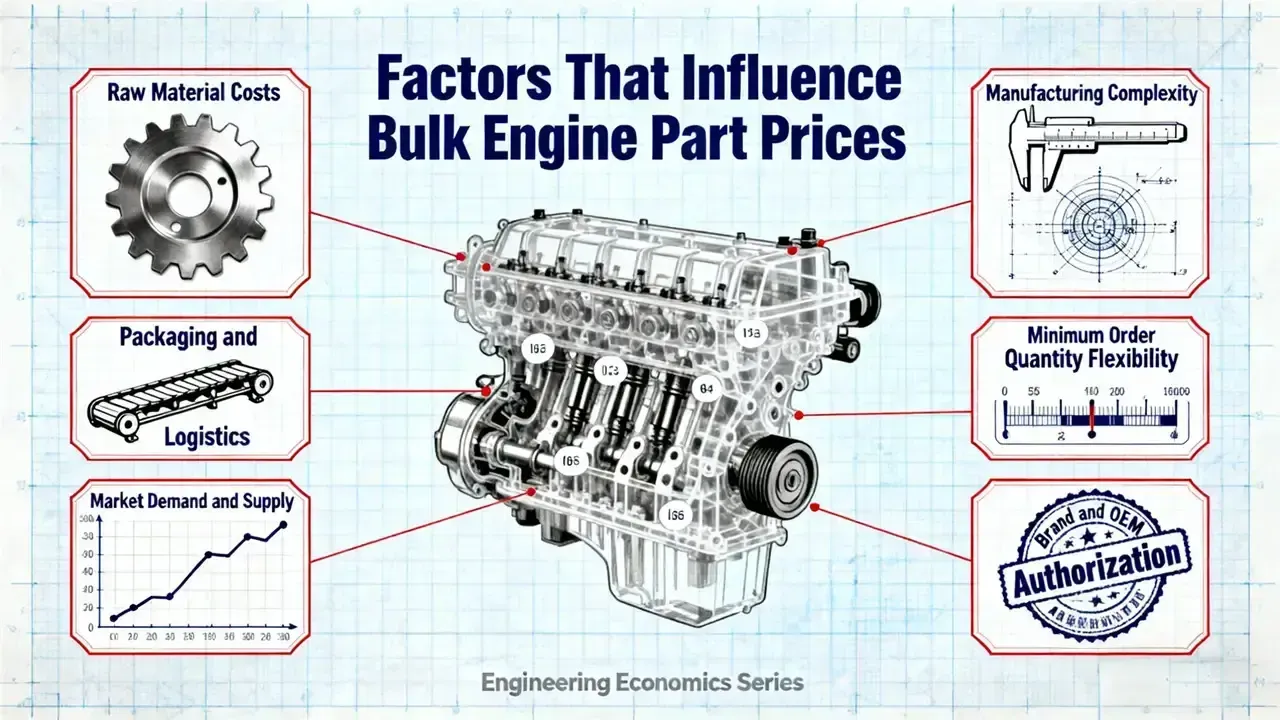
Factors That Influence Bulk Engine Part Prices
Bulk pricing for engine parts is determined by 6 core factors, each with a direct impact on what you pay per unit. Understanding these helps you avoid overpaying and identify opportunities to save:
1. Raw Material Costs (The Foundation of Pricing)
Engine parts rely on specialized materials—their cost fluctuations are the single biggest driver of bulk pricing. Common materials and their cost impacts:
- Steel (for crankshafts, connecting rods): Forged steel (e.g., 4340 alloy, used in heavy-duty crankshafts) costs 30–50% more than cast iron. Global steel prices (influenced by iron ore supply and energy costs) can swing by 15–20% annually—for example, a 2023 steel shortage pushed bulk crankshaft prices up 12% for many suppliers.
- Aluminum (for pistons, cylinder heads): High-grade aluminum (e.g., A356-T6, used in Linkteco’s pistons) is 2x more expensive than standard aluminum. Recycled aluminum cuts costs by 10–15%—Linkteco uses 30% recycled aluminum in bulk piston orders to keep prices stable.
- Rubber/Composite (for gaskets, hoses): EPDM rubber (resistant to oil and coolant) costs 25% more than basic neoprene. Multi-layer steel (MLS) gaskets (used in head gaskets) add 40% to material costs vs. single-layer rubber gaskets.
Example: A bulk order of 500 forged steel crankshafts costs ~120/unit when steel prices are low, but jumps to 135/unit during a shortage—adding $7,500 to your total cost.
2. Manufacturing Complexity
The more precision and labor required to make a part, the higher the bulk price:
- Machining precision: Parts like camshafts (with egg-shaped lobes) need CNC grinding (tolerance ±0.001mm), which adds 20% to production costs vs. basic cast parts.
- Heat treatment: Parts like pistons (hardened to resist wear) require heat-treating processes (e.g., T6 tempering), which increases cost by 15–25%.
- Certifications: Meeting automotive standards (IATF 16949, ISO 9001) requires extra testing (e.g., pressure testing for head gaskets, fatigue testing for crankshafts). These tests add 5–10% to bulk pricing but ensure quality—cheaper uncertified parts often fail prematurely.
Linkteco’s bulk pricing includes certification costs upfront—no hidden fees for testing or compliance, unlike some suppliers who cut corners to offer “lower prices.”
3. Market Demand and Supply
Like any product, bulk engine parts pricing responds to supply and demand:
- Seasonal demand: Summer (when AC use spikes) increases demand for water pumps and radiators—bulk prices can rise 5–10% during peak months. Winter boosts demand for glow plugs (diesel engines) and battery parts.
- Vehicle model popularity: Parts for high-volume models (e.g., Toyota Corolla, Ford F-150) have lower bulk prices due to economies of scale. Niche parts (e.g., vintage muscle car pistons) cost 20–30% more because production runs are smaller.
- Supply shortages: Global events (e.g., semiconductor shortages, shipping delays) disrupt supply. In 2022, a shortage of aluminum pushed bulk piston prices up 18% for 6 months.
Tip: Buy non-seasonal parts (e.g., gaskets, oil filters) in off-peak months to lock in lower bulk prices.
4. Brand and OEM Authorization
Brand status and OEM (Original Equipment Manufacturer) partnerships significantly impact pricing:
- OEM parts: Authorized OEM parts (e.g., Ford OEM crankshafts) include brand licensing fees, pushing bulk prices 20–40% higher than aftermarket parts. These fees cover the vehicle manufacturer’s quality control and branding.
- Aftermarket brands: Reputable aftermarket brands (e.g., Linkteco) avoid OEM fees, so bulk prices are lower—but quality remains comparable. No-name aftermarket parts may cost 10–15% less than branded ones, but often use subpar materials (e.g., low-grade steel for crankshafts).
- Private labeling: Some suppliers (like Linkteco) offer private labeling for bulk orders (e.g., your shop’s logo on oil filters) for a 5–10% premium—cheaper than building your own brand from scratch.
5. Packaging and Logistics
Bulk orders require specialized packaging and shipping, which add to the total cost:
- Packaging type: Standard bulk packaging (industrial crates for pistons, shrink-wrap for gaskets) is included in pricing. Custom packaging (e.g., individually boxed parts for retail resale) adds 8–12% to cost.
- Shipping method: Sea freight (for global orders) costs 50–70% less than air freight but takes 3–4 weeks longer. Linkteco offers both options—air freight for emergency bulk orders (e.g., 50 water pumps needed in 5 days) and sea freight for planned inventory.
- Warehousing: Suppliers with regional warehouses (e.g., Linkteco’s U.S. and EU warehouses) reduce shipping costs for local buyers. A U.S. buyer ordering 1,000 oil filters from Linkteco’s U.S. warehouse pays $ 2/unit in shipping, versus $ 5/unit from a China-based warehouse.
6. Minimum Order Quantity (MOQ) Flexibility
MOQs influence how much you pay per unit—suppliers offer lower prices for larger orders to offset production setup costs:
- Low MOQs (5–50 units): Higher per-unit prices (e.g., $110/piston for 50 units) because setup costs (e.g., calibrating CNC machines) are spread over fewer parts.
- High MOQs (500+ units): Lower per-unit prices (e.g., $85/piston for 500 units) as setup costs are diluted.
- Custom MOQs: Negotiable for long-term buyers—Linkteco reduces MOQs by 30% for clients who sign 12-month supply contracts.
OEM vs Aftermarket Pricing in Bulk Orders
One of the biggest pricing decisions for wholesale buyers is choosing between OEM and aftermarket parts. The gap in bulk costs is significant, but value depends on your clients’ needs:
Pricing Factor | OEM Bulk Parts | Aftermarket Bulk Parts (e.g., Linkteco) |
Per-Unit Cost | 20–40% higher than aftermarket. Example: Toyota OEM pistons = $180/unit (500 units). | 20–40% lower. Example: Linkteco aftermarket pistons = $110/unit (500 units). |
Licensing Fees | Included (15–25% of total cost) to use the vehicle brand. | None—no brand fees, so savings passed to buyers. |
Volume Discounts | Minimal (5–10% off for 1,000+ units) due to rigid pricing policies. | Generous (15–30% off for 1,000+ units) with tiered discounts. |
Customization Costs | High (15–20% premium for modified parts, e.g., larger piston bores). | Low or none—Linkteco offers custom parts (e.g., corrosion-resistant manifolds) at no extra cost for bulk orders. |
Total Bulk Savings | \(7,500 for 500 pistons (vs. retail, but \)35,000 more than aftermarket). | \(42,500 for 500 pistons (vs. retail, \)35,000 less than OEM). |
Key Insight: For clients who prioritize “genuine” parts (e.g., luxury car dealerships), OEM is worth the higher cost. For cost-focused clients (e.g., independent repair shops, fleets), aftermarket parts deliver the same quality at 30–40% lower bulk prices. Linkteco’s aftermarket parts meet OEM specs (e.g., same 4340 steel for crankshafts) but skip brand fees—ideal for buyers balancing quality and cost.
How Volume Discounts Work in Wholesale Auto Parts
Volume discounts are the biggest way to save on bulk engine parts—but they’re not one-size-fits-all. Suppliers use 3 common models to reward larger orders:
1. Tiered Pricing (Most Common)
Prices drop as order volume increases, with clear “tiers” for different quantities. Linkteco’s tiered pricing for core engine parts illustrates how this works:
Order Volume | Pistons (per unit) | Head Gaskets (per unit) | Oil Filters (per unit) | Total Savings vs. 100 Units |
100 units | $100 | $18 | $6 | — |
500 units | $85 | $15 | $5 | 15% ($8,500 for 500 pistons) |
1,000 units | $75 | $12 | $4 | 25% ($25,000 for 1,000 pistons) |
5,000+ units | $65 | $10 | $3.50 | 35% ($175,000 for 5,000 pistons) |
Tip: Plan orders to hit the next tier—if you need 450 pistons, order 500 to unlock the 15% discount (saves $7,500 vs. 450 units at the 100-unit tier).
2. Threshold Discounts (For Large Orders)
Suppliers offer an extra discount once a “threshold” volume is reached—often for orders that exceed standard MOQs. For example:
- Linkteco offers a 5% “threshold discount” for orders over 1,000 units (on top of tiered pricing).
- A buyer ordering 1,200 pistons gets the 25% tiered discount plus 5% extra—total savings of 30%.
Threshold discounts are ideal for distributors or large repair chains that need 1,000+ units of a single part annually.
3. Long-Term Contract Discounts
Signing a 6–24 month supply contract locks in lower bulk prices and adds extra perks:
- 5–10% off tiered pricing (e.g., 70/piston instead of 75 for 1,000 units).
- Waived shipping costs for quarterly bulk orders.
- Priority production during shortages (e.g., first access to pistons if steel prices spike).
Linkteco’s contract clients save an average of 18% annually vs. one-time bulk buyers—critical for businesses with predictable inventory needs.
Regional and Global Supply Chain Cost Differences
Where your supplier manufactures and ships parts has a huge impact on bulk pricing. Global and regional supply chains differ in 3 key cost drivers:
1. Manufacturing Location
Suppliers based in regions with lower labor and material costs offer cheaper bulk prices:
- Asia (China, Vietnam): Labor costs are 50–60% lower than in North America/Europe, and access to cheap steel/aluminum reduces material costs. Linkteco’s China manufacturing facility allows us to offer bulk pistons at 75/unit(1,000units), vs.100/unit from a U.S.-based OEM supplier.
- North America/Europe: Higher labor and material costs, but faster delivery (1–3 days vs. 3–4 weeks) for local buyers. Linkteco’s U.S. warehouse stocks 85% of core parts, so U.S. buyers get Asian manufacturing costs with North American shipping speed.
2. Tariffs and Trade Policies
Import duties add to bulk costs for cross-border orders:
- U.S. buyers: Importing parts from China may incur a 25% tariff (per U.S. trade policy), pushing a 75 piston to 93.75/unit. Linkteco avoids this by shipping from its U.S. warehouse (no tariffs on domestic orders).
- EU buyers: Parts from Asia face 10–15% tariffs, but parts from within the EU (e.g., Linkteco’s EU warehouse) are tariff-free.
Tip: Choose suppliers with regional warehouses to avoid tariffs—this can cut bulk costs by 10–25%.
3. Logistics Efficiency
Longer shipping distances increase costs and delivery times:
- Sea freight (Asia to U.S.): $2–3/unit for bulk parts (e.g., 1,000 oil filters), but takes 3–4 weeks.
- Air freight (Asia to U.S.): $8–10/unit, but arrives in 3–5 days.
- Local shipping (U.S. warehouse to U.S. buyer): $1–2/unit, arrives in 1–2 days.
Linkteco’s global logistics network lets buyers choose the best balance of cost and speed—critical for emergency orders (e.g., a fleet needing 100 water pumps in 5 days) vs. planned inventory.
FAQ
1. Is bulk always cheaper than buying smaller quantities?
Not always—if you can’t use the parts before they become obsolete (e.g., parts for a discontinued vehicle), excess inventory wastes money. For small buyers (e.g., a repair shop needing 20 pistons), splitting a bulk order with other local shops (to hit a 50-unit MOQ) is cheaper than buying 20 units at retail. Linkteco helps small buyers connect with “bulk co-ops” to share orders and savings.
2. How much do wholesale buyers typically save on bulk engine parts vs. retail?
On average, 30–50% for core parts. For example:
- Retail: 10 oil filters = 120(12/unit).
- Bulk (100 units): 600(6/unit) = 50% savings.
- For large orders (1,000+ units), savings can reach 50–60% (e.g., 3.50/unit for oil filters vs. 12/unit retail).
3. Does customization increase bulk engine parts pricing?
It depends on the supplier:
- OEM suppliers: Yes—custom parts (e.g., larger piston bores) add 15–20% to bulk pricing.
- Reputable aftermarket suppliers: No—Linkteco offers custom parts (e.g., corrosion-resistant exhaust manifolds, branded packaging) at no extra cost for bulk orders (500+ units).
4. Are there hidden costs in bulk engine parts pricing?
Some suppliers hide costs—watch for:
- Testing/certification fees: Charged separately for IATF 16949 compliance (Linkteco includes these in upfront pricing).
- Packaging surcharges: Added for “specialty packaging” (e.g., waterproof crates) that should be standard.
- Shipping delays: Suppliers may quote low freight costs but use slow shipping, leading to costly downtime.
Linkteco’s bulk quotes include all costs (material, manufacturing, packaging, shipping) with no hidden fees—critical for budget planning.
Conclusion
Bulk engine parts pricing is shaped by a mix of material costs, manufacturing complexity, order volume, and supply chain logistics. For wholesale buyers, the key to saving money is:
- Choosing the right supplier (with transparent pricing and regional warehouses).
- Leveraging volume discounts (hit tier thresholds, sign long-term contracts).
- Balancing OEM vs. aftermarket parts (prioritize aftermarket for cost-focused clients).
At Linkteco, we design our bulk pricing to be fair and flexible—no hidden fees, generous volume discounts, and global logistics to minimize costs. Our parts use the same materials as OEM (e.g., 4340 forged steel, A356-T6 aluminum) but skip brand fees, so you get quality at 30–40% lower prices.
- Get a custom bulk quote: Visit the Linkteco Homepage and share your part type, quantity, and location—we’ll send a detailed quote with no obligations.
- Learn more about savings: Contact our team to discuss tiered discounts, contract terms, or co-op bulk orders for small buyers.
Don’t let opaque pricing eat into your profits. Partner with Linkteco for bulk engine parts that deliver quality, savings, and reliability—every time.

Catalog
Quick Link
Support
Contact
Tel: +8619168959101
Email: info@linktecowholesale.com
Add: 12/F, Building 3C, TianAn Cloud Park Phase 1, Bantian, Longgang District, Shenzhen, 518129, China
©2026 LinkTeco All Rights Reserved.