

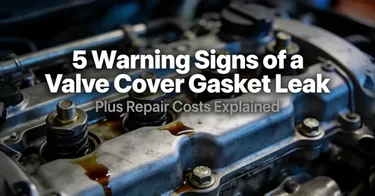
5 Warning Signs of a Valve Cover Gasket Leak (Plus Repair Costs Explained)
The valve cover gasket may be a humble component, but its role as a critical seal in the engine’s valvetrain cannot be overstated. A compromised gasket allows oil to leak, leading to cascading engine damage—from fouled ignition systems to catastrophic overheating—if left unaddressed.
For professional repair shops, fleet managers, and discerning DIY enthusiasts, this guide delivers in-depth technical insights, data-backed diagnosis methods, and actionable replacement strategies that outperform generic resources. Linkteco’s precision-engineered valve cover gaskets, designed for global vehicle makes, ensure long-lasting sealing performance backed by ISO 9001 and IATF 16949 certifications.
What the Valve Cover Gasket Does
To understand leak-related failures, it’s essential to dissect the gasket’s functional role in modern engine architecture. The valve cover—typically constructed from die-cast aluminum or reinforced plastic—encases the valvetrain (valves, camshafts, lifters, and rocker arms) atop the cylinder head. The valve cover gasket, a flexible sealing medium, fills the micro-gap between these two components, serving three non-negotiable purposes:
- Oil Retention: Seals the valvetrain’s lubrication reservoir, preventing engine oil from escaping onto heat-generating components (e.g., exhaust manifolds) or accumulating in critical areas (e.g., spark plug wells).
- Contamination Barrier: Blocks ingress of dirt, moisture, and combustion byproducts, which cause corrosion, accelerated wear, and valvetrain binding.
- Pressure Regulation: Maintains the engine’s crankcase ventilation pressure (typically 0.5–2 psi), ensuring optimal oil circulation and preventing oil vapor buildup.
Gasket materials are engineered for specific engine demands, with three primary formulations dominating modern vehicles (per SAE International’s Gasket Material Standards J2226):
- Nitrile Rubber (NBR): Most common for mainstream cars; temperature resistance range of -40°F to 250°F (-40°C to 121°C); cost-effective but prone to degradation in high-heat engines.
- Silicone Rubber: Ideal for turbocharged/supercharged engines; temperature resistance up to 350°F (177°C); resistant to oil swelling and thermal cycling.
- Cork Composite: Used in classic cars and heavy-duty trucks; compressible for uneven mating surfaces; temperature resistance up to 300°F (149°C) but requires periodic retorquing.
Gasket failure typically occurs after 60,000–120,000 miles, with accelerated degradation linked to extreme heat (turbocharged engines), extended oil change intervals, and chemical exposure to low-quality lubricants. For deep dives into gasket maintenance, refer to our Engine Gasket Replacement Interval Guide.
Early Leak Indicators (Diagnostic Precision)
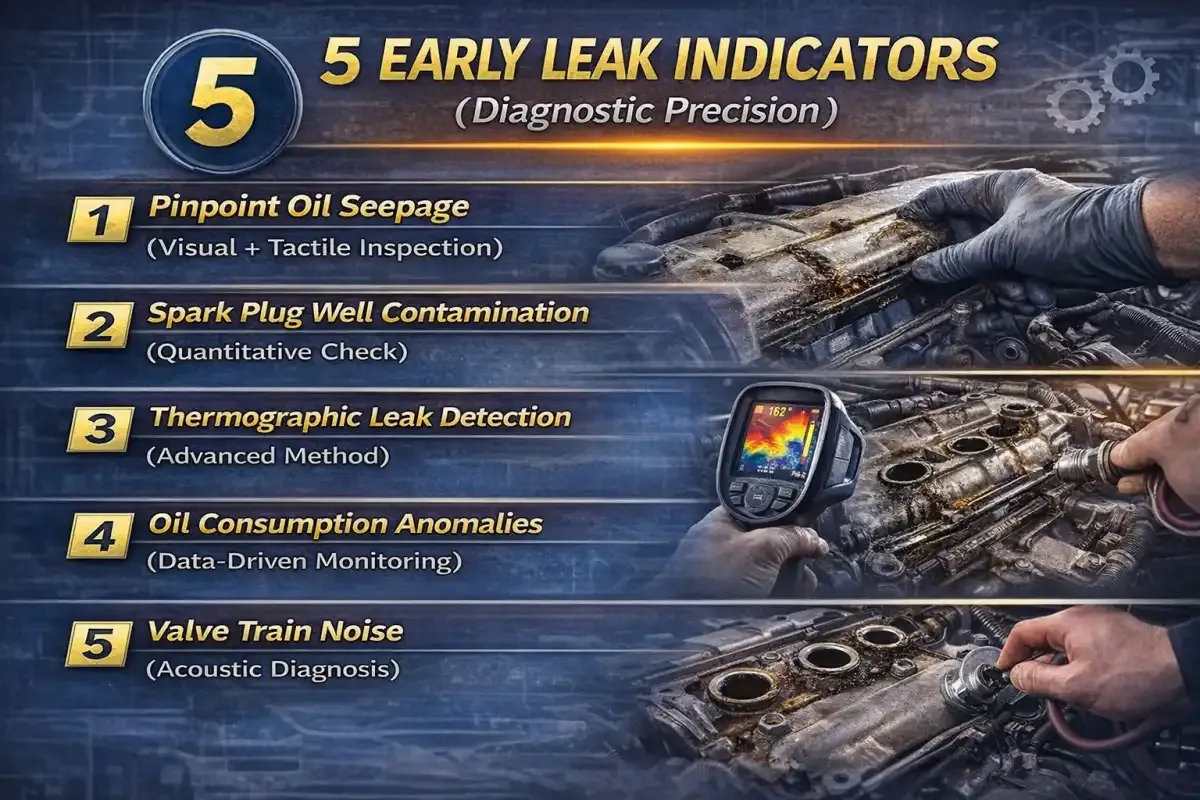
Early leak detection requires a systematic approach, combining visual inspection, tool-assisted testing, and symptom correlation. These subtle cues, often missed by generic guides, signal incipient gasket failure:
1. Pinpoint Oil Seepage (Visual + Tactile Inspection)
Small, localized oil deposits on the cylinder head or valve cover flange are the first sign. Unlike pan gasket leaks (which drip vertically), valve cover gasket seepage spreads horizontally along the mating surface.
- Diagnostic Technique: Use a UV dye kit (e.g., Permatex UV Leak Detection Kit) to trace leaks. Add dye to the engine oil, run the engine for 15 minutes, and inspect with a UV light—leaks glow bright green, even in tight spaces.
- Critical Distinction: Oil from valve cover gaskets is clean (fresh lubricant), while leaks from the timing cover or head gasket may contain coolant or combustion residue.
2. Spark Plug Well Contamination (Quantitative Check)
Oil accumulation in spark plug wells is a definitive indicator of gasket failure, as the gasket seals the well openings. Even 1–2 milliliters of oil can foul spark plugs and short ignition coils.
- Diagnostic Technique: Remove spark plug coils and use a bore scope to inspect well bottoms. For measurable data, extract oil with a syringe—volumes exceeding 5mL confirm a severe leak requiring immediate replacement.
- Impact Analysis: Contaminated plugs show black, wet deposits (vs. normal tan/gray electrodes) and misfire codes P0300–P0308, with fuel efficiency drops of 10–15% (per ASE’s Engine Performance Study).
3. Thermographic Leak Detection (Advanced Method)
Infrared thermography (IR) reveals leaks invisible to the naked eye by detecting temperature anomalies—oil leaking onto hot components creates cooler patches (oil dissipates heat faster than metal).
- Application: Use a portable IR camera (e.g., FLIR C2) to scan the valve cover flange while the engine idles at operating temperature (195–220°F). Temperature drops of 10°F+ along the flange indicate active seepage.
4. Oil Consumption Anomalies (Data-Driven Monitoring)
A gradual increase in oil consumption—without external leaks—signals internal gasket seepage (oil burning in the combustion chamber).
- Benchmark: Normal oil consumption for modern engines is 0.2–0.5 quarts per 1,000 miles. Consumption exceeding 1 quart per 1,000 miles, paired with no visible leaks, strongly points to valve cover gasket failure.
- Verification: Perform a cylinder leak-down test—excessive blow-by (>10%) may indicate oil is being drawn into cylinders via compromised gaskets.
5. Valve Train Noise (Acoustic Diagnosis)
As oil leaks reduce lubrication, the valvetrain produces subtle ticking or tapping noises, distinct from rod knock or timing chain rattle.
- Diagnostic Tool: Use a mechanic’s stethoscope to isolate noise—louder ticking at the valve cover (vs. the engine block) confirms insufficient lubrication due to gasket leaks.
- Root Cause: Leaks reduce oil pressure at the valvetrain (typically 10–15 psi at idle), causing lifter collapse or rocker arm friction.
Severe Leak Complications (Technical Consequences)
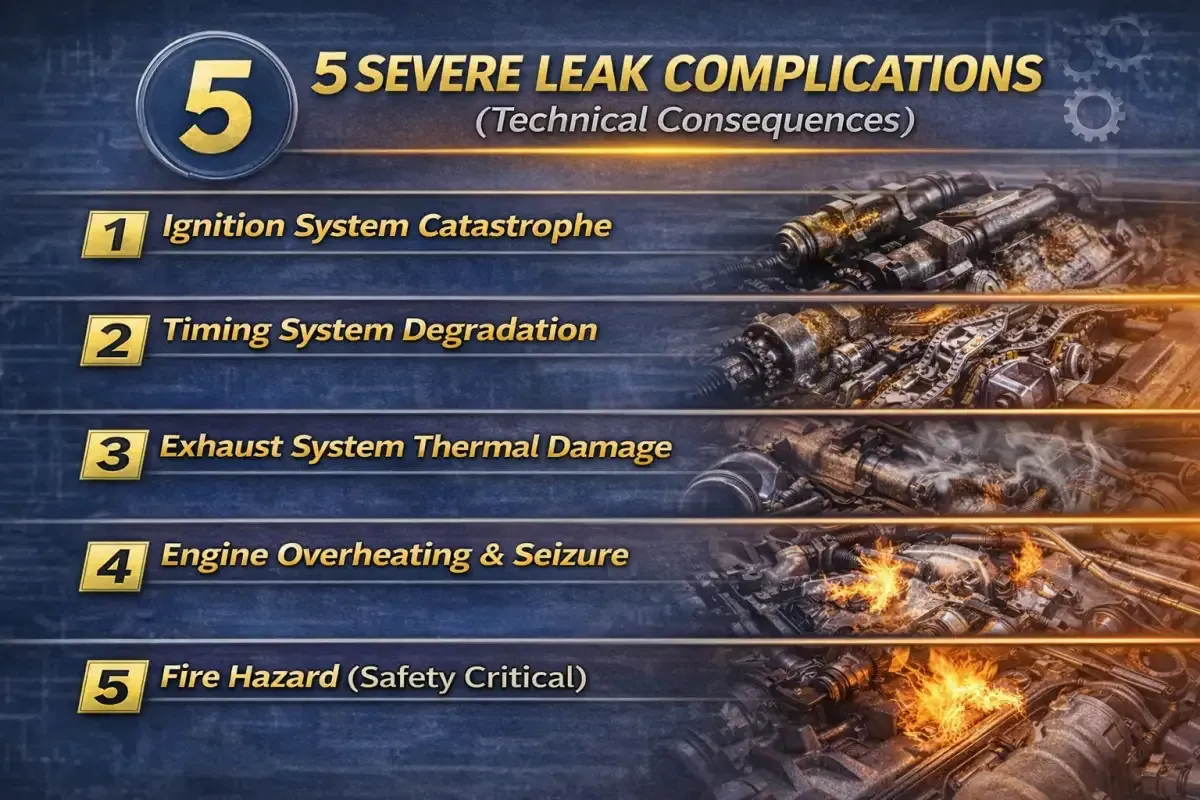
Ignoring early leaks leads to mechanical failures with cascading costs, rooted in engineering principles of lubrication, thermal management, and material science:
1. Ignition System Catastrophe
Oil contamination of spark plugs and ignition coils causes permanent damage to electrical components. Silicone insulation on coils degrades when exposed to oil, leading to arcing and coil failure.
- Technical Impact: Misfires increase cylinder temperatures by 20–30%, accelerating piston ring wear and carbon deposits.
- Cost Breakdown: Replacement of 4 ignition coils + spark plugs: $400–$1,200 (professional) vs. $300–$800 for gasket replacement. For luxury vehicles (e.g., BMW N55 engine), coil replacement alone costs $600–$1,000.
2. Timing System Degradation
In overhead-cam engines, severe leaks drip oil onto timing belts or chains. Rubber timing belts swell and lose tensile strength (SAE tests show 30% strength loss after 10 hours of oil exposure), while chains suffer accelerated wear on guides and tensioners.
- Catastrophic Risk: A failed timing belt in interference engines (e.g., Honda K-series, Volkswagen TSI) causes valve-piston contact, resulting in bent valves, cracked pistons, and cylinder head damage.
- Repair Cost: Timing system replacement + engine rebuild: $3,500–$8,000+ vs. proactive gasket replacement: $300–$1,200.
3. Exhaust System Thermal Damage
Oil leaking onto exhaust manifolds reaches combustion temperatures (1,200–1,600°F), causing localized overheating and manifold warpage. Catalytic converters become clogged with oil ash, triggering P0420/P0430 codes and failing emissions tests.
- Material Science Angle: Oil’s hydrocarbon content reacts with catalytic converter platinum/palladium catalysts, forming carbon deposits that block exhaust flow.
- Cost Impact: Exhaust manifold replacement: $800–$1,800; catalytic converter replacement: $1,500–$4,000 (due to precious metal content).
4. Engine Overheating & Seizure
Low oil levels reduce the engine’s cooling capacity—oil dissipates 30% of engine heat (per SAE’s Thermal Management Report). Without sufficient lubrication, friction between moving parts (e.g., crankshaft bearings, piston rings) generates excessive heat.
- Failure Progression: Overheating causes cylinder head warpage (>0.003” distortion) and head gasket failure, leading to coolant-oil mixing and engine seizure.
- Cost Escalation: Cylinder head resurfacing + head gasket replacement: $1,800–$3,500; full engine replacement: $4,000–$12,000+.
5. Fire Hazard (Safety Critical)
Oil leaking onto hot exhaust components ignites at 400–500°F (flash point of motor oil). Engine bay fires spread rapidly to plastic components (e.g., air intake, wiring harnesses), causing total vehicle loss.
- Industry Data: The National Fire Protection Association (NFPA) reports 12,000 vehicle fires annually due to oil leaks, with valve cover gaskets accounting for 18% of cases.
Cost Factors in Valve Cover Replacement
Replacement costs are influenced by engine design, labor complexity, and material quality—with critical nuances for B2B buyers (repair shops, fleets) and DIY enthusiasts:
1. Vehicle-Specific Complexity
Engine architecture dictates labor time and part costs, with key variables including:
- Accessibility: 4-cylinder engines (e.g., Toyota 2ZR-FE) have exposed valve covers (1–2 hours labor), while V6/V8 engines (e.g., Ford 5.0L Coyote) require intake manifold removal (2–4 hours labor).
- Turbocharged Engines: Turbo heat shields and intercooler piping add 1–2 hours of labor (e.g., Volkswagen EA888 engine: $600–$1,000 professional replacement).
- Luxury Vehicles: BMW, Mercedes-Benz, and Audi use precision-machined valve covers with integrated gaskets, requiring OEM-specific tools (e.g., Mercedes Benz’s special torque wrench for M274 engine) and increasing costs by 30–50%.
2. Material & Part Quality
Gasket quality directly impacts longevity, with three tiers of materials:
- Economy (Nitrile Rubber): $20–$50 per gasket; lifespan 20,000–40,000 miles; suitable for budget repairs.
- Premium (Silicone): $50–$150 per gasket; lifespan 60,000–100,000 miles; resistant to heat and oil swelling (Linkteco’s silicone gaskets meet SAE J2226 Class A standards).
- OEM-Grade (FKM/Fluorocarbon): $100–$300 per gasket; lifespan 100,000+ miles; used in high-performance engines (e.g., Porsche 911 Turbo) with temperature resistance up to 400°F.
3. B2B Bulk Pricing & Custom Solutions
For repair shops and fleets, Linkteco offers tiered pricing based on order volume:
- MOQ 20–50 units: 10–15% discount on standard gaskets.
- MOQ 50+ units: 20–30% discount + free shipping (EXW, FOB, CFR, CIF terms available).
- Custom Gaskets: For specialty vehicles (e.g., modified trucks, classic cars), custom-molded gaskets with 2–4 week lead times; minimum order 100 units.
4. Labor Cost Breakdown (By Region & Shop Type)
Labor rates vary by expertise and location, with B2B negotiation leverage for bulk service contracts:
- Independent Repair Shops: $90–$130 per hour (average 2 hours = $180–$260 labor).
- Dealerships: $140–$200 per hour (average 3 hours = $420–$600 labor); includes OEM parts and factory-trained technicians.
- Mobile Mechanics: $100–$150 per hour; ideal for fleet on-site repairs (reduces downtime by 40%).
FAQ
Q1: Can I drive with a valve cover gasket leak?
- Minor Leak (<5mL/1,000 miles): Short-distance driving (<50 miles) is permissible if oil levels are monitored hourly. Avoid high RPM (>3,000) and load (towing, hills), which increase oil pressure and leak rate.
- Severe Leak (>10mL/1,000 miles): Driving is unsafe. Leaks cause oil pressure drops (<5 psi at idle), leading to valvetrain damage. Tow the vehicle to a shop immediately.
- Engineering Rationale: Even small leaks reduce lubrication to critical components, with wear accelerating exponentially under load (per the Archard Wear Equation).
Q2: How to differentiate valve cover gasket leaks from other oil leaks?
- Location: Valve cover leaks appear on the top/side of the engine; oil pan leaks drip from the bottom; rear main seal leaks accumulate on the transmission bellhousing.
- Oil Quality: Valve cover leaks produce clean, fresh oil; head gasket leaks mix oil with coolant (milky appearance); timing cover leaks may contain metal shavings (from chain wear).
- Tool-Assisted Diagnosis: Use a fuel pressure tester to check crankcase pressure—excessive pressure (>2 psi) points to PCV system issues, not gasket leaks.
Q3: Do turbocharged engines require special valve cover gaskets?
- Yes: Turbocharged engines operate at 30–50% higher temperatures (cylinder head temps up to 350°F) and higher crankcase pressure (up to 3 psi).
- Specialized Requirements: Gaskets must be made of high-temperature silicone or FKM rubber with steel reinforcement rings to resist blowout. Linkteco’s turbo-specific gaskets include a stainless-steel core for structural integrity.
- Installation Note: Torque specifications are 10–15% tighter (e.g., 8–10 ft-lbs vs. 7–9 ft-lbs for naturally aspirated engines) to prevent gasket compression set under heat.
Q4: How to extend the valve cover gasket's lifespan?
- Lubrication: Use full-synthetic oil with the correct viscosity (e.g., 5W-30 for most modern engines) to reduce gasket swelling. Avoid oil additives that contain solvents (e.g., some “stop-leak” products) which degrade rubber.
- Thermal Management: Address overheating issues promptly—engine temps exceeding 240°F accelerate gasket degradation by 2x (per SAE’s Gasket Durability Study).
- Installation: Clean mating surfaces with acetone (removes oil residue) and torque bolts in a crisscross pattern to OEM specs (use a calibrated torque wrench). Replace bolt grommets (if equipped) to prevent uneven pressure.
Q5: Are aftermarket gaskets as reliable as OEM?
- High-Quality Aftermarket (e.g., Linkteco): Meet or exceed OEM standards. Linkteco’s gaskets undergo 3-stage testing: dimensional accuracy (CNC-measured), compression set resistance (24-hour heat aging at 300°F), and leak testing (10 psi air pressure for 5 minutes).
- Low-Quality Aftermarket: Avoid generic gaskets with inconsistent thickness (±0.005”) or low-grade rubber—these fail 3x faster than OEM or premium aftermarket options.
- B2B Advantage: Linkteco’s gaskets are compatible with 95% of global vehicle makes (GM, Ford, Toyota, BMW, Mercedes-Benz, Hyundai) and come with a 24-month warranty, matching OEM coverage.
Conclusion
Valve cover gasket leaks are not mere nuisances—they are early warnings of potential engine catastrophe, rooted in fundamental principles of lubrication, thermal management, and material science. Professional repair shops, fleet managers, and serious DIYers require more than surface-level advice—they need data-driven diagnosis, technical insights, and access to high-quality parts that deliver long-term reliability.
Linkteco’s valve cover gaskets are engineered to outperform competitors, with:
- Precision Manufacturing: CNC-machined mating surfaces for <0.001” thickness tolerance.
- Advanced Materials: High-temperature silicone and FKM rubber with steel reinforcement, tested to 1,000+ thermal cycles.
- Global Compatibility: Coverage for L6, V6, V8, and turbocharged engines used in luxury SUVs, pickups, and performance vehicles.
- B2B Support: Bulk pricing, custom molding, 85% in-stock availability for fast 7–25 day global delivery, and dedicated technical support from ASE-certified engineers.
Don’t settle for generic guides or inferior parts that risk costly engine damage. Contact Linkteco today to request a custom quote for bulk orders or download our complete engine gasket product catalog to explore our full range. For technical assistance—including gasket cross-referencing, installation guides, or compatibility checks—reach out to our team via our contact page.
Elevate your repair quality, reduce downtime, and build customer trust with Linkteco’s precision-engineered valve cover gaskets. Your engine’s longevity depends on the seal—choose the best.
- Browse our Engine Gasket collection for in-stock parts.
- Explore our Blog for more technical deep dives into engine maintenance.
- Request a free sample to test our gasket quality firsthand.
Linkteco—Your Global Partner for High-Performance Engine Parts, Engineering Expertise, and Reliable Supply Chains.

Contact
©2026 LinkTeco All Rights Reserved.