

2026 Engine Knock Guide: Causes, Diagnosis & Cost to Fix
Engine knock is more than just an annoying noise—it’s a critical warning sign of potential catastrophic engine damage. Left unaddressed, it can warp pistons, crack cylinder heads, or even seize the engine entirely, leading to repair bills that range from $1,500 to $10,000+. For DIY enthusiasts, fleet managers, and professional mechanics alike, knowing how to identify engine knock, pinpoint its causes, and take immediate action is essential to protecting your vehicle’s longevity. This guide delivers data-backed diagnostic insights, clear cause breakdowns, and actionable solutions—all aligned with SAE detonation standards and OEM best practices. Linkteco’s precision-engineered engine components, from ignition parts to fuel system components, help resolve and prevent knock-related issues.
What Engine Knock Actually Is
Before diagnosing knock, it’s critical to understand what’s happening inside your engine. Engine knock (also called detonation or pinging) occurs when the air-fuel mixture in the combustion chamber ignites spontaneously and unevenly—instead of being ignited by the spark plug at the optimal moment.
In a healthy engine, the spark plug triggers a controlled flame front that spreads evenly across the combustion chamber, pushing the piston down smoothly. With a knock, pockets of unburned fuel-air mixture ignite prematurely due to extreme pressure and heat, creating multiple colliding flame fronts. This collision produces the characteristic “pinging,” “ticking,” or “hammering” noise—often described as tapping on metal with a small hammer.
Key Characteristics of Engine Knock
- Sound: Varies from a subtle, high-pitched ping (light knock) to a deep, rhythmic hammering (severe knock).
- Timing: Most noticeable under load—accelerating uphill, towing, or passing at highway speeds—or when the engine is warm.
- Location: Originates from the cylinder head area (top of the engine), distinct from bottom-end noises like rod knock (which comes from the crankshaft area).
SAE International’s detonation studies (SAE J990) note that even mild, occasional knock can reduce engine lifespan by 30% over time, as repeated pressure spikes wear down piston rings, cylinder walls, and valve seats.
Common Causes of Knocking
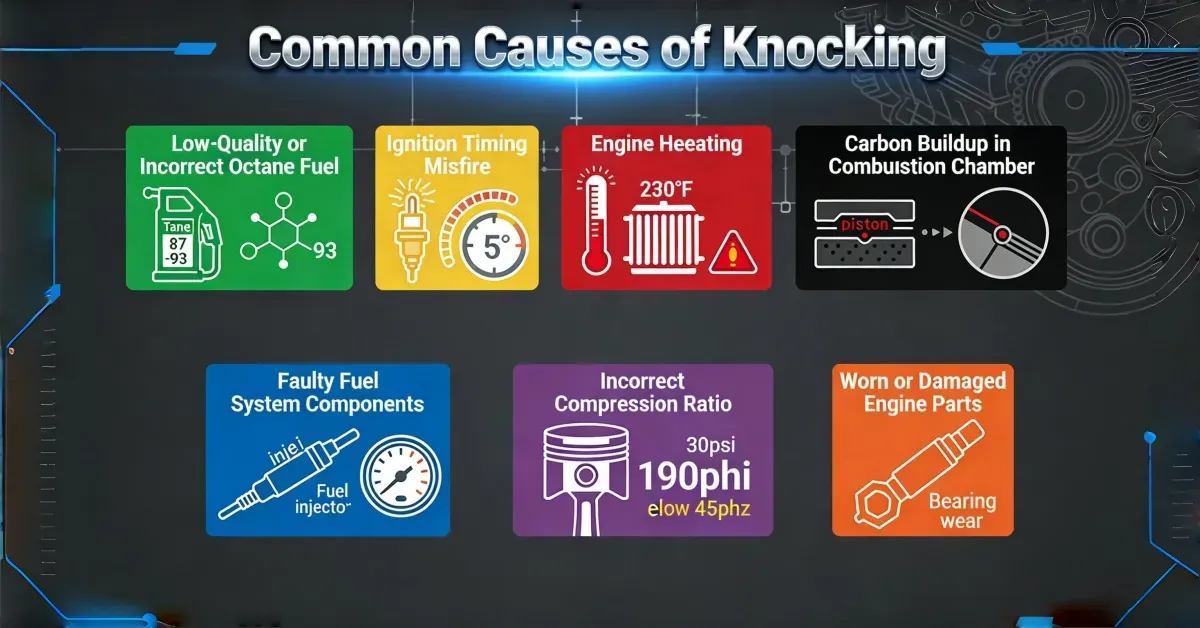
Engine knock stems from a breakdown in the air-fuel combustion process, triggered by one or more of these common issues. Each cause disrupts the delicate balance of fuel quality, timing, or engine conditions needed for smooth combustion:
1. Low-Quality or Incorrect Octane Fuel
The #1 cause of engine knock is using fuel with an octane rating lower than the engine requires. Octane rating measures a fuel’s resistance to spontaneous combustion—higher octane fuels can withstand more pressure and heat before igniting.
- Why It Happens: Engines with high compression ratios (e.g., turbocharged, supercharged, or performance engines) require premium fuel (91+ octane). Using regular (87 octane) fuel causes the mixture to detonate prematurely under high pressure.
- Example: A turbocharged Honda Civic Type R (compression ratio 10.3:1) running on 87 octane will almost always knock under acceleration, as the fuel can’t handle the turbo’s added pressure.
2. Ignition Timing Misfire
Ignition timing refers to when the spark plug fires relative to the piston’s position. If the spark fires too early (advanced timing), the air-fuel mixture has more time to compress and heat up—leading to premature detonation.
- Common Triggers: Faulty knock sensor (fails to adjust timing when knock is detected), worn timing belt/chain (shifts timing), or aftermarket tuning that advances timing too aggressively.
- Diagnostic Clue: Knock occurs consistently at specific RPM ranges (e.g., 2,500–3,500 RPM) even with high-octane fuel.
3. Engine Overheating
Excessive engine temperature (above 240°F / 116°C) increases the likelihood of knock by raising the temperature of the combustion chamber. Heat reduces fuel’s resistance to detonation and accelerates pre-ignition.
- Root Causes: Cooling system failures (leaks, faulty thermostat, clogged radiator), low coolant levels, or prolonged driving in extreme heat (100°F+ / 38°C+) with heavy loads.
- SAE Data: SAE’s Thermal Management Report found that engine temps above 250°F increase knock risk by 200%, as heat-soaked cylinder heads act as a “hot spot” that ignites fuel prematurely.
4. Carbon Buildup in the Combustion Chamber
Over time, unburned fuel and oil residue form carbon deposits on the cylinder head, pistons, and valves. These deposits act as insulation, trapping heat and creating hot spots that trigger premature ignition.
- High-Risk Engines: Direct-injection (DI) engines (e.g., Ford EcoBoost, Volkswagen TSI) are particularly prone to carbon buildup, as fuel doesn’t wash over the intake valves like in port-injection systems.
- Symptom Link: Knock worsens over time (as deposits grow) and is most noticeable during cold starts or light acceleration.
5. Faulty Fuel System Components
Problems with fuel delivery can disrupt the air-fuel ratio, leading to lean or rich conditions that increase knock risk:
- Lean Mixture: Insufficient fuel relative to air (caused by clogged fuel injectors, weak fuel pump, or restricted fuel lines) raises combustion temperatures, triggering knock.
- Rich Mixture: Excess fuel can lead to incomplete combustion and carbon buildup, creating hot spots.
- Diagnostic Tip: A fuel pressure test (target: 40–60 psi for most modern engines) can reveal weak fuel pumps or clogged lines.
6. Incorrect Compression Ratio
The compression ratio (ratio of cylinder volume at bottom dead center to top dead center) is engineered for specific fuel octane levels. Modifications or wear that increase compression beyond factory specs will cause knock.
- Common Modifications: Performance upgrades like turbocharging, supercharging, or piston replacement (without adjusting for octane) often raise compression ratios.
- Wear-Related Causes: Head gasket failure (allows coolant into the cylinder, reducing effective compression) or worn piston rings (causes low compression, but uneven compression across cylinders can trigger knock).
7. Worn or Damaged Engine Parts
Mechanical wear can create conditions that mimic or cause knock:
- Worn Piston Rings: Allow oil into the combustion chamber, where it burns and forms carbon deposits.
- Damaged Valves: Leaking valves disrupt compression, leading to uneven combustion and knock.
- Crankshaft/Camshaft Issues: Worn bearings or timing misalignment (from camshaft wear) disrupts piston-to-valve timing, increasing knock risk. For more on these components, visit our Symptoms of a Bad Crankshaft or Camshaft guide.
Mechanical vs Fuel Detonation Knock
Not all engine knock is the same—distinguishing between mechanical knock and fuel detonation knock is critical to solving the problem. Here’s how to tell them apart:
Fuel Detonation Knock (Most Common)
- Cause: Fuel quality, ignition timing, overheating, or carbon buildup (issues with the combustion process).
- Sound: Sharp, high-pitched ping or tick—often described as “marbles rattling in a can.”
- Occurrence: Happens under load (acceleration, towing) or high RPM; improves when you release the gas pedal.
- Temporary Fix: Switching to higher-octane fuel or reducing engine load often reduces or eliminates the noise.
- Long-Term Fix: Address the root cause (e.g., replace fuel, clean carbon deposits, repair cooling system).
Mechanical Knock (More Severe)
- Cause: Worn or damaged engine parts (e.g., piston slap, rod knock, valve train wear).
- Sound: Deep, dull hammering or knocking—louder and more rhythmic than fuel detonation.
- Occurrence: Present at idle or low RPM; worsens with acceleration. Doesn’t improve with fuel changes.
- Example: Piston slap (worn piston rings allowing piston movement) creates a “clacking” noise at cold startup, while rod knock (worn connecting rod bearings) produces a heavy “knock-knock” that increases with RPM.
- Urgency: Requires immediate inspection—mechanical knock indicates parts are already wearing or failing.
Quick Diagnostic Test to Differentiate
- Fuel Swap Test: Fill the tank with premium fuel (91+ octane) and drive under load. If the noise disappears, it’s fuel detonation.
- Load Test: Accelerate uphill or tow a light load. Fuel knock worsens; mechanical knock remains consistent or gets louder.
- Idle Test: Let the engine idle in neutral. Mechanical knock is often audible at idle; fuel knock is not.
Immediate Steps to Take When You Hear Knock
Ignoring engine knock, even for a short time, can cause permanent damage. Follow these steps to minimize risk until you can complete a full diagnosis:
1. Reduce Engine Load Immediately
- Release the gas pedal to lower RPM and reduce cylinder pressure.
- Avoid acceleration, towing, or driving uphill—keep the engine at a steady, low RPM (1,500–2,000 RPM).
- If the knock is severe (loud hammering), pull over to a safe location and turn off the engine. Do not restart until inspected.
2. Switch to Higher-Octane Fuel
- If you suspect fuel quality is the issue, top up the tank with premium fuel (91+ octane). Even a partial fill can raise the octane rating enough to reduce knock temporarily.
- Avoid “octane boosters” as a long-term solution—they only provide a temporary octane increase and don’t fix the root cause.
3. Check for Overheating
- Monitor the temperature gauge—if it’s above 220°F (104°C), turn on the heater to full blast (draws heat from the engine) and pull over.
- Let the engine cool for 30+ minutes before checking coolant levels (never open the radiator cap when hot). Top up with the correct coolant if levels are low.
4. Avoid High RPM and Short Trips
- Until the issue is fixed, limit driving to necessary trips only.
- Keep RPM below 3,000 and avoid sustained high speeds—this reduces cylinder pressure and heat.
5. Schedule a Diagnostic Inspection
- For fuel detonation knock: Have a mechanic check fuel pressure, ignition timing, and carbon deposits (use a bore scope to inspect the combustion chamber).
- For mechanical knock: Request a compression test and leak-down test to check for worn parts (pistons, rods, valves).
FAQ
Q1: Can fuel additives fix engine knock?
It depends on the cause:
- Yes (Temporarily): Additives designed to clean carbon deposits (e.g., Techron, Sea Foam) can reduce knock caused by carbon buildup—they dissolve deposits that create hot spots.
- No (Permanently): Additives won’t fix knock from low octane fuel, timing issues, or mechanical wear. They’re a band-aid, not a solution.
- Pro Tip: Use additives as part of regular maintenance (every 10,000 miles) to prevent carbon buildup, but don’t rely on them to resolve existing knock.
Q2: Will engine knock damage my engine immediately?
Mild, occasional knock won’t cause immediate damage, but repeated or severe knock will:
- Short-Term (Weeks): Wear on piston rings and cylinder walls, reduced fuel efficiency.
- Long-Term (Months): Piston warping, cracked cylinder heads, or rod bearing failure.
- Critical Note: Severe knock (loud hammering) can cause piston damage in minutes—stop driving immediately.
Q3: How do I know if my knock sensor is faulty?
The knock sensor detects knock and tells the ECU to adjust timing to fix it. A faulty sensor won’t trigger this adjustment, leading to persistent knock. Signs of a bad knock sensor:
- Knock occurs even with high-octane fuel.
- Check Engine Light (CEL) with code P0325 (knock sensor circuit malfunction).
- Poor fuel efficiency and reduced power.
- Verify with a multimeter: Test the sensor’s resistance against OEM specs (found in OEM knock sensor documentation).
Q4: Can a dirty air filter cause engine knock?
Indirectly, yes. A clogged air filter restricts airflow, creating a rich air-fuel mixture (too much fuel, too little air). Rich mixtures burn incompletely, leading to carbon buildup and hot spots that trigger knock. Replacing a dirty air filter is a simple, low-cost preventive measure.
Q5: Is engine knock more common in turbocharged engines?
Yes—turbocharged engines are 2–3x more prone to knock due to higher cylinder pressure and heat. Turbochargers compress air, increasing combustion chamber pressure, which requires higher-octane fuel and precise timing. To prevent knock in turbo engines:
- Always use the recommended octane fuel (91+).
- Keep the turbo system clean (replace air filters, inspect intercoolers).
- Avoid aggressive driving when the engine is cold.
Conclusion
Engine knock is a warning you can’t afford to ignore—whether it’s fuel-related detonation or mechanical wear, addressing it quickly saves you from costly engine repairs. By learning to identify the type of knock, pinpointing its cause, and taking immediate action, you can protect your vehicle’s engine and extend its lifespan.
Linkteco offers a full line of engine components designed to resolve and prevent knock, including high-quality fuel injectors, ignition coils, knock sensors, and piston rings. All our parts meet OEM specs and are tested to withstand extreme pressure and heat—backed by ISO 9001 and IATF 16949 certifications.
For deeper insights into engine components and their role in preventing knock, explore our Automotive Engine Parts Glossary. If you’re dealing with a persistent knock or need help selecting the right parts for your repair, contact our ASE-certified technical team for personalized support.
Don’t let engine knock turn into a catastrophic failure:
- Browse our engine parts collection to find replacement components.
- Request a free diagnostic guide tailored to your vehicle make and model.
- Schedule a consultation with our team to optimize your engine’s performance and prevent future knock.
Linkteco—Your Trusted Partner for High-Performance Engine Parts, Diagnostic Expertise, and Reliable Solutions.

Contact
©2026 LinkTeco All Rights Reserved.