

Harness Speed: The Ultimate Guide to Turbo and Superchargers
What Turbochargers Do
Core Components & How They Work
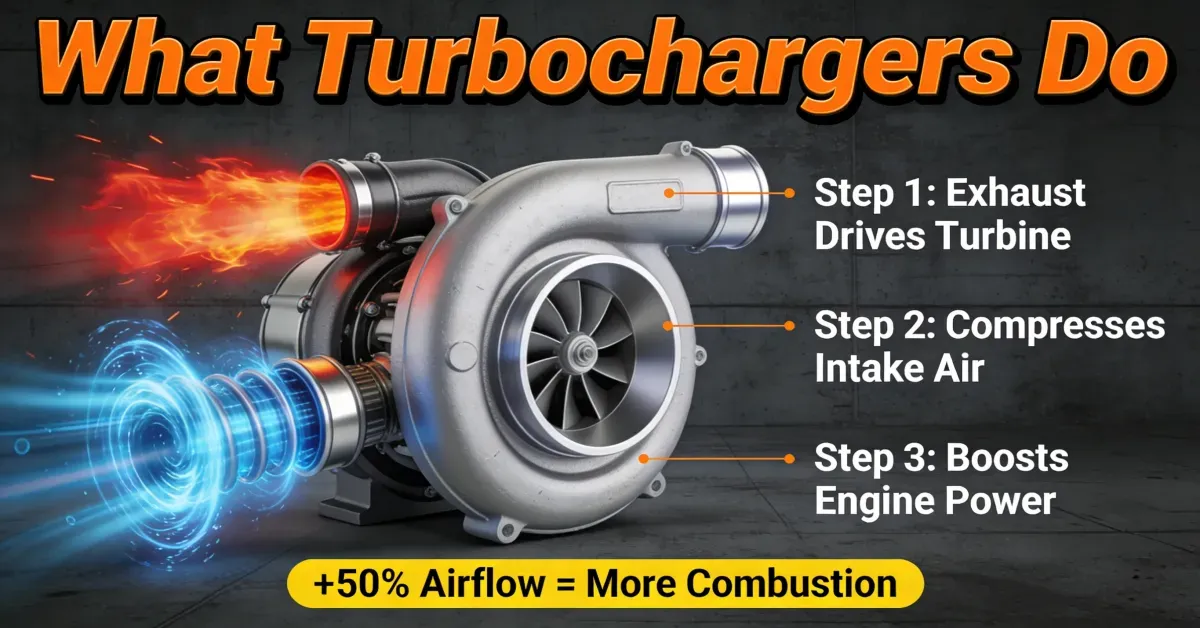
A turbo has two key halves connected by a shared shaft, housed in a single unit:Turbine Housing (Hot Side): Mounted to the exhaust manifold, this captures high-pressure exhaust gases. As gases flow through, they spin a turbine wheel (typically made of heat-resistant Inconel alloy) at speeds up to 150,000 RPM—far faster than any engine’s crankshaft.
Compressor Housing (Cold Side): On the opposite end, the spinning shaft turns a compressor wheel. This wheel draws in ambient air, compresses it (increasing its density), and pushes it into the engine’s intake manifold.
Supporting Parts: A wastegate (regulates exhaust flow to prevent overboosting), intercooler (cools compressed air to increase density), and boost controller (manages pressure) work together to keep the turbo efficient and safe.
Key Advantages of Turbochargers
SAE’s 2024 induction study found that turbos deliver 20–40% more power than naturally aspirated engines of the same size, with these stand-out benefits:Better Fuel Efficiency: Turbos only work when extra power is needed (e.g., accelerating). At idle or cruising, they act like a naturally aspirated engine, using less fuel than a supercharger.
High-Top-End Power: Turbos shine at high RPM (3,000+), where exhaust flow is strongest. This makes them perfect for highway passing and track driving, where sustained high power is key.
Flexible Tuning: Aftermarket turbos can be adjusted to deliver more boost (e.g., from 10 psi to 15 psi) with a simple tune, unlocking even more power potential.
Compact Size: Turbos fit in tight engine bays, making them easy to install in most vehicles—even small hatchbacks.
The Big Drawback: Turbo Lag
The biggest complaint about turbos is lag—a delay between pressing the gas pedal and the turbo kicking in. This happens because the turbine needs time to spin up to speed: at low RPM, there’s not enough exhaust flow to generate boost, so the engine feels sluggish until the turbo “spools” (typically around 2,000–3,000 RPM).Modern solutions like twin-scroll turbos (split turbine housing to improve low-RPM flow) and electric turbochargers (use a motor to spin the turbine at low RPM) have reduced lag, but it’s still noticeable compared to superchargers.
What Superchargers Do
Core Types & Operation
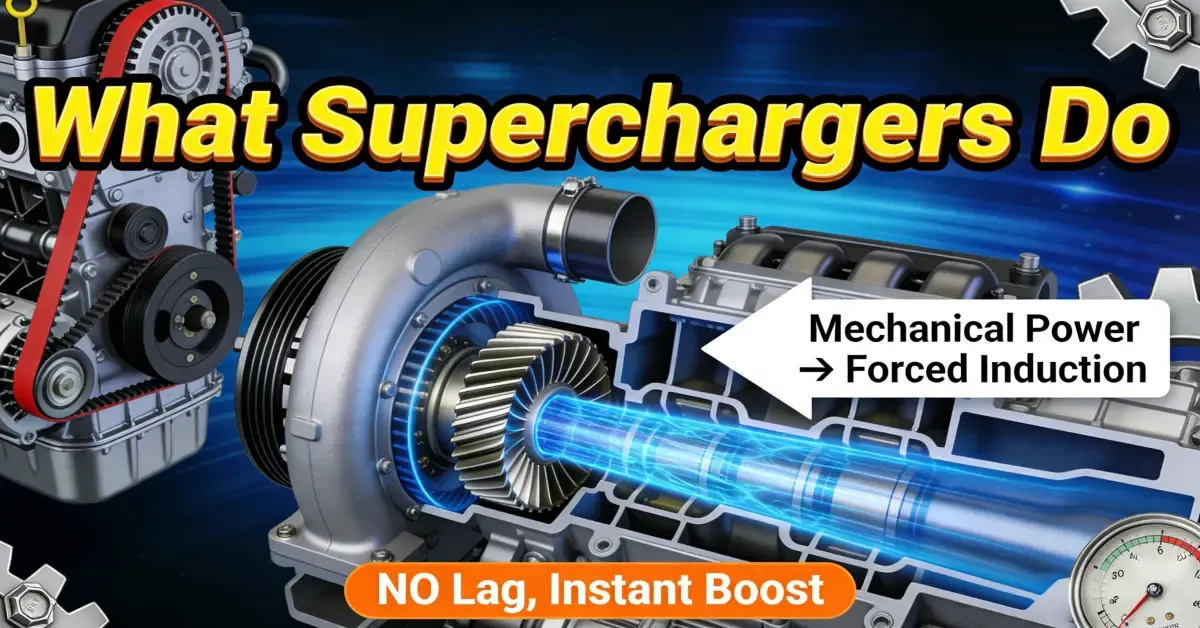
Superchargers come in three main designs, each with unique characteristics. According to leading boosting system manufacturers, these are the most common:Roots Supercharger: The oldest design (used on early Ford Mustangs and Dodge Chargers). It uses two interlocking lobes to trap and force air into the engine. Delivers massive low-end torque but is less efficient at high RPM. Known for its distinctive “whine” sound.
Centrifugal Supercharger: Works like a tiny turbo but is driven by the crankshaft instead of the exhaust. It uses a spinning impeller to compress air, delivering a more linear power curve (similar to a turbo) but with no lag. Popular for street rods and import cars.
Twin-Screw Supercharger: A modern upgrade to Roots-style. Two screw-shaped rotors mesh together to compress air, balancing low-end torque and high-RPM efficiency. Used on high-performance vehicles like the Ford F-150 Raptor and Jaguar F-Type.
Key Advantages of Superchargers
For drivers who prioritize throttle feel over maximum efficiency, superchargers have clear benefits:No Lag: Instant power from idle to redline. This is critical for off-roading (needing torque to climb rocks) and drag racing (quick 0–60 mph times).
Simple Installation: No need to modify exhaust systems (unlike turbos). Most aftermarket kits bolt directly to the engine, making them easier for DIYers to install.
Linear Power Delivery: Power increases steadily with RPM, making the engine feel more predictable and natural to drive—great for beginners or classic car purists.
Durability: Fewer moving parts than turbos (no wastegate or intercooler required for some models) and less heat exposure, leading to longer lifespan with basic maintenance.
The Big Drawback: Engine Parasitic Loss
Since superchargers are driven by the engine, they use some of the engine’s power to operate—this is called parasitic loss. At high RPM, a supercharger can siphon off 10–20% of the engine’s power, reducing overall efficiency. This means worse fuel economy than a turbo, especially during highway driving, where the supercharger is always working.
Key Differences (Cost, Power Curve, Lag)
The choice between turbo and supercharger often comes down to trade-offs in cost, performance, and daily usability. Below is a detailed comparison of the most critical factors, based on real-world data from SAE and automotive manufacturers:Factor | Turbocharger | Supercharger | Winner for… |
|---|---|---|---|
Cost (Parts + Installation) | $2,500–$5,000 (more if exhaust mods are needed) | $2,000–$4,000 (simpler installation) | Budget-conscious DIYers |
Power Curve | Non-linear: Low power at low RPM, sharp boost at 2,500+ RPM | Linear: Steady power from idle to redline | Predictable daily driving/off-roading |
Lag | Noticeable (0.5–1 second delay at low RPM) | None—immediate throttle response | Drag racing/quick acceleration needs |
Fuel Efficiency | 3–5 MPG better than supercharger (only works when needed) | Worse (constant parasitic loss) | Daily commuters/highway drivers |
Top-End Power | Higher (up to 50% power gain with aftermarket kits) | Moderate (30–40% power gain) | Track enthusiasts/high-RPM driving |
Maintenance | Higher: Change turbo oil every 5,000 miles; intercooler cleaning | Lower: Check belt tension; occasional oil change | Drivers wanting low upkeep |
Heat Output | High (exhaust proximity; needs intercooler) | Moderate (no exhaust contact) | Engine bays with limited space |
Which Is Better for Your Use Case
There’s no “one-size-fits-all” answer—your vehicle, driving habits, and goals will determine the best choice. Below are the most common scenarios and our expert recommendations:1. Daily Commuting & Highway Driving
Best Choice: TurbochargerWhy? Turbos strike the perfect balance between power and fuel efficiency. You’ll get extra oomph for merging onto highways, but the turbo will disengage during steady cruising—saving gas. Modern turbos (like those in the Honda Civic Type R or BMW 330i) have minimal lag, making them smooth for stop-and-go traffic.2. Drag Racing & 0–60 mph Speed
Best Choice: Supercharger (or Twin-Turbo)Why? Drag racing is all about instant torque off the line—and superchargers deliver that. A roots-style supercharger on a Dodge Challenger Hellcat can hit 0–60 mph in 3.4 seconds, thanks to no lag. For extreme power, twin-turbo setups (two small turbos) reduce lag and deliver more top-end power than a single supercharger.3. Off-Roading & Heavy Towing
Best Choice: SuperchargerWhy? Off-roading requires low-end torque to climb rocks or mud—superchargers deliver power at 1,000 RPM, where turbos are still spooling. Towing heavy loads (e.g., a boat or trailer) also benefits from linear power—no sudden boost surges that can cause the vehicle to jerk.4. Classic Cars & Muscle Cars
Best Choice: SuperchargerWhy? Classic engines (e.g., 1960s Ford 302 or Chevy 350) have simple designs that pair well with superchargers. No need to modify exhaust systems (a big plus for preserving originality), and the supercharger’s “whine” complements the classic V8 rumble. Brands like Edelbrock and Weiand make bolt-on kits for most classic muscle cars.5. Track Racing & High-RPM Driving
Best Choice: TurbochargerWhy? Tracks require sustained high-RPM power, and turbos excel here. A turbocharged Porsche 911 GT3 RS can maintain 500+ horsepower at 7,000 RPM, outperforming supercharged rivals on long straights. Intercoolers also help keep intake air cool during extended track sessions, preventing power loss from heat soak.6. Small Displacement Engines (1.0L–2.0L)
Best Choice: TurbochargerWhy? Small engines don’t generate enough crankshaft power to drive a supercharger efficiently (parasitic loss would negate power gains). Turbos, however, use exhaust gases that would otherwise be wasted—making them ideal for small cars like the Toyota Yaris or Hyundai Elantra.FAQ
Forced induction questions often boil down to torque, reliability, and practicality. Below are answers to the most common ones, backed by SAE data and manufacturer specs:Q1: Which increases torque more—turbocharger or supercharger?
It depends on RPM, but superchargers win at low RPM, while turbos win at high RPM:Low RPM (1,000–3,000): Superchargers deliver 20–30% more torque. A 5.7L Hemi V8 with a roots supercharger makes 450 lb-ft of torque at 2,000 RPM—vs. 350 lb-ft for the same engine with a turbo (which hasn’t spooled yet).
High RPM (3,000+): Turbos take over. The same Hemi with a twin-turbo kit makes 550 lb-ft at 5,000 RPM—vs. 480 lb-ft for the supercharged version.
Q2: Will adding a turbo or supercharger damage my engine?
Only if installed incorrectly. Modern engines are built to handle moderate boost (8–12 psi) with no issues. To avoid damage:Use a kit designed for your specific engine (avoid universal kits).
Upgrade supporting parts: colder spark plugs, high-flow fuel injectors, and a stronger clutch (for manual transmissions).
Get a professional tune to adjust fuel and ignition timing (critical for preventing detonation).
Q3: Do turbos or superchargers require premium gas?
Yes—both. Compressed air increases cylinder pressure and temperature, so using low-octane gas (87 octane) can cause detonation (knocking), which damages pistons and valves. Most boosted engines require 91 octane or higher. The extra cost at the pump is offset by better performance and fuel efficiency (for turbos).Q4: Can I install a turbo and supercharger together (twin-charging)?
Yes, but it’s complex and expensive. Twin-charging uses a supercharger for low-end torque and a turbo for high-RPM power—eliminating lag while maximizing top-end performance. Examples include the Volvo XC90 T8 and the now-discontinued Volkswagen Golf R400. However, the kit costs $6,000–$10,000, and installation requires extensive engine modifications. It’s only worth it for serious performance enthusiasts.Q5: Are turbo/supercharger upgrades legal?
It depends on your location. In the U.S., the EPA requires aftermarket parts to be CARB-certified (California Air Resources Board) to be street-legal. Most major brands (e.g., BorgWarner, Edelbrock) offer CARB-certified kits. Check your state’s emissions laws—California and New York have stricter rules than states like Texas or Florida. Off-road-only kits are cheaper but illegal for street use.Conclusion
The turbocharger vs supercharger debate comes down to what you value most: if you want instant power for off-roading, drag racing, or classic cars, go with a supercharger. If you prioritize fuel efficiency, top-end power, or drive a small-displacement engine, a turbocharger is the better choice. Both options deliver transformative performance—turning a mild-mannered daily driver into a thrill machine. At Linkteco, we make forced induction easy for both beginners and experts. Our CARB-certified turbo and supercharger kits are designed for 95% of popular vehicles (Ford, Chevy, Toyota, BMW) and include everything you need: parts, installation guides, and access to our ASE-certified technicians. We also offer personalized tuning services to ensure your boosted engine runs smoothly and reliably. Not sure which kit fits your vehicle? Visit our Automotive Engine Parts Glossary to learn more about turbo and supercharger components, or browse our model-specific comparisons to see real-world results. For a free consultation, reach out to our team—we’ll help you choose the perfect forced induction system to harness speed and power, tailored to your driving style.
Contact
©2026 LinkTeco All Rights Reserved.