

Choosing Engine Bearings Made Easy: The Ultimate Buying Guide
What Engine Bearings Do
Engine bearings are precision components designed to support rotating engine parts while minimizing friction, heat, and wear. Their primary role is to create a controlled, low-friction interface between moving components—most critically between the crankshaft, connecting rods, and engine block.
Rather than allowing metal-to-metal contact, engine bearings rely on a thin, pressurized film of engine oil to separate surfaces during operation. This hydrodynamic oil film carries engine loads, absorbs shock from combustion forces, and enables smooth rotational movement even under extreme pressure and high RPM conditions.
There are several key functions that engine bearings perform inside an engine:
Load Support: Bearings carry the immense radial and axial loads generated during combustion and crankshaft rotation.
Friction Reduction: By maintaining an oil film, bearings dramatically reduce friction compared to direct metal contact.
Heat Dissipation: Bearings transfer heat away from rotating components into the engine block and oil system.
Alignment Control: Properly sized bearings help maintain crankshaft and connecting rod alignment, preserving correct engine geometry.
Because bearings are sacrificial components, they are engineered to wear before more expensive parts such as crankshafts or engine blocks. When correctly selected and installed, high-quality bearings significantly extend engine service life and protect core components from catastrophic damage.
For professional buyers and engine builders, understanding bearing function is essential to making informed decisions about material selection, clearance tolerances, and long-term engine reliability.
Bearing Material Types (Steel, Bi-metal, Tri-metal)
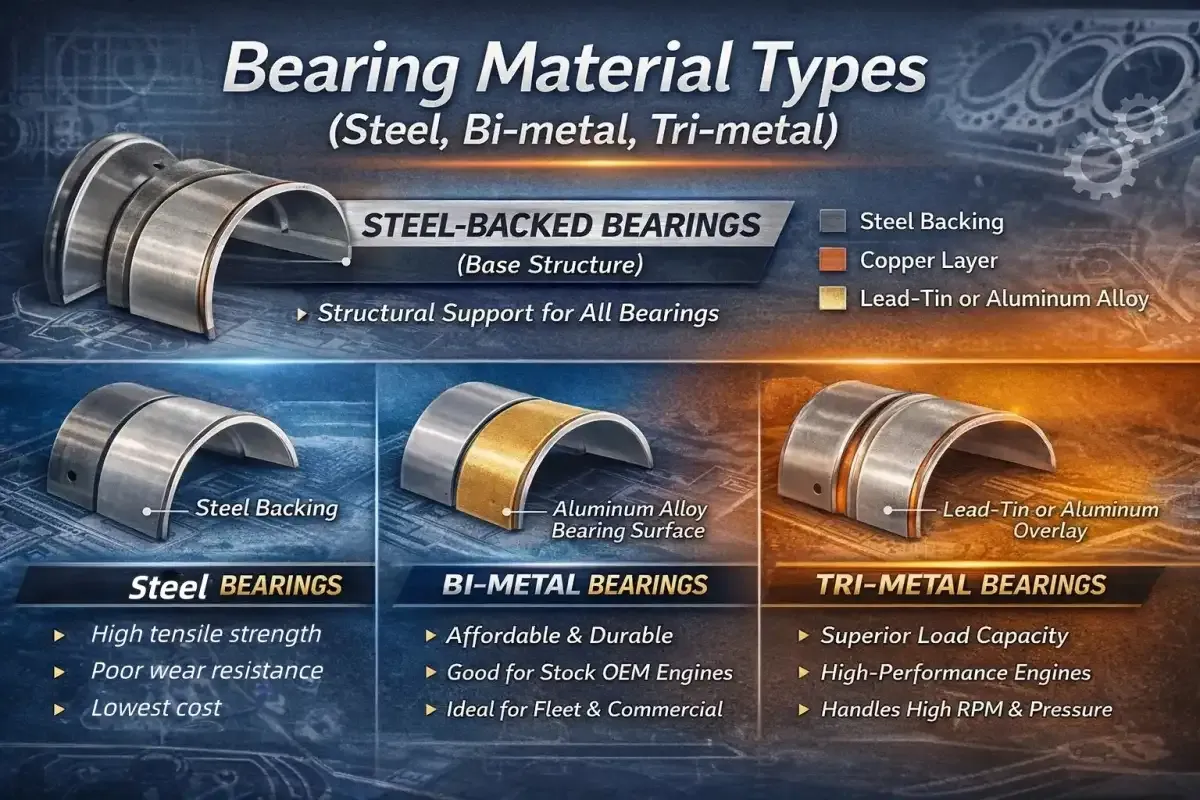
1. Steel Bearings (Monometallic)
Steel bearings are the most basic option, made from a single piece of hardened steel (typically chromium or nickel-chromium alloy). They’re rare in modern engines but still used in some low-load, low-cost applications.Key Characteristics:Strength: High tensile strength, resistant to deformation under light loads.
Wear Resistance: Poor—steel-on-steel contact (without a soft overlay) leads to rapid wear if oil pressure drops.
Cost: Lowest among all bearing materials (30–50% cheaper than bi-metal).
2. Bi-metal Bearings
Bi-metal bearings (also called “two-layer” bearings) are the industry standard for most modern passenger cars and light trucks. They consist of a steel backing (for strength) and a thin layer (0.005–0.010 inches) of soft material (typically aluminum-tin or copper-lead alloy) bonded to the steel.Key Characteristics:Strength + Conformability: The steel backing provides structural strength, while the soft overlay conforms to minor imperfections in the crankshaft journal (reducing the risk of “seizure” if alignment is slightly off).
Wear Resistance: Good—aluminum-tin alloys resist wear in normal operating conditions (oil pressure ≥5 psi at idle).
Cost: Mid-range (2–3x more expensive than steel, but 30% cheaper than tri-metal).
Oil Compatibility: Works with standard mineral oils and synthetic blends (common in passenger cars).
3. Tri-metal Bearings
Tri-metal bearings (three-layer) are premium components designed for high-load, high-performance, or heavy-duty applications. They feature a steel backing, a middle layer of copper-lead alloy (for load capacity), and a thin overlay (0.0005–0.001 inches) of soft material (typically tin-lead or lead-indium) for conformability and wear resistance.Key Characteristics:Extreme Load Capacity: The copper-lead middle layer handles up to 3x more load than bi-metal bearings (ideal for high-compression engines).
Wear + Seizure Resistance: Excellent—the soft overlay acts as a “sacrificial layer,” wearing slowly and preventing the crankshaft from seizing even if oil pressure drops temporarily.
Heat Resistance: Performs well at high temperatures (up to 300°F), making it suitable for turbocharged or supercharged engines.
Cost: Premium (3–4x more expensive than bi-metal).
How to Select Proper Bearing Clearance
Bearing clearance (the gap between the bearing and the crankshaft journal) is just as critical as material—too tight, and the bearing will starve for oil (causing overheating); too loose, and the crankshaft will wobble (leading to excessive wear and noise). For B2B buyers, understanding clearance selection ensures you source parts that match your customers’ engine rebuild specs.What Is Bearing Clearance & Why It Matters
Bearing clearance is the radial gap between the inner surface of the bearing and the outer surface of the crankshaft journal. It’s measured in thousandths of an inch (0.001”) or millimeters (0.025mm). The clearance must be large enough to allow oil to flow into the gap (creating the critical oil film) but small enough to keep the crankshaft centered.According to manufacturer tolerance charts, incorrect clearance is the second leading cause of bearing failure (after material mismatch). For example:Too Tight (≤0.0005” for passenger cars): Oil can’t flow into the gap—metal-on-metal contact causes rapid wear, overheating, and seizure.
Too Loose (≥0.003” for passenger cars): Crankshaft wobble creates “knocking” noise, increases oil consumption, and wears the bearing edges.
Engine Type/Application | Recommended Clearance (Inches) | Key Considerations |
|---|---|---|
Passenger Cars (Naturally Aspirated, 1.0L–3.5L) | 0.0010”–0.0020” | Use bi-metal bearings; standard clearance for daily driving |
High-Performance Cars (Turbocharged/Supercharged) | 0.0015”–0.0025” | Tri-metal bearings; slightly larger clearance to handle heat expansion |
Heavy-Duty Diesel Trucks (5.0L+) | 0.0020”–0.0030” | Tri-metal bearings; larger clearance for high oil flow (handles heavy loads) |
Classic Cars (Older Engines, Loose Tolerances) | 0.0020”–0.0030” | Bi-metal or tri-metal; compensates for worn crankshaft journals |
Racing Engines (Extreme RPM) | 0.0025”–0.0035” | Tri-metal bearings; maximum oil flow to prevent heat soak |
How to Verify Clearance (For Your Customers)
As a B2B supplier, you should advise your customers to verify clearance before installation. The most common method is the “plastic gauge test”:Clean the crankshaft journal and bearing surface.
Place a strip of plastic gauge (included in most bearing kits) across the journal.
Install the bearing cap and torque to OEM specs (do not rotate the crankshaft).
Remove the cap and measure the width of the compressed gauge with the included scale—this equals the clearance.
Common Mistakes Buyers Make
B2B buyers often fall into avoidable traps when sourcing engine bearings—these mistakes lead to excess inventory, customer returns, and lost revenue. Below are the most common errors and how to avoid them:1. Prioritizing Price Over Quality
Many buyers opt for the cheapest bearings to cut costs, but this backfires. Low-cost bearings (e.g., generic steel bearings) have inconsistent material quality and tolerances—leading to premature failure, customer complaints, and costly rework. Solution: Source from reputable manufacturers (like Linkteco) that meet SAE J2432 standards. The slightly higher upfront cost is offset by lower return rates and customer trust.2. Ignoring Application-Specific Needs
Buying a “one-size-fits-all” bearing (e.g., bi-metal for a heavy-duty diesel truck) is a recipe for failure. Each engine type has unique load, heat, and oil flow requirements. Solution: Create a procurement checklist for your team: engine make/model, displacement, fuel type (gas/diesel), turbocharged/supercharged, and operating conditions (fleet/daily driver/racing). Use this to match bearings to the application.3. Overlooking Clearance Tolerances
Assuming all bearings of the same size have the same clearance is a common mistake. Bearings are often sold in “standard” (OEM) or “oversized” (0.001”, 0.002”, 0.003”) clearances to accommodate worn crankshafts. Solution: Stock both standard and oversized options for high-demand engine models. Label inventory clearly by clearance to avoid misorders.4. Not Checking Material Compatibility with Oil
Modern low-phosphate oils (required for emissions compliance) can corrode copper-lead bearings, but many buyers don’t realize this. Solution: Prioritize aluminum-tin bi-metal bearings and lead-indium tri-metal bearings—they’re compatible with modern oils. Avoid copper-lead bearings for post-2010 vehicles.5. Failing to Validate Supplier Quality
Bulk purchasing from unvetted suppliers can lead to inconsistent quality (e.g., uneven overlay thickness, poor bonding between layers). Solution: Partner with suppliers that provide material certification (per bearing material studies) and tolerance reports. Request sample bearings for testing before placing large orders.FAQ
Q1: Are tri-metal bearings always better than bi-metal?
No—“better” depends on the application. Tri-metal bearings are superior for high-load, high-heat applications (diesel trucks, performance engines), but they’re overkill (and more expensive) for standard passenger cars. For daily driver rebuilds, bi-metal bearings offer the best balance of cost and reliability. As a buyer, stock both to cover all customer needs.Q2: Can I mix bearing materials (e.g., tri-metal main bearings + bi-metal rod bearings)?
Not recommended. Mixing materials creates inconsistent load distribution and wear rates—leading to premature failure of the weaker bearing. Advise your customers to use the same material for all main and rod bearings in a single engine rebuild.Q3: How does bearing clearance affect oil pressure?
Larger clearance reduces oil pressure (more oil flows through the gap), while smaller clearance increases pressure. For example, a clearance of 0.003” (loose) can reduce oil pressure by 15–20% vs. a standard 0.0015” clearance. This is critical for diesel engines, which require high oil pressure to handle heavy loads—avoid loose clearances for these applications.Q4: What’s the shelf life of engine bearings?
Properly stored (in a dry, temperature-controlled environment, sealed in original packaging), engine bearings have a shelf life of 3–5 years. Avoid storing them in humid areas (can cause rust on steel backings) or near chemicals (can damage the soft overlay). As a B2B buyer, rotate inventory to ensure you’re selling fresh bearings.Q5: Are OEM bearings better than aftermarket?
Not necessarily—reputable aftermarket brands (like Linkteco) manufacture bearings to OEM specs using the same materials and tolerances. OEM bearings are often 20–30% more expensive, making aftermarket a better choice for cost-conscious customers. The key is to source from suppliers with strict quality control (look for IATF 16949 certification).Conclusion
Choosing the right engine bearings as a B2B buyer comes down to three core principles: match the material to the application, select the correct clearance for the engine’s operating conditions, and prioritize quality over short-term cost savings. By following this guide, you’ll stock inventory that meets your customers’ needs, reduce return rates, and build trust as a knowledgeable supplier.At Linkteco, we’re committed to simplifying your engine bearing procurement. Our B2B offerings are designed for bulk buyers like you:Comprehensive Inventory: We stock bi-metal (aluminum-tin) and tri-metal (lead-indium) bearings in standard and oversized clearances for 95% of popular makes/models (Ford, Chevy, Toyota, diesel trucks).
Quality Assurance: All bearings meet SAE J2432 standards and come with material certification and tolerance reports. We source only from ISO 9001-certified manufacturers.
Bulk Pricing Benefits: Take advantage of our volume discounts—the more you order, the lower your per-unit cost. We also offer flexible payment terms for repeat customers.
Technical Support: Our ASE-certified team can help you match bearings to specific engine applications, answer technical questions, and provide training resources for your staff.

Contact
©2026 LinkTeco All Rights Reserved.