

What Happens When Your Oil Pump Fails? Warning Signs & Repairs
What the Oil Pump Does
Before exploring failure, it’s vital to understand the oil pump’s role in keeping your engine healthy. Think of it as the “heart” of the lubrication system—its job is to circulate oil with the right pressure and volume to every critical component. Here’s a step-by-step breakdown of its operation:Oil Intake: The pump draws oil from the oil pan through a pickup tube fitted with a mesh screen (to filter out large debris like metal shavings or dirt). This screen prevents contaminants from entering the pump and causing internal wear.
Pressurization: Inside the pump, rotating gears (gear-type pumps) or rotors (rotor-type pumps) compress the oil, building pressure ranging from 10–20 psi at idle to 40–60 psi at high RPM. This pressure ensures oil reaches even hard-to-access parts like main bearings and valve lifters.
Pressure Regulation: A built-in pressure relief valve prevents excessive pressure (which can damage seals or gaskets). If pressure exceeds the engine’s needs, the valve opens, diverting excess oil back to the oil pan.
Lubrication & Cooling: Pressurized oil flows through a network of galleries (channels) in the engine block and cylinder head, coating bearings, camshafts, and piston pins. Beyond lubrication, the oil absorbs heat from these parts and carries it back to the pan, acting as a secondary cooling system.
Common Symptoms of a Failing Oil Pump
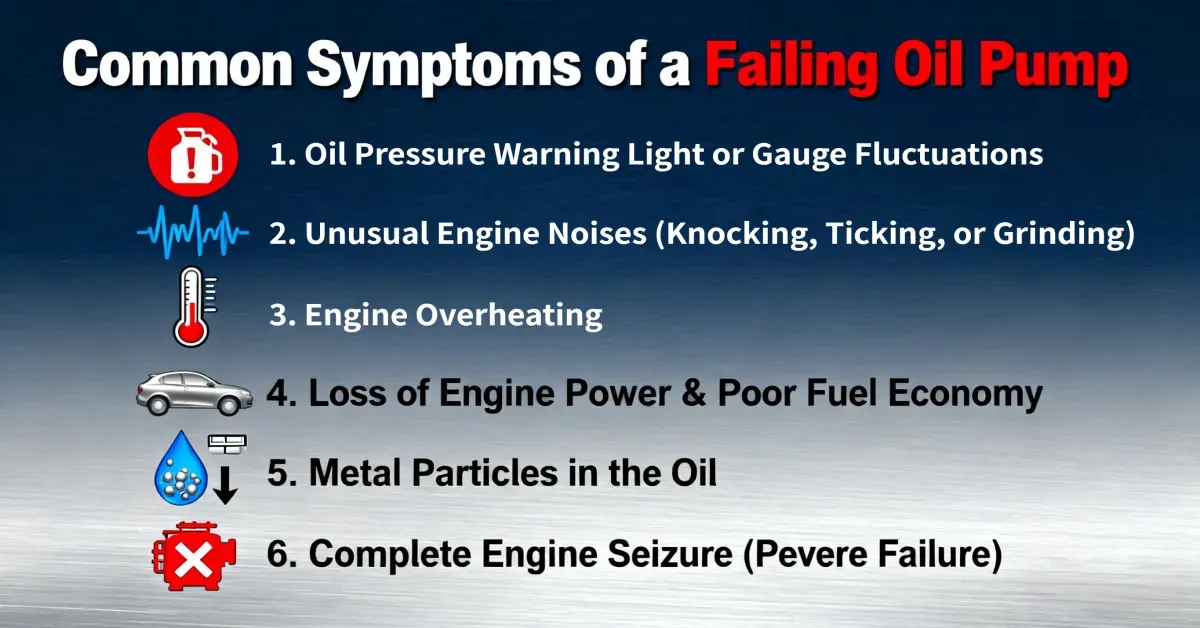
1. Oil Pressure Warning Light or Gauge Fluctuations
The most obvious indicator is the oil pressure warning light (a red icon shaped like an oil can) illuminating on the dashboard. For vehicles with a mechanical gauge, you may notice: Fluctuations: Pressure drops suddenly at idle or rises and falls unpredictably (instead of staying steady).Persistent Low Pressure: Gauge reads below 10 psi at idle (normal is 10–20 psi) or below 35 psi at 2,000 RPM (normal is 40–60 psi).A light that flickers at idle (but goes out when accelerating) often signals early pump wear—oil flow is insufficient when the pump is running slowly, but improves as RPM increases.2. Unusual Engine Noises (Knocking, Ticking, or Grinding)
Without adequate oil pressure, metal parts rub together, creating distinct sounds:Deep Knocking: A rhythmic “knock-knock-knock” that gets louder with RPM indicates crankshaft or rod bearing wear—oil isn’t cushioning the moving parts. This is a direct result of pump failure and requires immediate action.High-Pitched Ticking: A rapid ticking from the top of the engine points to valve train parts (lifters, rockers) starving for oil. While less urgent than bearing noise, it still signals pump issues.Grinding from the Front of the Engine: If the pump’s internal gears or rotors wear out, they can produce a grinding sound (the pump is usually mounted at the front of the engine, near the crankshaft pulley).Tip: Use a long screwdriver as a “stethoscope”—place the metal end on the pump housing and the handle to your ear. A loud grinding noise confirms internal pump damage.3. Engine Overheating
Oil doesn’t just lubricate—it also dissipates heat from high-temperature components like pistons and bearings. A failing pump reduces oil flow, so heat can’t escape. You’ll notice:The Temperature gauge is climbing above 220°F (104°C) during normal driving. Steam or coolant leaks (overheating can damage the cooling system). Overheating and low oil pressure often occur together—addressing one without the other will lead to repeated issues.4. Loss of Engine Power & Poor Fuel Economy
Increased friction from inadequate lubrication makes the engine work harder. This translates to: Sluggish acceleration (the engine struggles to reach higher RPM).A 10–15% drop in fuel efficiency (more energy is wasted on friction than moving the vehicle).Hesitation or misfires (oil-starved components disrupt engine timing). Diesel engines and high-performance vehicles are particularly sensitive to this symptom—their high compression ratios rely on smooth, well-lubricated parts.5. Metal Particles in the Oil
Worn pump gears or rotors shed metal particles that mix with the oil. To check for this: Inspect the oil dipstick: If the oil looks gritty or has a metallic sheen, the pump is wearing out. Check the oil drain plug: Most plugs have a magnet—if it’s covered in fine metal shavings, the pump (or bearings) is failing. These particles act as abrasives, accelerating wear on other components—creating a vicious cycle of damage.6. Complete Engine Seizure (Severe Failure)
If early symptoms are ignored, the pump will stop working entirely. The engine will suddenly stall and won’t restart—attempting to crank it will result in a “locked” feeling (no rotation). This happens when bearings seize to the crankshaft, a catastrophic failure that often requires a full engine replacement.
Causes of Oil Pump Wear
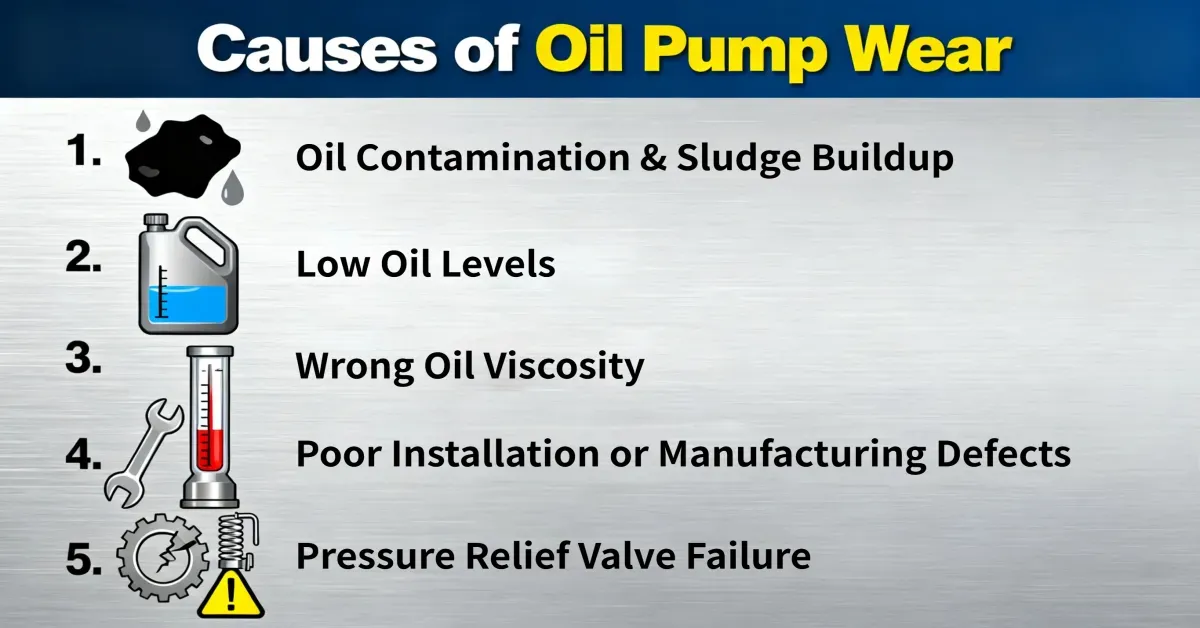
1. Oil Contamination & Sludge Buildup
- The #1 cause of oil pump failure is sludge—a thick, tar-like substance formed by old oil, carbon deposits, and metal particles. Sludge clogs the pump’s pickup screen and internal passages, forcing the pump to work harder. Over time, this wears down gears and rotors. Sludge forms when:
Oil changes are skipped (oil degrades after 5,000–7,500 miles).
Low-quality oil (or the wrong viscosity) is used.
The engine overheats repeatedly (breaks down oil additives).
2. Low Oil Levels
If the oil pan is low on oil, the pump’s pickup tube can’t draw enough fluid. This causes “cavitation”—air bubbles form in the oil, which collapse inside the pump and erode metal components. Cavitation leaves pitting on the pump’s gears, reducing efficiency and leading to failure.3. Wrong Oil Viscosity
- Oil viscosity (thickness) directly impacts pump performance:
Too Thin Oil: Thin oil (e.g., 5W-20 in a high-mileage truck) slips past the pump’s gears, reducing pressure and causing the pump to spin faster than needed.
Too Thick Oil: Thick oil (e.g., 20W-50 in a cold climate) forces the pump to work harder, straining gears and bearings. This is common in winter, when cold oil becomes more viscous. Always follow SAE viscosity standards and your engine’s OEM guidelines.
4. Poor Installation or Manufacturing Defects
Installation Errors: A misaligned pump (not properly bolted to the engine block) causes uneven gear wear. Using the wrong gasket or sealant can block oil passages, starving the pump.
Low-Quality Parts: Cheap, non-OEM pumps often have inconsistent gear spacing or weak materials (e.g., plastic rotors instead of steel).
Linkteco’s oil pumps are tested to IATF 16949 standards, ensuring OEM-level durability.
5. Pressure Relief Valve Failure
The pressure relief valve prevents the pump from generating too much pressure. If the valve gets stuck closed, pressure builds up inside the pump, straining gears. If it sticks open, the pump wastes energy circulating oil back to the pan, leading to low pressure and overheating.
How Oil Pump Failure Damages Bearings
Oil pump failure and bearing damage are inseparable—one quickly leads to the other. Here’s the destructive chain reaction, building on our previous guide:Oil Film Collapse: Bearings rely on a 0.001–0.003-inch oil film to separate their soft babbitt alloy from the crankshaft’s hard journal. A failing pump can’t maintain the 5–10 psi needed to keep this film intact.
Metal-to-Metal Contact: With no oil cushion, the bearing rubs directly against the crankshaft. At 1,000 RPM, this friction grinds away the babbitt alloy, creating metal shavings that contaminate the oil.
Heat Buildup: Friction generates temperatures exceeding 500°F (260°C), melting the remaining bearing material. The molten alloy bonds to the crankshaft, creating uneven “hot spots” that wear the journal into an egg shape.
Seizure: A seized bearing locks the crankshaft, bending connecting rods or cracking the cylinder block. At this point, bearing replacement alone isn’t enough—you’ll need a crankshaft rebuild or full engine swap.
Diagnostic Tests for Oil Pressure
To confirm oil pump failure (and rule out other issues like a faulty sensor), use these diagnostic methods—split into DIY and professional techniques:DIY Diagnostic: Manual Oil Pressure Gauge Test
This test costs $30–$60 and takes 30 minutes, and it’s the most reliable way to verify pump performance.Tools Needed: Manual pressure gauge (with adapter for your engine), socket set, PTFE thread sealant, rags, safety glasses.
Steps: Park the vehicle on level ground and let the engine cool completely (4+ hours). Locate the oil pressure sending unit—usually near the oil filter or rear of the cylinder block (consult your OEM manual for exact placement). Disconnect the electrical connector from the sending unit, then remove the unit with a socket (turn counterclockwise). Wrap the gauge’s adapter with 2–3 turns of PTFE tape, then screw it into the sending unit port (hand-tighten, then 1/4 turn with a socket—don’t over-tighten) .Start the engine and record pressure at three stages:
Cold Idle (1–2 minutes): Normal = 25–40 psi; Low = Below 20 psi (pump issue).
Warm Idle (10–15 minutes): Normal = 10–25 psi; Low = Below 10 psi (severe pump wear or bearing damage).
2,000 RPM (warm): Normal = 40–65 psi; Low = Below 35 psi (confirm pump failure).Turn off the engine, remove the gauge, and reinstall the sending unit (use new sealant).
Professional Diagnostics
For shops or fleet managers, these tests provide deeper insights:
- Oil Pump Flow Bench Test: The pump is removed and tested for volume (gallons per minute) and pressure. A healthy pump delivers 5–7 GPM at 2,000 RPM; a failing one delivers less than 3 GPM. This catches “weak” pumps that work at idle but fail under load (e.g., towing).
- Oil Analysis: A lab tests oil samples for metal content—high lead (from bearings) or iron (from pump gears) confirms wear before noise or pressure drops appear.
- Borescope Inspection: A flexible camera checks bearings and oil galleries for damage without engine teardown—critical for verifying if pump failure has spread to other parts.
Repair vs. Full Replacement
The right fix depends on the pump’s condition and whether secondary damage has occurred. Below is a breakdown of options, costs, and when to choose each:Scenario | Repair Solution | Cost Range | Best For |
|---|---|---|---|
Clogged Pickup Screen (No Pump Damage) | Remove pump, clean screen, reinstall with new gasket | DIY: $20–$50 (gasket + cleaner); Professional: $150–$300 | Early-stage issue with no noise or pressure loss |
Pressure Relief Valve Stuck | Replace valve (some pumps have replaceable valves; others require pump replacement) | DIY: $30–$80 (valve + gasket); Professional: $200–$400 | Fluctuating pressure, no internal pump wear |
Internal Pump Wear (Gears/Rotors Damaged) | Replace pump with OEM-quality unit (Linkteco’s pumps include pickup screen and gasket) | DIY: $160–$450 (pump kit); Professional: $800–$2,000 (4-cylinders: $800–$1,400; V8s: $1,500–$2,000) | Confirmed pump damage (grinding noise, low pressure) |
Pump Failure + Bearing Damage | Replace pump + bearings; recondition crankshaft (micropolish or grind) | Professional Only: $1,800–$3,500 | Rod knock, metal particles in oil, low compression |
Pump Failure + Engine Seizure | Full engine rebuild or replacement | Professional Only: $4,000–$10,000+ | Engine won’t crank, bent rods, or cracked block |
FAQ
Q1: Can I drive with a failing oil pump to reach a repair shop?
No—even short distances are dangerous. A failing pump can lose all pressure suddenly, causing bearing damage or seizure. If you’re on the road and notice warning signs, pull over immediately, turn off the engine, and call a tow truck. The $100–$200 tow cost is trivial compared to a $5,000 engine rebuild.Q2: How long does an oil pump replacement take?
For a professional mechanic: 2–4 hours for most 4-cylinder engines; 4–6 hours for V8s or diesel engines (they require more disassembly). DIYers should allocate 4–8 hours (especially if it’s their first time).Q3: Will a new oil pump fix low oil pressure?
It depends on the root cause. If low pressure is due to pump wear, yes. If it’s due to worn bearings or clogged galleries, a new pump won’t solve the issue—you’ll need to address those problems first. Always run a manual pressure test after replacement to confirm success.Q4: How often should oil pumps be replaced?
Oil pumps don’t have a “scheduled” replacement interval—they last until they wear out. With proper maintenance (regular oil changes, using the right viscosity), they typically last 150,000–200,000 miles. For high-mileage engines (120k+ miles), have the pump inspected during major service.Q5: Are aftermarket oil pumps reliable?
Not all—cheap aftermarket pumps often use low-quality materials (e.g., plastic rotors) or have poor tolerances. Linkteco’s pumps are engineered to match OEM specifications, with steel gears, heat-treated rotors, and rigorous testing to ensure durability. They also come with a 12–24 month warranty.Conclusion
Oil pump failure is a preventable disaster—early detection of symptoms like low pressure, unusual noises, or overheating can save you thousands in repairs. The key to avoiding issues is twofold: stick to a strict oil change schedule (using the right viscosity) and choose quality replacement parts when repairs are needed. Whether you’re a repair shop owner sourcing bulk oil pumps or a DIYer fixing your vehicle, Linkteco has the solutions you need: OEM-Quality Pumps: IATF 16949-certified, compatible with 95% of passenger and commercial vehicles.Complete Kits: Pumps include pickup screens, gaskets, and seals—no need to buy parts separately.Technical Support: ASE-certified engineers available to help with diagnostics and installation questions. Don’t wait for a warning light to turn into an engine seizure. Visit Linkteco’s Oil Pump Wholesale page to browse our catalog, or contact our team via our contact form for personalized advice. We’ll help you find the right pump, diagnose issues, and keep your engines running smoothly for miles to come.
Contact
©2026 LinkTeco All Rights Reserved.