

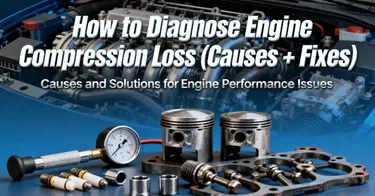
How to Diagnose Engine Compression Loss (Causes + Fixes)
Engine compression is the hidden force that powers your vehicle—without it, fuel can’t burn efficiently, and your engine loses power, fuel economy, and reliability. Compression loss occurs when the combustion chamber fails to seal properly, letting air/fuel mixture escape before it can generate power. This issue can range from a minor fix (e.g., adjusting valves) to a major overhaul (e.g., rebuilding the engine), but the key to minimizing cost is early diagnosis.
Whether you’re a DIY mechanic, a repair shop owner, or a fleet manager, this guide will walk you through everything you need to know about engine compression loss: what it is, why it happens, how to diagnose it (with DIY and professional methods), and the right repair solutions for every scenario. We’ll also link to essential resources like our Automotive Engine Parts Glossary and Top-End Engine Rebuild Explained to help you source parts and execute repairs.
What Is Engine Compression and Why Does It Matter
Before diving into diagnosis, let’s start with the basics: engine compression is the pressure built up in the combustion chamber when the piston moves upward (compression stroke) to squeeze the air-fuel mixture. This pressure is critical for two reasons:
- Efficient Combustion: Gasoline engines require compression ratios of 8:1 to 12:1 (diesel engines 16:1 to 22:1) to ignite fuel properly. Higher compression creates more heat, which triggers combustion without relying solely on spark plugs (especially in diesel engines).
- Power Output: The force of expanding gases (from combustion) pushes the piston downward, turning the crankshaft and generating power. Low compression means less force, resulting in sluggish acceleration and reduced towing capacity.
Normal compression readings vary by engine type, but most gasoline engines should register 120–190 psi (pounds per square inch) per cylinder, with no more than a 10–15 psi difference between cylinders. Diesel engines run higher, at 275–400 psi.
When compression drops below these ranges— or varies drastically between cylinders—you’ll notice symptoms like misfires, rough idling, and poor fuel economy. Left unaddressed, compression loss can lead to complete engine failure.
Common Causes of Compression Loss
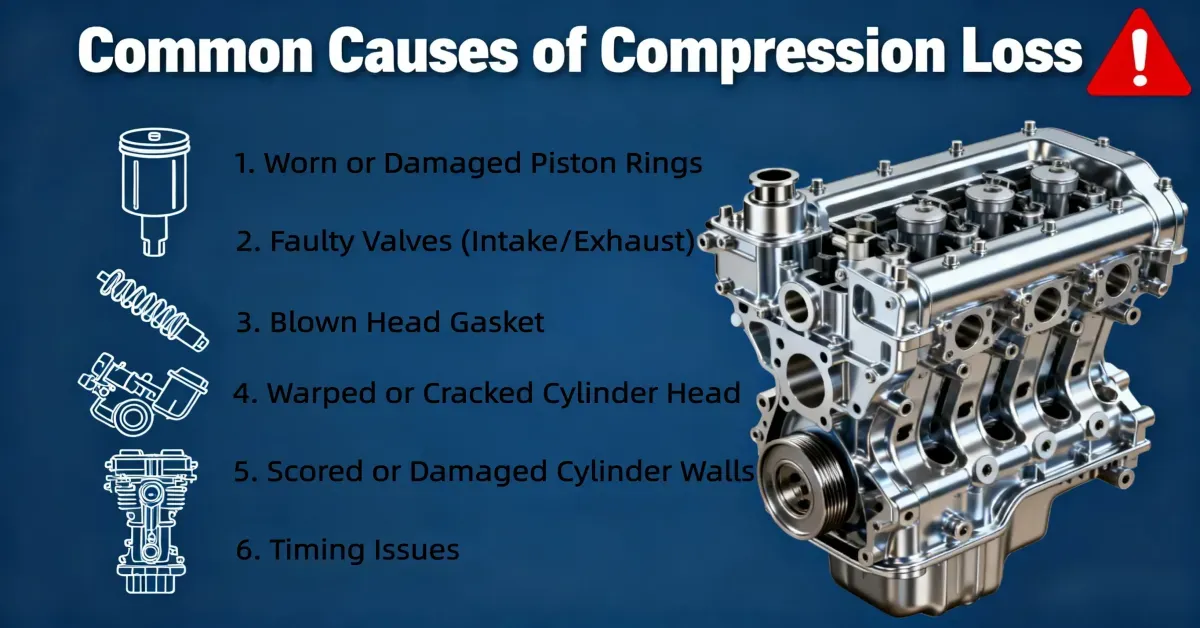
Compression loss stems from failures in the combustion chamber’s “sealing system”—components that prevent air/fuel leakage. Below are the most frequent causes, ordered by likelihood:
1. Worn or Damaged Piston Rings
Piston rings are thin metal bands that fit around the piston, sealing the gap between the piston and cylinder wall. Over time, they wear down, break, or become stuck in piston grooves (due to carbon buildup), allowing compression to leak into the oil pan.
- Common in: High-mileage engines (150k+ miles), engines that burn oil (blue smoke from exhaust), or vehicles driven aggressively (frequent high RPM).
- How it causes loss: Compression escapes past the rings, reducing pressure in the combustion chamber and increasing oil consumption.
2. Faulty Valves (Intake/Exhaust)
Valves control airflow into and out of the combustion chamber. If valves are worn, bent, or not seating properly (due to worn valve seats or valve stem seals), compression leaks through the valve openings.
- Common in: Engines with timing chain/belt failure (valves collide with pistons), overheated engines (valves warp), or engines with carbon deposits (valves stick open).
- How it causes loss: Leaking valves let compressed air escape during the compression stroke—often more noticeable in adjacent cylinders.
3. Blown Head Gasket
The head gasket seals the cylinder head to the engine block, preventing coolant, oil, and compression from mixing or leaking. A blown head gasket (caused by overheating, warped head, or improper torque) creates gaps for compression to escape.
- Common in: Engines that overheated (e.g., faulty thermostat, leaking radiator), or vehicles with recent head gasket replacement (poor installation).
- How it causes loss: Compression leaks into coolant passages (bubbles in radiator) or oil galleries (milky oil), or between adjacent cylinders (equal low compression in two cylinders).
4. Warped or Cracked Cylinder Head
The cylinder head houses the valves and combustion chambers. Overheating or improper torque can warp the head (uneven surface) or crack it, breaking the combustion chamber seal.
- Common in: Diesel engines (high compression), engines with repeated overheating, or heads that weren’t resurfaced during repair.
- How it causes loss: Warping creates gaps between the head and block; cracks let compression escape directly from the combustion chamber.
5. Scored or Damaged Cylinder Walls
The cylinder walls are precision-machined to be smooth, allowing piston rings to seal effectively. Scratches (from debris), corrosion (from coolant leaks), or excessive wear (high mileage) create grooves where compression can leak.
- Common in: Engines with oil contamination (metal particles), coolant leaks (acidic coolant eats away at metal), or engines run without enough oil.
- How it causes loss: Compression seeps through scratches into the oil pan, similar to worn piston rings.
6. Timing Issues
The camshaft and crankshaft must be perfectly synchronized (timed) to ensure valves open and close at the right time. If timing is off (e.g., stretched timing chain, broken timing belt), valves may not close fully during the compression stroke.
- Common in: Engines with neglected timing component replacement (timing belts should be replaced every 60k–100k miles).
- How it causes loss: Valves remain slightly open during compression, letting air escape before pressure builds.
How to Diagnose Low Compression (DIY + Tools)
Diagnosing compression loss requires two key tests: a compression test (to measure pressure) and a wet compression test (to pinpoint the cause). Below is a step-by-step guide for DIYers, plus professional tools for more accurate results.
DIY Diagnostic: Compression Test (Basic)
Tools Needed
- Compression tester (with adapter for your engine’s spark plug hole): $30–$80 (analog or digital).
- Socket set (to remove spark plugs).
- Screwdriver (to disable fuel pump or ignition).
- Helper (optional, to crank the engine).
Step-by-Step Process
Prepare the Engine:
- Warm the engine to operating temperature (10–15 minutes of driving) — cold engines give inaccurate readings.
- Turn off the engine and disconnect the negative battery terminal.
- Remove all spark plugs (label them to remember which cylinder they came from).
- Disable the fuel pump (pull the fuel pump fuse or relay) or ignition (unplug ignition coils) to prevent fuel injection or spark during testing.
Perform the Test:
- Screw the compression tester’s adapter into the first spark plug hole (hand-tighten, then snug with a socket—don’t over-tighten).
- Have a helper crank the engine for 3–5 seconds (until the tester’s needle stops rising).
- Record the pressure reading.
- Repeat for all cylinders, writing down each reading.
Interpret Results:
- Normal: All cylinders within 120–190 psi (gasoline) or 275–400 psi (diesel), with ≤15 psi difference between cylinders.
- Low Compression: One or more cylinders below the normal range, or >15 psi difference between cylinders.
- Critical Low: Any cylinder below 90 psi (gasoline) or 200 psi (diesel) — engine may not run reliably.
DIY Diagnostic: Wet Compression Test (Pinpoint Cause)
If the basic test shows low compression, a wet test (adding oil to the cylinder) helps determine if the issue is with piston rings or valves/head gasket.
Step-by-Step Process
- For the low-compression cylinder(s), add 1–2 teaspoons of engine oil to the spark plug hole (this temporarily seals worn piston rings).
- Reattach the compression tester and crank the engine for 3–5 seconds.
- Compare the new reading to the dry test:
- Reading increases by 30+ psi: The Issue is worn piston rings (oil seals the gap).
- Reading stays the same: The Issue is valves, head gasket, or cylinder wall damage (oil can’t fix these seals).
Professional Diagnostic Tools (For Shops/Fleets)
For a more precise diagnosis, professional tools help identify hidden issues:
1. Cylinder Leak-Down Tester
- How it works: Injects compressed air (100 psi) into the cylinder and measures how much leaks out (leak-down percentage).
- Interpretation: ≤10% leak-down = normal; 10–20% = mild issue; >20% = severe. The tester also lets you listen for leaks:
- Air from the intake = leaking intake valve.
- Air from the exhaust = a leaking exhaust valve.
- Air from the oil dipstick = worn piston rings.
- Air from the adjacent cylinder = blown head gasket.
2. Endoscope Inspection
- How it works: A flexible camera is inserted through the spark plug hole to visualize the cylinder wall, piston, and valves.
- Use case: Identifies scratches, corrosion, bent valves, or carbon buildup without disassembling the engine.
3. Valve Lash Adjustment Check
- How it works: Measures the gap between the valve stem and rocker arm (valve lash). Too many lashes means valves don’t seat properly.
- Relevance: Common in overhead valve (OHV) engines—adjusting lash can fix minor compression loss from valve seating issues.
Repair Options Based on Cause Severity
The cost and complexity of repairs depend on the root cause of compression loss. Below is a breakdown of solutions, costs, and when to choose each:
| Cause of Compression Loss | Repair Solution | DIY Feasibility | Cost Range (DIY vs. Professional) | Expected Lifespan After Repair |
|---|---|---|---|---|
| Worn Piston Rings | Replace piston rings; hone cylinder walls (to remove carbon buildup). | Advanced (requires engine teardown) | $300–$800 (parts) vs. $1,500–$3,000 (labor + parts) | 80k–120k miles |
| Faulty Valves/Valve Seats | Valve job (grind valves, replace valve seats/stems); adjust valve lash. | Advanced (requires cylinder head removal) | $200–$500 (parts) vs. $1,000–$2,500 (labor + parts) | 100k–150k miles |
| Blown Head Gasket | Replace head gasket; resurface cylinder head (if warped); retorque head bolts. | Intermediate (doable for experienced DIYers) | $50–$200 (gasket kit) vs. $800–$1,800 (labor + parts) | 80k–120k miles |
| Warped/Cracked Cylinder Head | Resurface head (if warped <0.003 inches) or replace head (if cracked). | Professional only | N/A vs. $1,500–$4,000 (parts + labor) | 100k–150k miles (resurfaced); 150k+ miles (new head) |
| Scored Cylinder Walls | Hone (minor scratches) or bore cylinders (severe damage) + new pistons/rings. | Professional only | N/A vs. $2,000–$4,500 (parts + labor) | 100k–150k miles |
| Timing Issues | Replace timing chain/belt/gears; reset timing. | Intermediate | $100–$300 (parts) vs. $500–$1,200 (labor + parts) | 60k–100k miles (until next timing service) |
Key Tips for Repairs
- Prioritize Preventive Maintenance: Fixing a blown head gasket early avoids warping the cylinder head (adding $1,000+ to repairs).
- Use Quality Parts: Linkteco’s OEM-compatible piston rings, head gaskets, and valves meet IATF 16949 standards—critical for sealing and durability.
- Follow Torque Specs: Improperly torqued head bolts or piston rings will cause repeat compression loss. Refer to OEM diagnostic manuals for exact specs.
FAQ
Q1: Is low compression always expensive to fix?
No—minor issues like valve lash adjustment or a blown head gasket can be fixed for $500–$1,800. The cost spikes only if damage spreads to the cylinder walls, pistons, or crankshaft. For example:
- Adjusting valve lash (DIY): $0–$50 (tools you already own).
- Replacing a head gasket (professional): $800–$1,800.
- Rebuilding the engine (severe damage): $4,000–$10,000+.
Q2: Can fuel additives fix low compression?
No—additives (e.g., “compression repair” products) are temporary band-aids at best. They may seal minor leaks for a few hundred miles, but they can’t fix worn piston rings, bent valves, or cracked heads. Save money and address the root cause instead.
Q3: Can I drive with low compression?
It depends on the severity:
- Mild Low Compression (100–120 psi, no misfires): You can drive short distances (1–2 weeks) to get repairs, but fuel economy will suffer.
- Severe Low Compression (≤90 psi, misfires/knocking): Do not drive—this will damage the engine further (e.g., bent rods from detonation) and increase repair costs.
Q4: How often should I test engine compression?
- Routine Check: Every 100k miles or during major service (e.g., timing belt replacement).
- Symptom-Based Check: If you notice misfires, rough idling, or oil consumption, test compression immediately.
- Pre-Purchase Check: Always test compression when buying a used vehicle—low compression is a red flag for hidden engine damage.
Q5: Does a top-end rebuild fix compression loss?
Yes—if the issue is with valves, head gasket, or cylinder head (most common causes). A top-end rebuild (covered in our Top-End Engine Rebuild Explained) replaces or refurbishes these components, restoring compression to factory levels.
Conclusion
Engine compression loss is a serious issue, but it doesn’t have to be a financial disaster—early diagnosis and targeted repairs save you thousands in avoidable damage. Whether you’re a DIYer using a compression tester or a shop owner with professional tools, the key is to identify the root cause (piston rings, valves, head gasket) and use quality parts to fix it.
At Linkteco, we provide everything you need to restore engine compression:
- OEM-compatible piston rings, head gaskets, valves, and cylinder heads—tested to SAE standards for sealing and durability.
- Detailed guides like our Engine Gasket Replacement Interval help you execute repairs correctly.
- Wholesale pricing and flexible MOQs for repair shops and fleet managers.
Don’t let low compression turn into engine failure. Visit our Automotive Engine Parts Glossary to learn more about critical components, or contact our team via the Contact Page for personalized advice on diagnosing compression loss. Linkteco’s experts are here to help you find the right parts and get your engine running at peak performance again.

Contact
©2026 LinkTeco All Rights Reserved.