

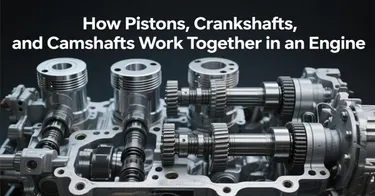
How Pistons, Crankshafts, and Camshafts Work Together in an Engine
The Role of Pistons in Power Generation
Key Design & Material
- Lightweight: Reduces inertia during rapid up-down movement (up to 3,000 cycles per minute in a 5,000 RPM engine).
- Heat resistance: Withstands combustion temperatures of up to 2,500°C without warping.
How Pistons Generate Power: The Four-Stroke Cycle
- Intake Stroke: Piston moves down in the cylinder. This creates suction, drawing a mixture of air and fuel into the combustion chamber (controlled by the camshaft, which opens the intake valve).
- Compression Stroke: Piston moves up, squeezing the air-fuel mixture into a small space (compression ratio: 8:1 to 12:1 for gasoline engines). This pressure makes the mixture easier to ignite.
- Power Stroke: The spark plug ignites the compressed mixture, creating an explosion. The force of the explosion pushes the piston down with extreme force—this is where raw engine power is generated.
- Exhaust Stroke: Piston moves up again, pushing burned exhaust gases out of the cylinder (controlled by the camshaft, which opens the exhaust valve).
How the Crankshaft Converts Motion into Rotation
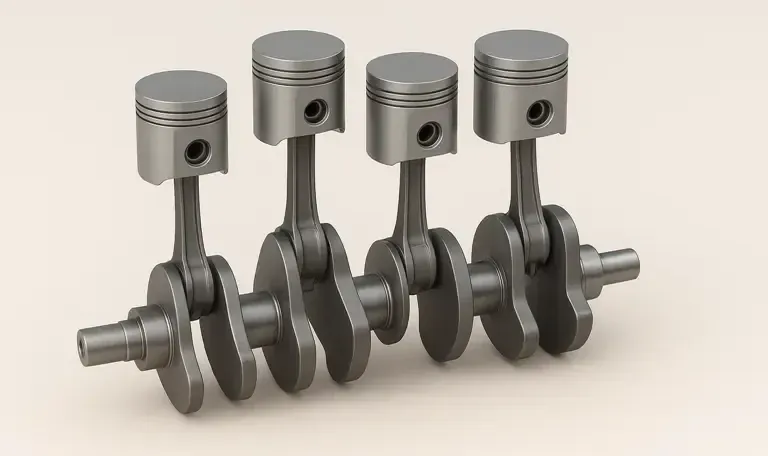
Step-by-Step Process:
Connecting Rod Linkage
Each piston is attached to the crankshaft via a connecting rod. As the piston moves down during the power stroke, the connecting rod pushes against the offset section of the crankshaft called the crank throw.Reciprocating to Rotational Motion
The crankshaft’s offset design allows this push to create torque. Instead of moving straight up and down, the crank throw rotates around the crankshaft’s central axis, transforming linear energy into rotation.Flywheel Stabilization
Attached to one end of the crankshaft, the flywheel stores rotational energy. This keeps the crankshaft spinning smoothly between combustion events, preventing jerky motion.Power Transfer
The crankshaft extends through the transmission, where the rotational power is geared down and sent to the wheels. In modern engines, the crankshaft also drives essential accessories via a serpentine belt, including the alternator, water pump, and A/C compressor.
Why the Crankshaft Matters in Engine Design
Precision Balancing: Because it spins at thousands of RPMs, crankshafts are carefully counterweighted to minimize vibrations that can damage bearings.
Material Strength: Most crankshafts are forged from steel or cast iron alloys to withstand massive forces. For high-performance or heavy-duty engines, manufacturers may use billet steel for durability.
Bearing Surfaces: The crankshaft rotates on main bearings, which must be properly lubricated to prevent friction and wear.
Buyer Insight (Wholesale Perspective)
For distributors, crankshafts are high-value components with strong demand in both OEM and aftermarket markets. Common considerations include:
OEM vs. Aftermarket: OEM crankshafts offer guaranteed fit and metallurgy, but aftermarket units can be cost-effective for repair shops.
High-Turnover Market: Crankshafts are often replaced in fleet and heavy-use vehicles due to fatigue or bearing failure.
Wholesale Advantage: Buying in bulk reduces costs significantly. For example, sourcing directly from a manufacturer like Linkteco Wholesale ensures better margins and quality consistency.
👉 If you’re interested in crankshaft supply, check out our Crankshaft Wholesale category to see available options for bulk orders.
What the Camshaft Does in Valve Timing
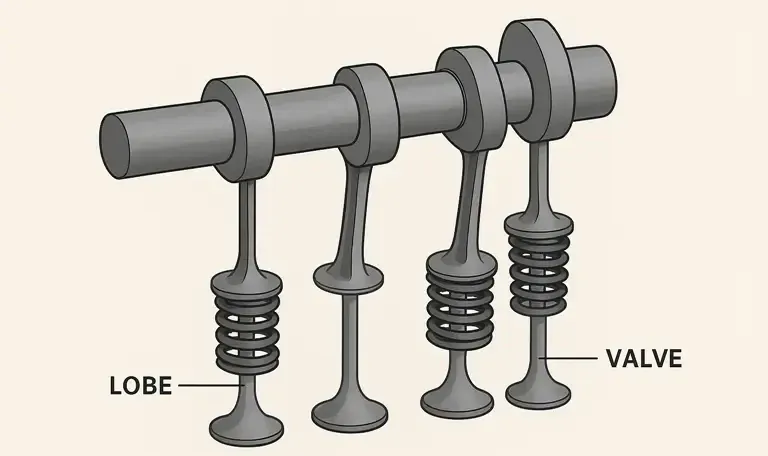
The camshaft is the “conductor” of the engine’s combustion orchestra. Its primary role is to control the opening and closing of the intake and exhaust valves with precise timing relative to piston movement.
How It Works
The camshaft rotates at half the speed of the crankshaft (because a four-stroke engine needs two crankshaft rotations for one full combustion cycle).
Lobes on the camshaft press against lifters, rocker arms, or tappets, which in turn move the valves.
By controlling valve lift (how far they open), duration (how long they stay open), and overlap (when intake and exhaust valves are open together), the camshaft regulates airflow into and out of the cylinders.
Impact on Engine Performance
Power & Efficiency: Aggressive cam profiles allow more airflow, boosting power at high RPM, while conservative cams improve efficiency and smooth idle.
Timing Systems: The camshaft is synchronized with the crankshaft via a timing belt, chain, or gears. Any misalignment in this system can severely impact performance.
Buyer Insight
For wholesale buyers, camshafts are precision-machined components where quality directly affects performance and emissions compliance. Many repair shops and distributors stock both:
OEM camshafts (for guaranteed fit and compliance with strict emission standards).
Performance camshafts (aftermarket demand in tuning communities).
Synchronization: How These Three Components Work Together
Pistons, crankshaft, and camshaft form the core timing system of an engine. Each must be synchronized down to fractions of a degree to ensure efficient combustion.
Step-by-Step Interaction
Piston Movement: Pistons compress the air-fuel mixture and transfer combustion force into the crankshaft.
Crankshaft Rotation: Converts piston motion into rotational energy that powers the drivetrain.
Camshaft Control: Precisely opens intake valves as pistons descend and exhaust valves as they rise, ensuring proper air-fuel exchange.
Timing Alignment
The timing belt or chain links the camshaft and crankshaft so valve action matches piston position.
If this synchronization is off (e.g., due to a stretched chain or skipped tooth on a belt), valves may open at the wrong time, leading to:
Power loss
Poor fuel economy
Severe engine damage (in interference engines, pistons can strike valves).
Buyer Insight
Distributors often bundle timing kits (camshaft, crankshaft sprockets, chain/belt, and tensioners) because repair shops prefer all-in-one solutions for major service jobs. As a manufacturer, Linkteco offers these OEM bundles, which are especially popular with fleet service buyers.
Common Issues with Pistons, Crankshafts, and Camshafts
Even the strongest engine parts are subject to wear, fatigue, and operational stress. Understanding their common issues is crucial for both mechanics and bulk buyers.
Pistons
Issues: Cracks, scoring, piston slap, or ring wear.
Causes: Poor lubrication, overheating, or detonation.
Wholesale Insight: Pistons and piston kits (with rings) are high-turnover items due to frequent replacements in high-mileage vehicles.
Crankshafts
Issues: Bearing wear, cracks, journal scoring, and imbalance.
Causes: Oil starvation, poor lubrication, or excessive RPMs.
Wholesale Insight: Crankshafts require precision machining; OEM buyers focus on metallurgy, while aftermarket buyers often prioritize cost efficiency.
Camshafts
Issues: Worn lobes, timing misalignment, or camshaft sensor failures.
Causes: Poor oiling, stretched timing chains, or material fatigue.
Wholesale Insight: Camshafts have steady demand, especially in regions where timing chain failures are common. Offering OEM-spec and upgraded aftermarket options helps capture both professional repair and performance markets.
FAQ
1. What connects pistons to the crankshaft?
- Small end: Attaches to the piston via a wrist pin (a hollow metal pin that lets the rod pivot as the piston moves).
- Big end: Splits into two halves (held together by bolts) that wrap around the crankshaft’s crankpin. A bearing insert (made from soft metal like copper-lead) fits between the rod and crankpin to reduce friction.
2. What happens if camshaft timing is off?
- Misfires: Valves open/close when the piston is in the wrong position (e.g., intake valve opens during compression), so the air-fuel mixture doesn’t ignite properly.
- Reduced power/fuel efficiency: Less air/fuel enters the cylinder, or exhaust gases aren’t fully expelled—the engine works harder to produce power.
- Catastrophic damage: If timing is off by 10+ degrees, the valve may collide with the piston (bend valves, crack pistons, or damage the cylinder head).
3. Why do camshafts rotate at half the crankshaft’s speed?
4. Can I replace pistons, crankshafts, or camshafts with non-OEM parts?
5. How often should I inspect these three components?
- Pistons: Check during engine rebuilds (150,000+ miles) or if you see blue smoke/oil consumption.
- Crankshaft: Inspect bearings during oil changes (look for metal shavings in the oil) and check for vibration at idle.
- Camshaft: Inspect cam lobes and timing belt/chain every 60,000 miles (or as per your vehicle’s manual).
Conclusion

Contact
©2026 LinkTeco All Rights Reserved.