

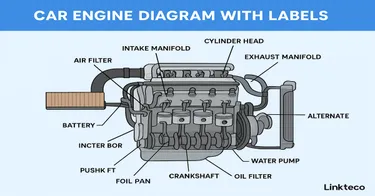
Car Engine Diagram with Labels: Learn the Parts of Your Engine
The engine is the core of every vehicle. Without it, nothing moves. Yet for many drivers, mechanics in training, and even parts buyers, the engine can feel like a mystery—an intricate mix of metal, fuel, and motion. That’s where a car engine diagram with labels becomes invaluable.
Diagrams don’t just illustrate where each part sits; they reveal how parts interact—from pistons firing inside the block to the radiator cooling everything down. For drivers, it’s a tool to better understand maintenance. For repair shops, distributors, and wholesale buyers, it’s a business advantage: accurate diagrams reduce mistakes, cut returns, and simplify bulk ordering.
In this guide, we’ll walk you through a labeled engine diagram, break down key components by section, and explain how to identify parts visually. As a leading wholesale engine parts supplier (Linkteco), we’ve designed this resource to help you feel confident recognizing, maintaining, and sourcing engine parts—whether you’re fixing your own car or stocking inventory for your shop.
Why an Engine Diagram Helps Understand Your Car
You wouldn’t assemble furniture without a manual—so why try to understand your engine without a diagram? A labeled engine diagram solves three big problems for beginners and pros alike:
- Eliminates confusion: It turns a "jumble of parts" into a mapped system, showing exactly where the engine block, pistons, or fuel injectors sit relative to each other. No more guessing which hose connects to the radiator or which part is the camshaft.
- Speeds up diagnosis: If your mechanic says "your water pump is leaking," a diagram lets you locate the part yourself—so you can visualize the issue and make informed decisions about repairs.
- Simplifies part sourcing: For wholesale buyers, a labeled diagram ensures you order the right part (e.g., a "4-cylinder engine block" vs. a "V6 cylinder head") by matching visual cues to product descriptions. Linkteco’s catalog even references common diagram labels to make ordering easier.
Whether you’re learning basic engine maintenance or building a parts inventory, a labeled diagram is your first step to engine literacy.
Labeled Diagram of a Car Engine (with image)
Below is a detailed labeled diagram of a 4-cylinder gasoline engine—the most common type in passenger cars (e.g., Toyota Corolla, Honda Civic). This diagram highlights 20+ key parts, from internal components like pistons to external parts like the radiator.
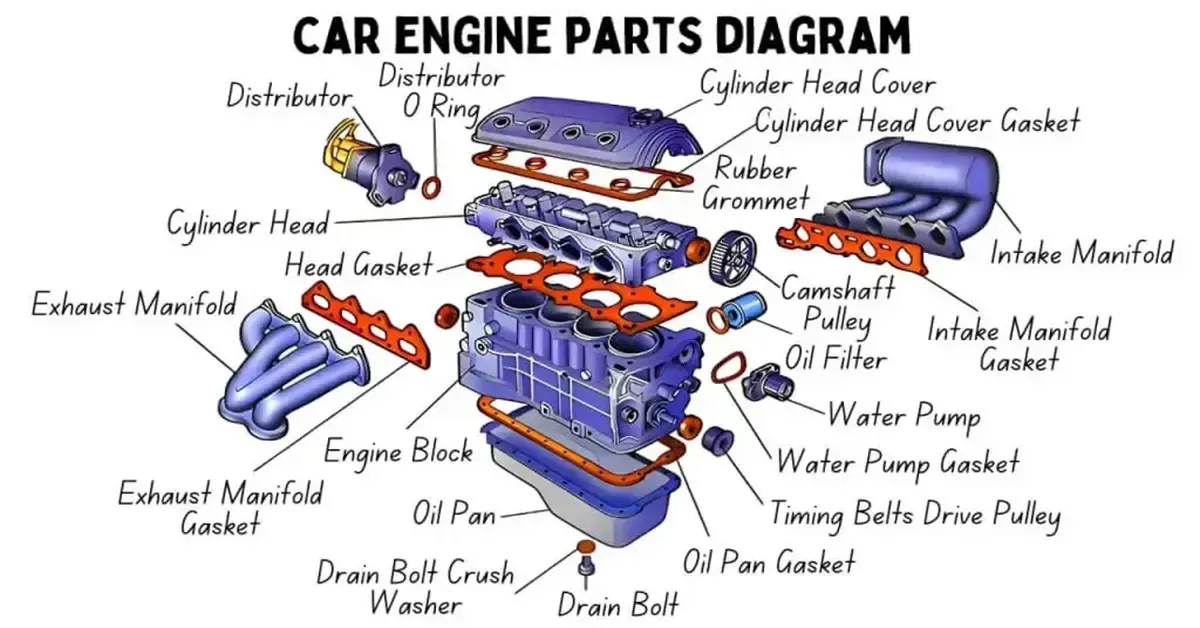
Figure 1: Labeled diagram of a 4-cylinder gasoline engine. Key parts include: 1. Engine Block, 2. Cylinder Head, 3. Pistons, 4. Crankshaft, 5. Camshaft, 6. Intake Manifold, 7. Exhaust Manifold, 8. Radiator, 9. Water Pump, 10. Oil Pan, 11. Fuel Injectors, 12. Spark Plugs, 13. Timing Belt, 14. Serpentine Belt, 15. Alternator, 16. Air Filter, 17. Battery, 18. Coolant Reservoir, 19. Oil Filter, 20. Throttle Body.This diagram uses a "cutaway" view to show both internal (hidden) parts (like pistons inside the engine block) and external parts (like the radiator mounted at the front). For reference, Linkteco’s What Are the 40 Parts of a Car Engine? guide expands on all these components with detailed descriptions—perfect for deepening your knowledge.
Major Sections of the Engine (block, head, intake, exhaust)
Your engine is divided into four core sections, each with a specific job. Using the labeled diagram above, let’s break down what each section does and how to identify its parts:
1. Engine Block
The engine block is the "foundation" of the engine—you’ll recognize it as the large, heavy metal component at the center. It’s usually made of aluminum (lightweight) or cast iron (durable for trucks).Key parts in this section:
- Cylinder bores: The four circular holes inside the block where pistons slide up and down (visible in the cutaway view).
- Crankcase: The lower part of the block that holds the crankshaft and oil pan.
- Coolant channels: Tiny passages that circulate coolant to keep the block cool (connected to the water pump).
Linkteco manufactures engine blocks for 95% of global vehicle brands, with precision-machined cylinder bores to ensure piston fit. For wholesale buyers, our Engine Block Wholesale page lists blocks by vehicle model—matching the "engine block" label in the diagram.
2. Cylinder Head
Sitting on top of the engine block (sealed by a head gasket), the cylinder head looks like a flat metal "lid." It’s the "control center" for combustion.Key parts in this section:
- Combustion chambers: The bowl-shaped cavities above each cylinder where fuel and air ignite.
- Spark plugs: Screwed into the head, these create the spark that starts combustion.
- Valves: Intake valves (let air/fuel in) and exhaust valves (let gases out), controlled by the camshaft.
A common issue here is a warped cylinder head (from overheating)—you might notice white smoke from the exhaust (a sign of coolant leaking into the combustion chamber). Linkteco’s cylinder heads are stress-relieved to prevent warping, with hardened valve seats for durability.
3. Intake System
The intake system brings clean air and fuel into the engine. You’ll see it on the top or side of the engine.Key parts in this section:
- Air filter: A rectangular box that filters dirt from incoming air (easy to spot—usually has a clip or screw-on cover).
- Intake manifold: A plastic or metal component with tubes that distribute air/fuel to each cylinder (connected to the throttle body).
- Throttle body: Controls airflow into the engine—linked to the gas pedal (you’ll see a cable or electrical connector attached).
A dirty air filter can reduce engine power—check it by removing the cover (as shown in the diagram) and looking for dust or debris. Linkteco supplies replacement air filters for most models, ideal for wholesale inventory.
4. Exhaust System
The exhaust system removes waste gases from the engine. It’s usually on the side or back of the engine, with metal tubes.Key part in this section:
- Exhaust manifold: A cast metal component that collects gases from each cylinder and sends them to the catalytic converter.
You might notice the exhaust manifold gets hot (it’s normal!), but rust or cracks here can cause loud exhaust noise. Linkteco’s exhaust manifolds are made of heat-resistant stainless steel to prevent rust.
Internal Moving Parts Explained (pistons, crankshaft, valves)
1. Pistons
Pistons are the cylindrical metal parts inside the cylinder bores (one per cylinder). They slide up and down to convert fuel energy into motion.How to identify: In the diagram, they’re the four silver cylinders inside the engine block. Each piston is connected to the crankshaft via a connecting rod (visible as thin metal rods).What they do: During the "power stroke," fuel ignites in the combustion chamber, pushing the piston down. This movement turns the crankshaft—the first step in getting your wheels to spin.Linkteco’s Pistons Wholesale page offers piston kits (pistons + rings + connecting rods) that match the "pistons" label in the diagram. Our pistons have a molybdenum coating to reduce friction and wear.
2. Crankshaft
The crankshaft is a long, steel shaft running through the bottom of the engine block. It’s the "link" between piston movement and wheel rotation.How to identify: In the diagram, it’s the thick metal shaft with offset "crankpins" (the parts connected to the piston rods). It’s hidden inside the crankcase but visible in the cutaway.What they do: When pistons push down, they tilt the crankpins, turning the crankshaft. This converts the piston’s up-down (linear) motion into the spinning (rotational) motion that drives the transmission and wheels.Linkteco’s crankshafts are forged from high-strength steel, with precision-machined crankpins to ensure smooth movement. We test each crankshaft for balance to reduce engine vibration.
3. Camshaft
The camshaft is a long shaft in the cylinder head (or block) with egg-shaped "cams" (lobes). It controls when valves open and close.How to identify: In the diagram, it’s the shaft above the pistons with bumpy lobes. It’s connected to the crankshaft via a timing belt.What they do: As the camshaft spins, the lobes push against valve lifters, opening the intake and exhaust valves at the right time. For example, it opens the intake valve when the piston moves down (to let air/fuel in) and closes it before the piston moves up (to trap the mixture).A broken timing belt can damage the camshaft—so it’s important to replace the belt at the manufacturer’s recommended interval (usually 60,000–100,000 miles). Linkteco’s timing belt kits include the belt, tensioner, and idlers for a complete replacement.
External Components That Support the Engine
While internal parts generate power, external components keep the engine running smoothly. Using the labeled diagram, here’s how to spot and understand these key supports:
1. Cooling System
The cooling system prevents the engine from overheating. You’ll find these parts at the front of the engine.Key parts:
- Radiator: A large, rectangular metal or plastic component with fins (visible at the very front). It cools hot coolant by letting air flow through the fins.
- Water pump: A small, pulley-driven component connected to the radiator. It circulates coolant through the engine block and radiator.
- Coolant reservoir: A plastic tank near the radiator that holds extra coolant (marked with "MIN" and "MAX" lines).
How to check: If your engine overheats, check the coolant level in the reservoir (use the diagram to find it). Low coolant could mean a leak in the radiator or hoses. Linkteco supplies radiators and water pumps with OEM-compatible fittings—easy to match to the diagram’s labels.
2. Lubrication System
The lubrication system keeps moving parts (like the crankshaft and pistons) from wearing out.Key parts:
- Oil pan: The metal pan at the bottom of the engine block that stores oil.
- Oil filter: A small, cylindrical component near the oil pan. It filters dirt from the oil before it circulates through the engine.
How to check: Use the oil dipstick (not labeled, but usually near the oil pan) to check oil level. Change the oil filter every 5,000–7,500 miles (follow your car’s manual). Linkteco’s oil filters are available in bulk for wholesale buyers—matching the "oil filter" label in the diagram.
3. Electrical System
The electrical system powers the engine and accessories.Key parts:
- Battery: A rectangular box (usually near the front of the engine bay) that provides power to start the engine.
- Alternator: A pulley-driven component that recharges the battery while the engine runs (connected to the serpentine belt).
- Timing belt: A rubber belt that synchronizes the crankshaft and camshaft (critical for valve timing).
How to check: If your car won’t start, check the battery terminals for corrosion (green or white buildup). A worn timing belt can cause engine damage—replace it as recommended. Linkteco’s timing belts are made of EPDM rubber for durability, with fiber reinforcement to prevent stretching.
FAQ
1. What are the 10 most important labeled parts in a car engine diagram?
The most critical parts to recognize (using the diagram above) are:
- Engine Block (foundation)
- Cylinder Head (combustion control)
- Pistons (power generation)
- Crankshaft (motion conversion)
- Camshaft (valve timing)
- Intake Manifold (air/fuel distribution)
- Exhaust Manifold (gas removal)
- Radiator (cooling)
- Water Pump (coolant circulation)
- Oil Pan (oil storage)
These parts are the "backbone" of the engine—failure in any of them will stop your car from running.
2. How can I identify engine parts visually (without a diagram)?
Use these visual cues:
- Engine Block: The largest, heaviest part in the engine bay (usually black or silver, with cylinders visible if it’s a cutaway).
- Cylinder Head: The flat metal component on top of the block, with spark plugs sticking out (gasoline engines).
- Radiator: The large, finned component at the front of the engine bay (connected to hoses).
- Air Filter: A rectangular box with a clip-on cover (usually on the side of the engine).
- Oil Pan: The metal pan at the bottom of the block (has a drain plug for oil changes).
3. Do diesel engines have the same labeled parts as gasoline engines?
Most parts are the same (engine block, crankshaft, radiator), but diesel engines lack spark plugs (they use compression to ignite fuel) and have a fuel injection pump (instead of carburetors). The labeled diagram above is for gasoline engines, but Linkteco’s diesel engine diagrams (available on request for wholesale buyers) highlight these differences.
4. Can I use a labeled diagram to order parts from Linkteco?
Absolutely! If you reference the diagram labels (e.g., "4-cylinder engine block" or "Toyota Corolla water pump"), our team can quickly match you to the right part. We even include diagram references in our product descriptions—so you can confirm fitment before ordering.

Contact
©2026 LinkTeco All Rights Reserved.