

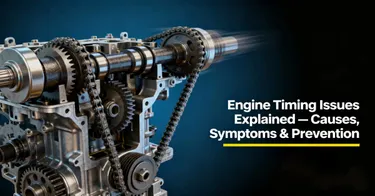
Engine Timing Issues Explained — Causes, Symptoms & Prevention
Engine timing is the unsung “conductor” of your vehicle’s powertrain, synchronizing the movement of critical components like pistons, valves, and camshafts to ensure smooth combustion. When timing goes wrong—even by a fraction of an inch—it disrupts the entire engine rhythm, leading to poor performance, costly damage, or complete failure. For auto repair professionals, fleet managers, and DIY enthusiasts, understanding timing issues is key to avoiding expensive breakdowns.
This guide demystifies engine timing: how it works, what causes misalignment, the symptoms you can’t ignore, and how to prevent problems before they start. We’ll also connect timing issues to components like crankshafts and camshafts (building on our guide to how these parts collaborate) and show how quality replacement parts from Linkteco keep timing precise.
How Engine Timing Works
Engine timing refers to the precise coordination between the bottom-end (crankshaft, pistons) and top-end (camshaft, valves) to maximize combustion efficiency. Here’s a simplified breakdown of the process, using a 4-stroke gasoline engine as an example:
1. The Core Synchronization: Crankshaft & Camshaft
The crankshaft (driven by piston movement) and camshaft (driven by the crankshaft) operate in a 2:1 ratio—for every two full rotations of the crankshaft, the camshaft rotates once. This ratio ensures valves open and close at the exact moment needed for each stroke:
Intake Stroke: Camshaft opens intake valve as piston moves down, drawing in air-fuel mixture.
Compression Stroke: Both valves closed as the piston moves up, compressing the mixture.
Power Stroke: Spark plug ignites mixture; piston moves down, driving the crankshaft.
Exhaust Stroke: Camshaft opens the exhaust valve as the piston moves up, expelling exhaust gases.
Even a 1-degree timing error can reduce fuel efficiency by 5–10% and increase emissions. For diesel engines (higher compression), the margin for error is even smaller—misalignment often causes immediate misfires.
2. Timing Components: Belts vs. Chains vs. Gears
Three systems transmit power from the crankshaft to the camshaft, each with unique timing implications:
Component Type | How It Works | Common Issues | Typical Service Life |
|---|---|---|---|
Timing Belt | Rubber belt with teeth; connects crankshaft and camshaft pulleys | Stretching, cracking, tooth wear, coolant damage | 60,000–100,000 miles (per OEM specs) |
Timing Chain | Metal chain; uses guides and tensioners for smooth operation | Stretching, guide wear, tensioner failure, noise | 150,000–250,000 miles (with proper oil changes) |
Timing Gears | Metal gears (crankshaft drives the camshaft directly) | Tooth wear, backlash (looseness) | 200,000+ miles (most durable, used in heavy-duty diesels) |
Modern passenger cars mostly use timing belts (cheaper to manufacture) or chains (longer-lasting). Linkteco’s Timing Chain Kits Wholesale include pre-tensioned chains, guides, and gaskets—designed to match OEM durability for both passenger and commercial vehicles.
Common Causes of Timing Misalignment
Timing issues rarely happen spontaneously—they’re almost always caused by wear, maintenance gaps, or component failure. Below are the most frequent culprits, ordered by likelihood:
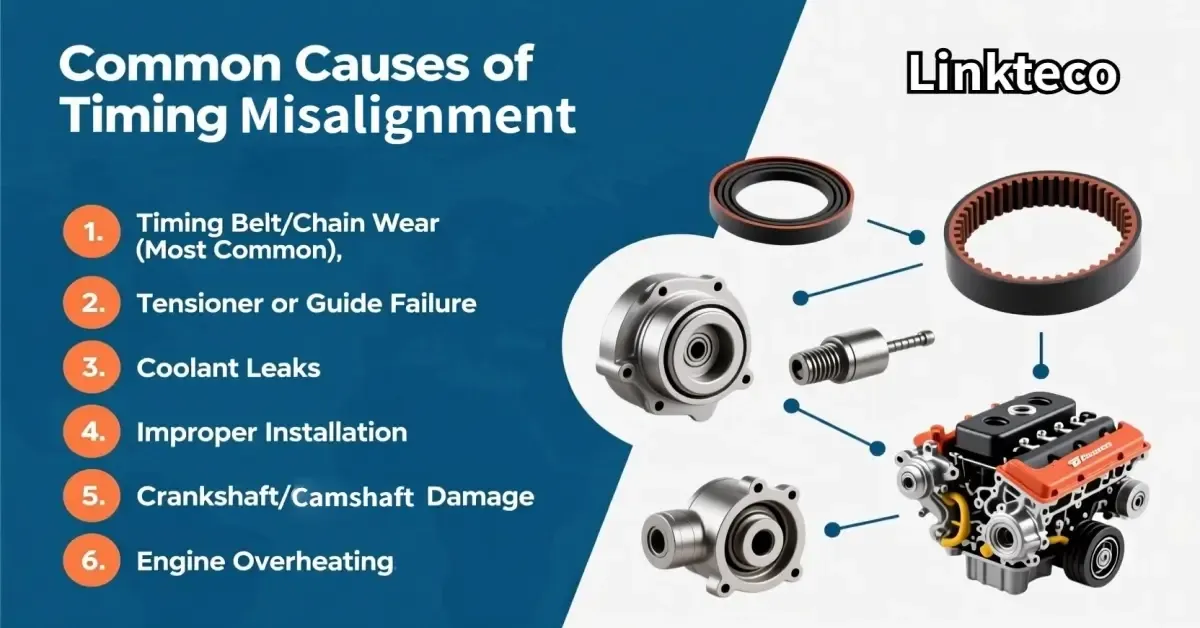
1. Timing Belt/Chain Wear (Most Common)
Timing belts degrade over time due to heat, oil exposure, and rubber fatigue. Symptoms of wear include:
Belts: Cracks (on the ribbed side), fraying, or stretched teeth (causes “skip” under load).
Chains: Stretching (measured by “chain slack”)—a 0.5-inch stretch in a 4-cylinder engine is enough to throw timing off.
Oil leaks (e.g., valve cover gasket failure) accelerate wear—oil breaks down rubber belts and causes metal chains to rust.
2. Tensioner or Guide Failure
Tensioners (hydraulic or mechanical) keep belts/chains tight; guides prevent lateral movement. When they fail:
Hydraulic Tensioners: Lose oil pressure (due to clogged passages) and can’t maintain tension—common in high-mileage engines.
Mechanical Tensioners: Spring fatigue reduces pressure, leading to slack.
Guides: Plastic guides crack (from heat), allowing the chain to slap against the engine block and jump teeth.
Gates (a leading timing component manufacturer) reports that 40% of timing failures are due to tensioner/guide issues—not the belt/chain itself (Gates technical data).
3. Coolant Leaks
Many timing belts run behind the water pump—if the pump leaks, coolant soaks the belt. Coolant breaks down the belt’s rubber compound, causing it to stretch or snap within weeks. This is a hidden risk: drivers often don’t notice a small coolant leak until timing fails.
4. Improper Installation
Timing components must be installed with exact alignment (using timing marks on pulleys/gears). Common installation mistakes include:
Misaligning timing marks (off by 1–2 teeth).
Over-tightening the belt (causes premature wear) or under-tightening (causes slack).
Reusing old tensioners (even if the belt/chain is new).
DIYers often make these mistakes—professional shops use specialized tools (e.g., camshaft locking plates) to ensure alignment.
5. Crankshaft/Camshaft Damage
Worn crankshaft or camshaft pulleys (damaged teeth) can’t grip the belt/chain properly. A bent camshaft (from a previous timing failure) also throws off alignment—this is common in engines with “interference” design (see below).
6. Engine Overheating
Extreme heat (250°F+) warps metal components like pulleys and stretches belts. Overheating also causes the cylinder head to warp, which can shift the camshaft’s position relative to the crankshaft.
Symptoms You’ll Notice While Driving

Timing issues reveal themselves through a mix of performance problems, sounds, and warning signs. Early detection can save you from a $2,000+ repair—watch for these red flags:
1. Hard Starting or No Start
If timing is off by more than a few teeth, the air-fuel mixture won’t ignite at the right moment. Symptoms include:
Engine cranks but doesn’t start (common with belt slippage).
Rough, uneven idle after starting (timing is slightly off).
Diesel engines are particularly sensitive—even 1 degree of timing delay can prevent startup.
2. Power Loss & Poor Fuel Economy
Timing misalignment reduces combustion efficiency, leading to:
Sluggish acceleration (engine “hesitates” when pressing the gas).
10–20% drop in MPG (more fuel is burned, but less power is produced).
Inability to maintain speed uphill (timing skips under load).
3. Unusual Noises
Different timing issues produce distinct sounds—use this to diagnose:
High-Pitched Squealing: Loose timing belt (slips on pulleys) or failing tensioner.
Metallic Rattling/Clattering: Worn timing chain guides (chain slaps against the block) or loose tensioner.
Deep Knocking: Advanced timing (fuel ignites too early), causing detonation—damages pistons over time.
Noise gets louder with RPM—if you hear it, avoid high-speed driving.
4. Check Engine Light (CEL) with Specific Codes
Modern engines use camshaft and crankshaft position sensors to monitor timing. A CEL with these codes indicates timing issues:
P0011/P0012: Camshaft position timing (over-advanced/retarded).
P0340/P0341: Camshaft position sensor circuit (often triggered by timing misalignment).
P0021/P0022: Camshaft timing for bank 2 (V6/V8 engines).
Use an OBD-II scanner to read codes—most auto parts stores offer free scanning.
5. Exhaust Smoke & Smell
Timing issues disrupt combustion, leading to abnormal exhaust:
Black Smoke: Rich air-fuel mixture (timing is too slow—fuel isn’t fully burned).
White Smoke (not coolant-related): Unburned fuel (common with severe timing delay).
Fuel Smell: Excess unburned fuel in exhaust (indicates timing is off by 3+ teeth).
Consequences of Severe Timing Failure
Ignoring timing symptoms leads to catastrophic engine damage—costing 5–10x more to repair than proactive maintenance. The severity depends on whether your engine is “interference” or “non-interference”:
1. Interference Engines (Most Modern Cars)
In interference engines, valves and pistons occupy the same space at different times—if timing fails (e.g., belt snaps), they collide. Consequences include:
Bent Valves: The most common damage—valves are pushed into the piston, bending stems or heads.
Damaged Pistons: Valve impacts create dents or cracks in piston tops.
Camshaft/Crankshaft Damage: Sudden stops (from collision) can bend the camshaft or warp crankshaft journals.
Examples of interference engines: Toyota Corolla (2000+), Honda Civic (1996+), Ford EcoBoost (all models). Repair costs: $1,500–$4,000+ (valve replacement + cylinder head work).
2. Non-Interference Engines (Older Models)
These engines have more space between valves and pistons—timing failure (belt snap) stops the engine but doesn’t cause collision damage. However, you’ll still face:
Two costs and downtime.
Replacement of the timing belt/chain and related components.
Examples: Toyota Camry (1990–2001), Chevrolet Silverado (V6, 1999–2007). Repair costs: $500–$1,200.
3. Long-Term Damage (Even Minor Misalignment)
Even if timing is off by 1–2 teeth (no collision), long-term issues include:
Increased carbon buildup (unburned fuel sticks to valves).
Premature bearing wear (uneven engine load).
Catalytic converter failure (unburned fuel overheats the converter).
Preventing Timing Component Wear
Timing issues are 90% preventable with proactive maintenance. Follow these steps to extend component life:
1. Replace Timing Components by OEM Interval (Not Just Mileage)
OEMs recommend replacement based on both mileage and time—whichever comes first. For example:
Timing belt: 60,000 miles or 6 years (whichever comes first).
Timing chain: 150,000 miles or 10 years.
Even if you drive little (e.g., 3,000 miles/year), rubber belts degrade from heat and humidity. Check your OEM service manual for exact specs.
2. Replace the “Timing Kit,” Not Just the Belt/Chain
Never replace just the timing belt or chain—always install a complete kit that includes:
Tensioner (hydraulic or mechanical).
Guides (plastic or metal).
Water pump (if driven by the timing belt).
Gaskets and seals (to prevent oil/coolant leaks).
Linkteco’s Timing Chain Kits Wholesale include all these components, tested to OEM tolerances—saving repair shops time and ensuring consistency.
3. Fix Oil & Coolant Leaks Immediately
Oil breaks down rubber belts and rusts chains; coolant degrades belt rubber. Inspect for leaks monthly:
Oil leaks: Check under the valve cover and oil pan gaskets.
Coolant leaks: Inspect the water pump and radiator hoses (near the timing cover).
4. Use High-Quality Oil & Change It Regularly
Timing chains rely on oil for lubrication—low-quality oil or infrequent changes cause chain stretch and tensioner failure. Follow these rules:
Use oil with the viscosity specified by the OEM (e.g., 5W-30 for most gasoline engines).
Change oil every 5,000–7,500 miles (3,000 miles for severe use: towing, stop-and-go traffic).
5. Inspect Timing Components During Routine Service
For timing belts: Remove the timing cover (if accessible) and check for cracks, fraying, or tooth wear. For timing chains: Listen for rattling noises and use a scan tool to check camshaft/crankshaft synchronization.
Repair vs. Timing Component Replacement
The right fix depends on the severity of the issue—minor misalignment may be repairable, but worn components require replacement. Here’s how to decide:
When to Repair (Minor Issues)
Repair is feasible if timing is off but components are still in good condition. Common repairs include:
Timing Adjustment: Realigning timing marks (e.g., after a belt slipped 1 tooth). Cost: $150–$300 (professional).
Tensioner Adjustment: Adjusting a mechanical tensioner or replacing hydraulic tensioner oil. Cost: $100–$250.
Repair is only recommended if a professional confirms components (belt/chain, guides) have at least 50% of their service life remaining.
When to Replace (Severe Wear/Failure)
Replacement is necessary if components are worn or damaged. Here’s what to expect:
Component | Replacement Scenario | DIY Cost (Parts) | Professional Cost (Parts + Labor) |
|---|---|---|---|
Timing Belt Kit | Belt cracks, teeth wear, or 60k+ miles | $80–$200 | $500–$900 |
Timing Chain Kit | Chain rattle, stretch, or 150k+ miles | $150–$350 | $800–$1,500 |
Valve Train (Bent Valves) | Interference engine failure | Not recommended (advanced skill) | $1,500–$4,000 |
Pro Tip: For interference engines, replace the water pump and seals when doing a timing job—access is already open, saving $200–$300 in future labor costs.
FAQ
Q1: Can engine timing skip a tooth, and what causes it?
Yes—this is one of the most common timing issues. It happens when the timing belt/chain slips on the camshaft or crankshaft pulley. Causes include: (1) loose tensioner, (2) worn belt teeth/chain links, (3) oil/coolant contamination, or (4) sudden engine load (e.g., flooring the gas while towing). A 1-tooth skip causes power loss; 3+ teeth often lead to no start or valve damage.
Q2: How much does it cost to fix a skipped timing tooth?
If no valve damage occurred: $150–$300 (professional adjustment) or $50–$100 (DIY, if you have alignment tools). If components are worn (tensioner/guide failure), add $300–$600 for a timing kit replacement.
Q3: Is it safe to drive with a timing rattle (chain noise)?
No—rattle means the chain is loose (tensioner/guide failure) and could skip teeth at any time. Driving even 10 miles can lead to interference damage. Stop driving and have it towed to a shop.
Q4: How do I know if my engine is interference or non-interference?
Check your OEM manual, use an online database (e.g., Gates Timing Belt Catalog), or call a dealership with your VIN. Most 2000+ passenger cars are interference—manufacturers use this design to improve fuel efficiency.
Q5: Do timing chains need to be replaced, or are they “lifetime” components?
While chains last longer than belts, they’re not lifetime parts. Most OEMs recommend replacement at 150,000–250,000 miles. Signs of wear (rattle, stretch) mean replacement is needed earlier—delaying can cause crankshaft/camshaft damage.
Conclusion
Engine timing issues are a classic example of “an ounce of prevention is worth a pound of cure.” By replacing timing components on schedule, fixing leaks immediately, and using quality parts, you can avoid costly failures and keep your engine running smoothly for 100,000+ miles.
Whether you’re a repair shop owner sourcing bulk timing kits or a fleet manager maintaining a lineup of vehicles, Linkteco has the solutions you need:
OEM-quality timing chain/belt kits—tested to Gates and OEM standards for durability.
Bulk pricing and flexible MOQs (minimum order quantities) to fit your business needs.
Technical support from ASE-certified engineers to help with installation and diagnosis.

Contact
©2026 LinkTeco All Rights Reserved.