

Why Engines Lose Oil Pressure — Causes, Symptoms & Fixes
How Oil Pressure Works in an Engine
Before diagnosing low pressure, it’s critical to understand how the system operates. Oil pressure is a delicate balance of supply (oil pump), flow (oil viscosity), and resistance (engine clearances). Here’s the step-by-step process:Oil Pickup & Pumping: The oil pump (driven by the crankshaft) draws oil from the pan through a pickup tube with a screen (to filter debris).
Pressure Regulation: The pump pushes oil through a pressure relief valve, which limits maximum pressure (typically 40–60 psi at high RPM, 10–20 psi at idle) to prevent seal damage.
Lubrication Path: Pressurized oil flows through galleries (channels) to critical components: main bearings, rod bearings, camshaft bearings, and valve train parts.
Return to Pan: After lubricating parts, oil drains back to the pan via gravity, completing the cycle.
Common Causes of Low Oil Pressure
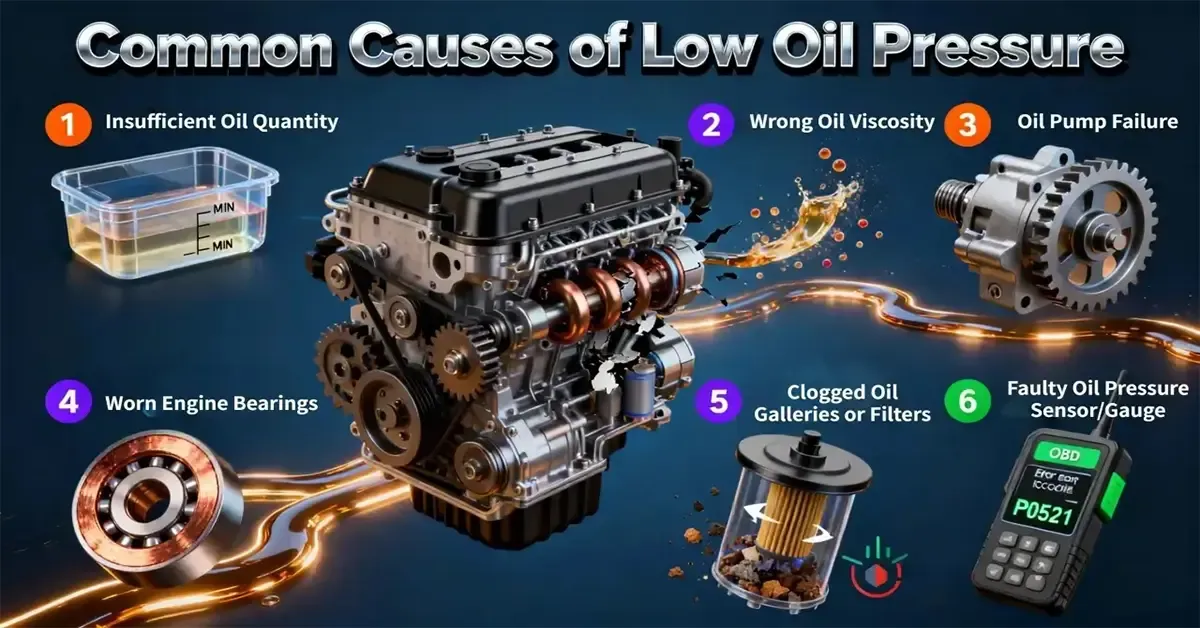
1. Insufficient Oil Quantity (Most Common)
The simplest cause: not enough oil in the pan. This happens due to leaks (gasket failure, oil pan cracks) or neglecting oil changes (burning oil over time). When levels drop, the pickup tube can’t draw enough oil, leading to pressure loss—especially at idle (when oil sloshes away from the pickup).Red Flag: Adding 1+ quarts of oil between changes (for passenger cars) indicates a leak or burning issue that needs repair.2. Wrong Oil Viscosity
Oil viscosity (thickness) directly impacts pressure. Using oil that’s too thin (e.g., 5W-20 instead of 10W-30 in a high-mileage truck) or too thick (e.g., 20W-50 in a cold-climate engine) disrupts flow:Too Thin: Oil slips past bearings too easily, dropping pressure (common in hot weather or with worn engines).
Too Thick: Cold, thick oil can’t flow through narrow galleries, causing temporary low pressure on startup (if it persists, it strains the oil pump).
3. Oil Pump Failure
The oil pump is the heart of the system—when it fails, pressure plummets. Common pump issues include:Worn Impellers/Rotors: Over time, metal parts erode, reducing pumping efficiency (seen in engines with 150k+ miles).
Clogged Pickup Screen: Debris (metal shavings from bearing wear, sludge) blocks the screen, starving the pump.
Pressure Relief Valve Stuck Open: A stuck valve bleeds off pressure continuously, even when the engine needs it.
4. Worn Engine Bearings
As we covered in our crankshaft guide, main and rod bearings rely on oil pressure to maintain a protective film. When bearings wear (from age or poor lubrication), the clearance between the bearing and crankshaft journal increases. Oil leaks through these gaps, dropping system pressure—a vicious cycle: low pressure → more wear → lower pressure.Warning Sign: Low pressure accompanied by a deep “knocking” sound (rod knock) means bearings are severely worn.5. Clogged Oil Galleries or Filters
Sludge (a mix of old oil, carbon, and metal particles) clogs narrow oil galleries, restricting flow to critical parts. A clogged oil filter (past its service life) can also cause pressure loss—most modern filters have a bypass valve that opens when clogged, but this sends unfiltered oil to the engine (trading pressure for component damage).6. Faulty Oil Pressure Sensor/Gauge
Sometimes the issue isn’t mechanical—it’s a false reading. A failing sensor (common in 100k+ mile engines) or broken gauge can show low pressure when the system is fine. To rule this out, test pressure with a manual gauge (see below).Symptoms You’ll Notice While Driving
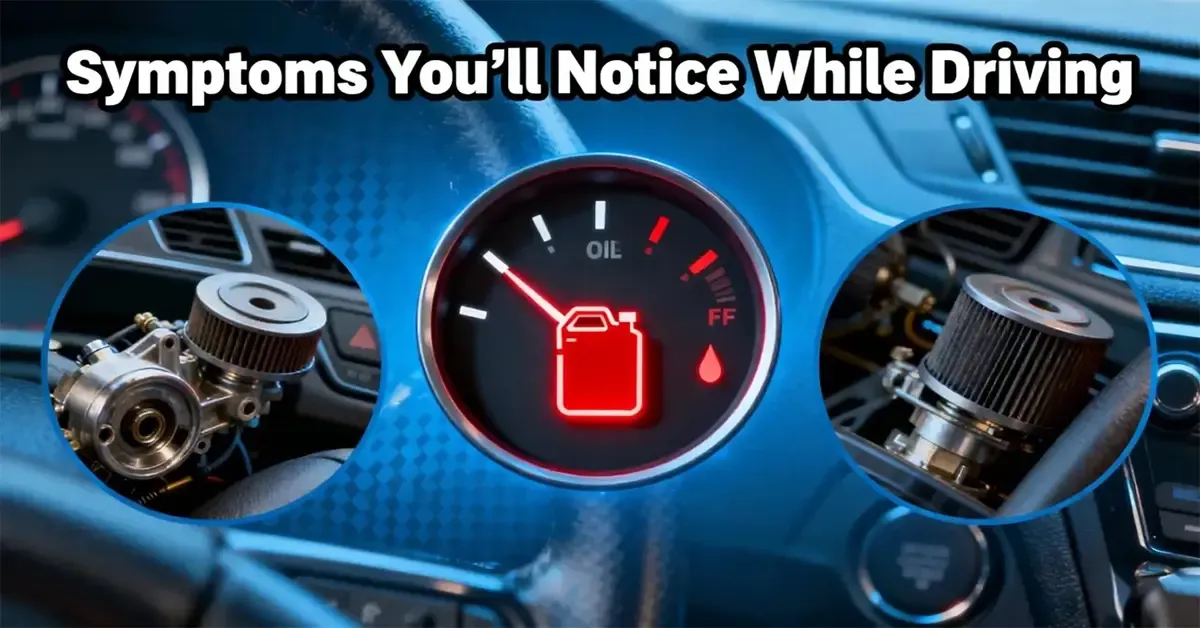
1. Oil Pressure Warning Light/Gauge
The most obvious sign: the red oil pressure light (shaped like an oil can) illuminates, or the gauge reads below normal. Key Distinction: A light that flickers at idle (but goes out at speed) usually means low oil level; a light that stays on at all RPMs indicates a serious issue (pump failure, bearing wear).2. Engine Noise (Knocking, Ticking)
Without proper lubrication, metal parts rub together: Deep Knocking: Rod or main bearing wear (oil can’t cushion the crankshaft). High-Pitched Ticking: Valve train parts (lifters, rockers) starved of oil. Noise gets louder with RPM—if you hear it, stop the engine immediately.3. Loss of Power & Poor Fuel Economy
Low oil pressure increases friction, making the engine work harder. You’ll notice sluggish acceleration, hesitation when revving, and a 10–15% drop in MPG. Diesel engines (higher compression) show this symptom more dramatically.4. Engine Overheating
Oil doesn’t just lubricate—it cools. Low pressure means less oil flows through hot parts (like the crankshaft and pistons), so heat builds up. The temperature gauge will climb above 220°F (104°C), even in normal driving.5. Oil Leaks or Burning Smells
Leaks (under the engine, around the valve cover) often precede low pressure. A burning smell (oil hitting hot exhaust parts) means oil is leaking onto the manifold—another sign of low levels or gasket failure.How Oil Pressure Failure Damages Bearings
Engine bearings depend entirely on a stable oil pressure to survive—they have no built-in “backup” for lubrication. When oil pressure drops, a predictable and destructive chain reaction unfolds, often rendering bearings (and sometimes the entire crankshaft) unsalvageable. Here’s the step-by-step breakdown of how this damage occurs:Oil Film Collapse (The Trigger): Bearings rely on a 0.001–0.003 inch thick oil film to separate their soft alloy surface from the crankshaft’s hard metal journal. This film acts as a cushion, preventing direct contact. When pressure falls below 5–10 psi (the minimum needed to maintain the film), the gap closes. For example, a failing oil pump might only deliver 3 psi at idle, letting the bearing “touch” the crankshaft.
Scoring & Abrasion (First Damage): The crankshaft spins at 500–3,000 RPM at idle—even brief metal-to-metal contact grinds away the bearing’s babbitt alloy (a lead-tin-copper mix designed for lubricity, not durability). This creates fine metal shavings that mix with the oil, turning it into an abrasive slurry that accelerates wear on other bearings and the oil pump.
Heat Buildup (Runaway Damage): Friction between the bearing and crankshaft generates extreme heat—temperatures can exceed 500°F (260°C) in seconds. This heat melts the remaining babbitt alloy, turning it into a sticky residue that bonds to the crankshaft journal. The once-smooth journal now develops “hot spots” and uneven wear, making it impossible to reuse without expensive machining.
Seizure & Catastrophic Failure (The End Result): As melted bearing material bonds to the crankshaft, the bearing can seize (lock) to the journal. The rotating crankshaft then bends the connecting rod (for rod bearings) or distorts the main bearing cap (for main bearings). A bent rod will punch a hole in the cylinder block or destroy the piston, while a seized main bearing locks the engine entirely—requiring a full replacement.
How to Test Oil Pressure
Low oil pressure warnings often trigger false alarms (e.g., a faulty sensor) or mask subtle issues (e.g., worn bearings). Testing pressure with reliable tools eliminates guesswork—here’s how to do it, whether you’re a DIYer or a professional:DIY Test: Manual Oil Pressure Gauge (For Home Garages)
This method costs $30–$70 and takes 20–30 minutes—no advanced skills needed. It’s the gold standard for ruling out sensor issues.Tools Needed: Digital or analog manual pressure gauge (ensure it matches your engine’s thread size—most use 1/8” NPT), socket set (deep sockets work best), thread sealant (PTFE tape or anaerobic sealant), rags, and safety glasses.Step-by-Step Process:Prep the Engine: Ensure the engine is cold (at least 4 hours since last use) and parked on level ground. Disconnect the negative battery terminal to avoid electrical shorts.
Locate the Sending Unit: Find the oil pressure sending unit—typically near the oil filter (on 4-cylinder engines) or the rear of the cylinder block (on V6/V8 engines). It looks like a small cylindrical part with an electrical connector.
Remove the Sending Unit: Disconnect the electrical connector (press the tab and pull gently). Use a socket to unscrew the sending unit—turn counterclockwise. Catch any dripping oil with a rag.
Install the Gauge: Wrap the gauge’s adapter with 2–3 turns of PTFE tape (to prevent leaks). Screw the adapter into the sending unit port by hand, then tighten 1/4 turn with a socket (don’t over-tighten—this strips the threads).
Run the Test: Reconnect the battery terminal. Start the engine and record pressure at three key stages:
Cold Idle (1–2 minutes): Normal = 25–40 psi. Low = Below 20 psi (indicates pump issues or low oil).
Warm Idle (10–15 minutes, engine at operating temp): Normal = 10–25 psi. Low = Below 10 psi (likely worn bearings or clogged galleries).
2,000 RPM (warm engine): Normal = 40–65 psi. Low = Below 35 psi (confirm pump failure or severe bearing wear).
Professional Tests (For Shops & Fleet Managers)
For complex issues or commercial vehicles, these tests provide deeper insights into root causes:Oil Analysis (Early Wear Detection): Send a 4-ounce oil sample to a lab like Blackstone Laboratories ($30–$50 per sample). The lab measures levels of lead (from babbitt bearings), copper (from bearing backing), and iron (from crankshaft wear). A spike in lead (e.g., 50+ ppm) indicates bearing wear before noise or pressure drops appear.
Borescope Inspection: Insert a flexible borescope through the spark plug hole or oil fill cap to visualize bearings and galleries ($150–$300 per inspection). This reveals sludge buildup, bearing scoring, or crankshaft damage without tearing down the engine—critical for fleet vehicles where downtime is costly.
Oil Pump Flow Bench Test: Remove the oil pump and test its output on a flow bench ($200–$400). A pump that delivers less than 5 gallons per minute (GPM) at 2,000 RPM (standard for most engines) is faulty—even if pressure tests seem “normal.” This catches weak pumps that fail under load (e.g., towing).
Repair Options & Cost Expectations
The cost of fixing low oil pressure hinges on two factors: the root cause and whether damage has spread to bearings or the crankshaft. Below is a detailed breakdown for common scenarios, including tips to avoid overpaying:Cause of Low Pressure | Repair Solution | Core Operation Tips | DIY Cost (Parts Only) | Professional Cost (Parts + Labor) |
|---|---|---|---|---|
Insufficient Oil (Low Level/Leaks) | Top off oil; replace leaking gaskets/seals | Use UV dye to find leaks; replace valve cover gaskets if oily residue is present | $25–$180 (synthetic oil + gasket kit) | $180–$600 (includes leak detection) |
Wrong Oil Viscosity | Drain oil; refill with OEM-specified viscosity | Check manual (e.g., 5W-30 for most 4-cylinders, 10W-40 for diesel trucks) | $40–$100 (full synthetic oil + premium filter) | $120–$250 (includes oil disposal) |
Clogged Filter/Galleries | Replace filter; flush oil system | Use hot oil flush (not chemical solvents) to avoid damaging seals | $30–$120 (filter + flush kit) | $250–$500 (includes gallery inspection) |
Faulty Sensor/Gauge | Replace oil pressure sensor/gauge | Test wiring first (use a multimeter) to avoid replacing good parts | $35–$90 (OEM sensor) | $160–$350 (includes electrical testing) |
Oil Pump Failure | Replace oil pump + pickup screen | Use Linkteco’s IATF-certified pumps (match OEM flow rates); clean pan thoroughly | $160–$450 (pump + gasket + screen) | $900–$2,000 (4-cylinders: $900–$1,400; V8s: $1,500–$2,000) |
Worn Bearings | Replace bearings + recondition crankshaft | Crankshaft must be micropolished (costs $200–$400); use oversized bearings if the journal is worn | Not recommended (requires engine stand + precision tools) $1,800–$3,500 (4-cylinders: $1,800–$2,500; diesels: $2,800–$3,500) |
|
FAQ
Q1: Can I drive with low oil pressure to get to a repair shop?
No—even 1 mile is risky. Low pressure means parts are already starved of oil. Driving can turn a $500 pump repair into a $5,000 engine replacement. Call a tow truck.Q2: Why does oil pressure drop when the engine is warm?
Warm oil is thinner (lower viscosity), so it flows more easily through bearings. If pressure drops only when warm, it’s likely: (1) low oil level, (2) worn bearings (increased clearance), or (3) thin oil (wrong viscosity).Q3: How often should I check oil pressure?
For passenger cars: Check during oil changes (every 5,000–7,500 miles). For fleets/diesel engines: Test monthly—high load and mileage accelerate wear. Use a manual gauge at least once per year to verify sensor accuracy.Q4: Will adding high-mileage oil fix low pressure?
High-mileage oil has viscosity boosters and seal conditioners, which can temporarily raise pressure in worn engines (by reducing bearing clearance leaks). It’s a band-aid, not a fix—always diagnose the root cause.Q5: Is low oil pressure covered by warranty?
Factory warranties cover defects (e.g., faulty oil pump), but not neglect (e.g., low oil levels, missed changes). Aftermarket warranties (Linkteco parts include 12–24 month coverage) cover failed replacement parts like pumps or bearings.Conclusion
Low oil pressure isn’t just a maintenance issue—it’s a threat to your engine’s lifespan. By understanding the causes (low oil, wrong viscosity, pump failure) and acting on symptoms (warning lights, knocking), you can avoid catastrophic damage and costly rebuilds. The key to long-term reliability? Use quality parts (like Linkteco’s oil pumps and bearings) and stick to a strict maintenance schedule. Whether you’re a repair shop owner sourcing bulk oil pumps or a fleet manager troubleshooting pressure issues, Linkteco has you covered: OEM-quality oil pumps, bearings, and gaskets—tested to SAE standards. Technical support from ASE-certified engineers (available 24/7).Bulk pricing and flexible MOQs to fit your business needs. Don’t wait for a warning light—proactively protect your engines. Visit Linkteco’s Oil Pump Wholesale page to browse replacement parts, or reach out via our Contact Page for a custom troubleshooting consultation. Our team will help you diagnose issues, source parts, and keep your engines running smoothly.
Contact
©2026 LinkTeco All Rights Reserved.