

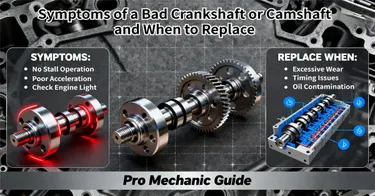
Symptoms of a Bad Crankshaft or Camshaft and When to Replace
Learn the symptoms of a failing crankshaft or camshaft—knocking, misfires, loss of timing—and when replacement is necessary.
The crankshaft and camshaft are two of your engine’s most critical moving parts—without them, your car won’t run. The crankshaft converts piston motion into rotational force (powering your wheels), while the camshaft controls valve timing (ensuring air/fuel and exhaust flow correctly). When either fails, it can lead to costly engine damage—or even a complete breakdown—if not addressed quickly.
For DIY mechanics, fleet managers, or repair shop owners, knowing the symptoms of a bad crankshaft or camshaft is key to diagnosing issues early. This guide breaks down how to spot failure signs, explains why these parts fail, and helps you decide when replacement (not just repair) is necessary. We’ll also tie in insights for wholesale buyers—like how Linkteco’s OEM-quality crankshafts and camshafts deliver long-term reliability.
What the Crankshaft and Camshaft Do in Your Engine
Before diving into symptoms, let’s recap the core roles of these parts—context that helps you understand why failures cause such big problems:
The Crankshaft: Engine “Power Translator”
The crankshaft is a heavy, forged steel shaft running through the bottom of the engine block. Its job is to:
- Connect to pistons via connecting rods, turning the pistons’ up-down (linear) motion into rotational motion.
- Transfer this rotational force to the flywheel, transmission, and ultimately your wheels.
- Work with the oil system: Oil galleries in the crankshaft lubricate its bearings, reducing friction from high-speed rotation (up to 6,000 RPM in passenger cars).
Think of it as the engine’s “drive shaft”—without it, piston power has no way to reach the wheels.
The Camshaft: Valve “Traffic Controller”
The camshaft is a long, hardened steel shaft (usually in the cylinder head or engine block) with egg-shaped “lobes” (cams). Its job is to:
- Open and close intake and exhaust valves at precise times during the four-stroke cycle (intake, compression, power, exhaust).
- Rotate at half the crankshaft’s speed (1 rotation per 2 crankshaft rotations) to keep valve timing in sync with piston movement.
- Work with the timing belt/chain: A belt or chain links the camshaft to the crankshaft, ensuring perfect synchronization.
If the camshaft’s lobes wear down or timing slips, valves open/close at the wrong time—causing misfires, power loss, or even valve-piston collisions.
To learn more about how these parts work with pistons, check out our guide: How Pistons, Crankshafts, and Camshafts Work Together.
Symptoms of a Failing Crankshaft
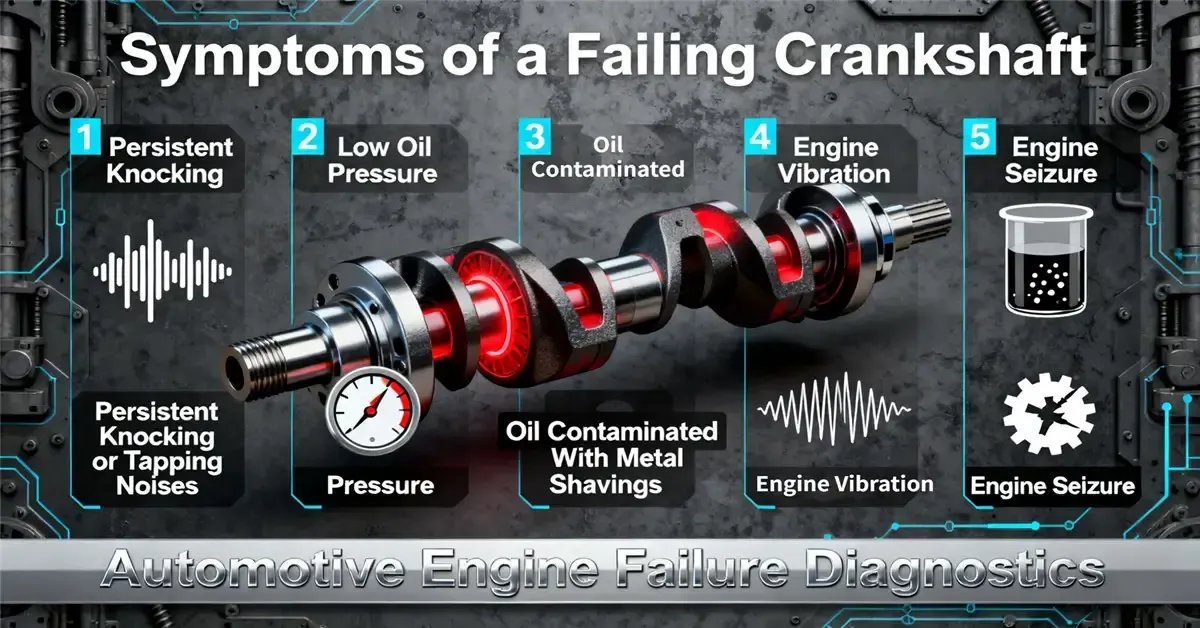
Crankshaft failure is often gradual—symptoms get worse over time as wear or damage progresses. Here are the most common red flags:
1. Persistent Knocking or Tapping Noises (From the Engine Bottom)
A knocking sound coming from the lower part of the engine (near the oil pan) is a classic sign of crankshaft bearing wear. Here’s why:
- The crankshaft rests on “main bearings” (in the engine block) and connects to pistons via “connecting rod bearings.” Over time, these bearings wear down, creating gaps between the crankshaft and bearings.
- When the engine runs, the crankshaft shifts in these gaps, causing a rhythmic knocking or tapping sound (louder at high RPM or under load, like accelerating).
Why it matters: If bearings fail completely, the crankshaft will grind against the engine block—destroying both parts and requiring a full engine rebuild.
2. Low Oil Pressure (Warning Light or Gauge)
Most modern cars have an oil pressure warning light (or gauge) on the dashboard. If it illuminates, low oil pressure could signal crankshaft issues:
- Worn main or connecting rod bearings create larger gaps, allowing oil to leak out of the bearing surfaces. This reduces overall oil pressure in the engine.
- A cracked crankshaft (rare but serious) can also leak oil from its internal galleries, dropping pressure.
Why it matters: Low oil pressure means the crankshaft isn’t getting enough lubrication—leading to faster wear and potential seizure (engine locking up).
3. Oil Contaminated With Metal Shavings
Check your engine oil during an oil change—if you see silver or gold metal shavings (often visible on the oil dipstick or drain plug), it’s a sign of crankshaft wear:
- Worn bearings shed tiny metal particles into the oil as they rub against the crankshaft.
- Severe wear may even produce larger metal flakes (a sign the crankshaft itself is scraping against other parts).
Why it matters: Metal shavings circulate through the oil system, damaging other parts (pistons, camshaft) and accelerating engine failure.
4. Engine Vibration (Worse at Idle or Low Speed)
A failing crankshaft causes uneven rotation, leading to excessive engine vibration:
- Worn bearings let the crankshaft wobble as it spins, transferring vibration to the engine block and cabin (you’ll feel it in the steering wheel or seat).
- A bent crankshaft (from a collision or overheating) also causes vibration, as its rotation is no longer balanced.
Why it matters: Vibration can loosen other engine parts (like bolts or hoses) and damage gaskets (leading to oil or coolant leaks).
5. Engine Seizure (Worst-Case Scenario)
If crankshaft issues are ignored, the engine will eventually seize (lock up) and stop running. This happens when:
- Bearings fail completely, causing the crankshaft to grind against the engine block.
- Low oil pressure leads to catastrophic friction and overheating.
Why it matters: Engine seizure usually requires a full replacement—costing 2–3x more than replacing a failing crankshaft early.
Symptoms of a Bad Camshaft
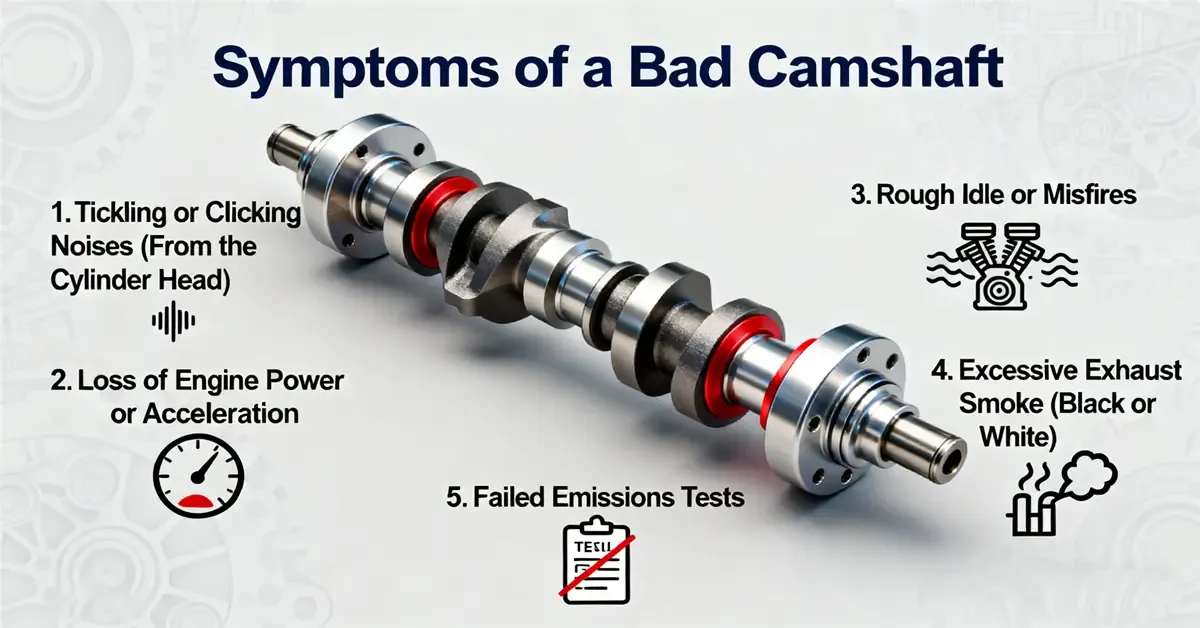
1. Tickling or Clicking Noises (From the Cylinder Head)
A ticking or clicking sound coming from the top of the engine (near the valve cover) is a common sign of camshaft lobe wear:
- The camshaft’s lobes push against valve lifters (or rocker arms) to open valves. When lobes wear down, they don’t push the lifters as far—creating a gap that causes ticking as parts tap together.
- A loose or broken timing belt/chain can also cause camshaft misalignment, leading to similar noises.
Why it matters: Worn lobes mean valves don’t open fully, reducing airflow and engine power.
2. Loss of Engine Power or Acceleration
If your car feels sluggish when accelerating or struggles to reach high speeds, a bad camshaft could be the cause:
- Worn camshaft lobes reduce valve lift (how far valves open) or duration (how long valves stay open). This limits the amount of air/fuel entering the cylinders and exhaust leaving—cutting power.
- Camshaft timing slip (from a broken timing belt) causes valves to open/close at the wrong time, leading to incomplete combustion and power loss.
Why it matters: A 10–20% power loss is common with mild camshaft wear, worse with severe damage.
3. Rough Idle or Misfires
A rough, shaky idle (or the engine sputtering when stopped) often points to camshaft issues:
- Timing slip or lobe wear causes some cylinders to get too little (or too much) air/fuel, leading to misfires (uneven combustion).
- You may also notice the “check engine” light illuminate, with diagnostic codes like P0300 (random misfire) or P0340 (camshaft position sensor error).
Why it matters: Misfires waste fuel (lowering MPG by 10–15%) and can damage the catalytic converter over time.
4. Excessive Exhaust Smoke (Black or White)
Unusual exhaust smoke is a warning sign of camshaft-related combustion problems:
- Black smoke: Too much fuel entering the cylinders (caused by intake valves staying open too long due to camshaft timing slip).
- White smoke (not from cold weather): Coolant leaking into cylinders (if a worn camshaft seal allows coolant to seep into the cylinder head).
Why it matters: Black smoke means poor fuel efficiency; white smoke signals coolant contamination (which can destroy the engine if ignored).
5. Failed Emissions Tests
If your car fails an emissions test, a bad camshaft may be to blame:
- Incorrect valve timing (from camshaft wear or timing slip) leads to incomplete combustion, increasing emissions of hydrocarbons (HC) or carbon monoxide (CO).
- Many modern cars use camshaft position sensors to adjust fuel injection—if the camshaft is faulty, the sensor sends wrong data, worsening emissions.
Why it matters: Failed emissions tests mean your car isn’t road-legal in most regions—you’ll need to fix the issue to drive legally.
When Replacement Is Better Than Repair
In some cases, you might wonder: Can I repair a bad crankshaft or camshaft, or do I need to replace it? Here’s how to decide:
When to Replace a Crankshaft (Not Repair)
Crankshafts are rarely repairable—replacement is almost always better because:
- Worn bearings: Bearings can be replaced, but if the crankshaft’s bearing surfaces are scratched or worn (a common side effect), the crankshaft itself won’t seal properly with new bearings.
- Bent or cracked crankshaft: Even minor bending (from overheating or impact) can’t be fixed reliably—attempting to straighten it often leads to further cracking.
- Cost vs. reliability: A new crankshaft (like Linkteco’s forged steel models) costs 30–50% less than repairing a damaged one—and comes with a warranty (24 months for Linkteco wholesale buyers).
When to Replace a Camshaft (Not Repair)
Camshafts have limited repair options—replacement is smarter in most cases:
- Worn lobes: Camshaft lobes can’t be “resurfaced” to restore their original shape—worn lobes will always cause valve timing issues, even with new lifters.
- Timing gear/sprocket damage: If the camshaft’s timing gear (or sprocket) is stripped, replacing just the gear rarely works—misalignment between the gear and camshaft leads to timing slip.
- Camshaft seizures: If the camshaft locks up (from lack of oil), it often damages the cylinder head—replacing the camshaft is necessary to avoid further head damage.
Exception: Minor issues like a loose camshaft sensor (not a faulty camshaft itself) can be repaired by tightening or replacing the sensor. Always diagnose the root cause first (e.g., use a code scanner for camshaft position errors) before deciding to replace.
FAQ
1. Can you drive with a bad crankshaft or camshaft?
No—driving with a failing crankshaft or camshaft is extremely risky:
- A bad crankshaft can seize the engine while driving, causing a sudden loss of power (dangerous in traffic or at high speeds).
- A bad camshaft can lead to valve-piston collisions (if timing slips completely)—this bends valves and destroys the cylinder head, costing 2,000–5,000 in repairs.
If you notice any symptoms, stop driving the car and have it towed to a repair shop.
2. Is camshaft or crankshaft replacement expensive?
Cost depends on the vehicle and part quality, but here’s a typical range (parts + labor):
- Crankshaft replacement:1,500–3,500 (passenger cars); 3,000–6,000 (trucks/heavy-duty vehicles). Linkteco’s Crankshaft Wholesale parts reduce costs by 30–40% for repair shops buying in bulk.
- Camshaft replacement: 1,200–2,500 (passenger cars); 2,000–4,000 (trucks). The higher cost for trucks comes from larger camshafts and more labor to access the cylinder head.
Pro tip: For fleet managers or repair shops, buying bulk parts from Linkteco cuts per-unit costs—e.g., 10+ camshafts cost 25% less than single-unit retail purchases.
3. How long do crankshafts and camshafts usually last?
With proper maintenance (regular oil changes, using the right oil viscosity),:
- Crankshafts: 200,000–300,000 miles (320,000–480,000 km) for passenger cars; 150,000–250,000 miles for trucks.
- Camshafts: 150,000–250,000 miles for passenger cars; 100,000–200,000 miles for trucks (due to higher load).
Linkteco’s crankshafts and camshafts are engineered for longer life—our forged steel crankshafts undergo 50,000-cycle fatigue testing, and our camshaft lobes are induction-hardened to resist wear.
4. How can I prevent crankshaft and camshaft failure?
The best prevention is regular maintenance:
- Change oil on schedule: Use the manufacturer-recommended oil (e.g., 5W-30 for most gasoline engines) and change it every 5,000–7,500 miles. Oil keeps crankshaft bearings and camshaft lobes lubricated.
- Replace the timing belt/chain: Follow the manufacturer’s schedule (usually 60,000–100,000 miles) to replace the timing belt/chain—failure here causes camshaft timing slip and crankshaft damage.
- Fix leaks early: Oil or coolant leaks reduce lubrication and cause overheating—both major causes of crankshaft/camshaft failure.
Conclusion
The crankshaft and camshaft are the backbone of your engine—catching their failure early saves you from costly rebuilds and dangerous breakdowns. Whether you’re a DIY mechanic noticing a knocking noise or a repair shop owner diagnosing misfires, knowing the symptoms and acting fast is key.
For wholesale buyers (repair shops, fleet managers, distributors), choosing high-quality replacement parts is just as important as early diagnosis. Linkteco’s crankshafts and camshafts are:
- OEM-quality: Forged steel crankshafts and induction-hardened camshafts that match factory specs for 95% of vehicle models.
- Cost-effective: Bulk discounts (30–40% off retail) for 10+ units, with 85% in-stock availability to avoid repair delays.
- Warranty-backed: 24-month warranties to protect your business from defective parts.
Ready to stock up on reliable crankshafts, camshafts, or other engine parts?
- Browse our Crankshaft Wholesale page to view our full lineup.
- Have questions about part fitment or bulk pricing? Reach out via our Contact Page—our technical team responds within 24 hours.
Don’t let low-quality parts lead to repeat repairs. Trust Linkteco to keep your engines (and your business) running smoothly.

Catalog
Quick Link
Support
Contact
Tel: +8619168959101
Email: info@linktecowholesale.com
Add: 12/F, Building 3C, TianAn Cloud Park Phase 1, Bantian, Longgang District, Shenzhen, 518129, China
©2026 LinkTeco All Rights Reserved.