

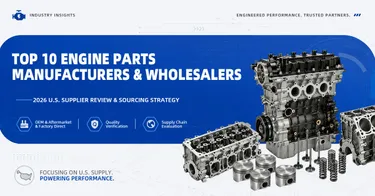
2026 USA Auto Parts Sourcing Guide: Top 10 Engine Parts Manufacturers & Suppliers
Summary
- Reviews 10 leading engine parts manufacturers and suppliers serving the USA Auto Parts market, including established aftermarket brands such as Dorman, Melling, and Silver Seal.
- Explains how procurement teams can evaluate suppliers using four critical sourcing metrics: product availability, engineering verification, catalog accuracy, and compliance traceability.
- Compares OEM and aftermarket sourcing models from a supply chain perspective, focusing on landed cost, lead-time management, inventory performance, and procurement flexibility.
- Examines how factory-direct sourcing strategies can help distributors improve margin protection, production visibility, and private-label development opportunities.
- Provides a practical framework for building a resilient engine parts supply network in 2026 and beyond.
Navigating the usa auto parts wholesale market in 2026 requires balancing rigid supply chains against volatile global logistics. According to the recent 2026 Joint Channel Market Size and Forecast released by the Auto Care Association and MEMA, the U.S. light-duty automotive aftermarket is projected to grow by 5.2% this year, driven by an aging domestic fleet and rising fleet maintenance costs. For international procurement managers, large-scale engine remanufacturers, and heavy-duty distributors, selecting the right partner is no longer just about scouting product catalogs; it is a strategic decision that directly impacts operational cash flow, warranty risk mitigation, and catalog compatibility precision.
The primary purpose of this strategic guide is to dissect and demystify the U.S. internal engine supply network, providing B2B buyers with an uncompromised, expert-level evaluation of the top 10 suppliers driving the market. By peeling back the marketing layers of legacy automotive parts distributors and emerging factories, we aim to deliver an objective analysis of their primary product portfolios—ranging from full-scale long block engine assembly components to everyday high-volume engine rebuild kits. Crucially, this report looks beyond surface-level specifications to expose the real operational bottlenecks that disrupt international trade: exact MOQ structural thresholds and real-world manufacturer lead times. Ultimately, this benchmark analysis serves as your tactical playbook to identifying a high-efficiency car engine parts supplier that aligns with your volume requirements, scales your inventory, and maximizes your 2026 purchasing margins.
Engine Parts Supplier Comparison Matrix
Selecting an engine parts supplier requires evaluating more than product availability. Procurement teams typically compare quality certifications, minimum order quantities, production lead times, and supply chain capabilities before making sourcing decisions.
The evaluation matrix below reviews ten well-known engine component suppliers serving the North American aftermarket. The assessment focuses on publicly available information related to certifications, order requirements, manufacturing lead times, and distribution models available at the time of publication.
Supplier Evaluation Matrix:
| Supplier Name | Quality Certifications | Standard Order Requirements (MOQ) | Typical Lead Time Profiles | Primary Product Portfolio Focus | Standard Distribution Model |
|---|---|---|---|---|---|
| Dorman Products Inc. | ISO 9001 / ISO 14001 | Tiered by Warehouse Distributor (WD) Program | 2 - 5 Days (US Domestic Stock) | Replacement Hardware & VVT Systems | Domestic Multi-Tier Distribution |
| Fel-Pro (DRiV) | IATF 16949 / ISO 9001 | High-Volume WD Account Minimums | 30 - 45 Days (Production Cycle) | Sealing Technologies & Gaskets | Multi-Tier Wholesale Network |
| MAHLE Aftermarket NA | IATF 16949 / ISO 14001 | Bulk Pallet / Container Programs | 45 - 60 Days (Metallurgy Run) | Pistons, Rings & Heavy-Duty Parts | OEM & Tier-1 Sourcing Channels |
| Linkteco | IATF 16949 / ISO 9001 | 50 - 100 Sets (Production Tier) | 7 - 15 Days (Factory Dispatch) | Engine Rebuild Kits & Valvetrain | Factory-Direct Export |
| Melling Engine Parts | ISO 9001:2015 | Regional Jobber / WD Minimums | 14 - 30 Days (Casting Batches) | Oil Pumps & Internal Lubrication | Independent Distributor Network |
| Cloyes Gear & Products | ISO 9001 / IATF 16949 | Case-Pack Minimums | 20 - 30 Days (Kit Sorting) | Timing Chains & Sprockets | Two-Step Warehouse Distribution |
| Cardone Industries | ISO 9001 / ISO 14001 | Core-Deposit & Reman Exchange Terms | 5 - 10 Days (Reman Depots) | Remanufactured Powertrain Units | Regional Core-Exchange Model |
| Edelbrock | ISO 9001 | Authorized Dealer Minimums | 10 - 20 Days (Foundry Batches) | Performance Castings & Heads | Performance Jobber Distribution |
| Flex-N-Gate Corp. | IATF 16949 / ISO 14001 | Direct OE Contract Volumes Only | 90 - 120 Days (Tooling Setup) | Automotive Structural Components | Tier-1 Direct-to-Assembly Line |
| Federal-Mogul / DRiV | IATF 16949 / ISO 9001 | Consolidated Group Purchasing Minimums | 45 - 60 Days (Legacy Plant Run) | Internal Engine Replacement Parts | Consolidated Corporate Sourcing |
Which Supplier Fits Your Business Model?
Procurement teams rarely look for the "best" overall supplier; instead, they select partners whose operational profiles match their specific business models.
| Buyer Profile / Business Model | Recommended Supplier Profile | Alignment Logic |
|---|---|---|
| National Distributors / WDs | Dorman / MAHLE / Fel-Pro | Requires deep domestic inventory and established multi-tier distribution channels. |
| OE Program Buyers / Automakers | Flex-N-Gate | Requires Tier-1 dedicated tooling capacity and direct assembly line integration. |
| Performance & Tuning Outlets | Edelbrock | Geared toward performance jobbers and high-margin specialty engine builders. |
| Regional Importers / Wholesalers | Linkteco / Cloyes | Requires factory-direct pricing for scheduled inventory replenishment on high-turnover components. |
| Low-MOQ Factory Direct Buyers | Linkteco | Fits businesses shifting away from domestic warehouse markups toward agile, factory-direct import programs. |
Quality Risk Mitigation: Suppliers certified to IATF 16949 typically maintain stricter production controls and traceability procedures, helping reduce quality variation and warranty-related risks on critical valvetrain components.
Inventory Capital Efficiency: Traditional two-step sourcing provides fast availability for immediate shortages but introduces layered channel margins. Managing scheduled inventory for high-volume engine rebuild kits via a factory-direct model allows procurement teams to minimize domestic distributor markups and balance landed cost.
Top 10 Engine Parts Suppliers: Comprehensive Profiles
1. Dorman Products Inc.
Company Snapshot:
Headquartered in Colmar, Pennsylvania, Dorman Products Inc. is a major aftermarket parts supplier serving the North American automotive repair and maintenance sector. The company is recognized for its broad application coverage and extensive catalog of replacement components designed to address common original equipment (OE) service challenges. Its distribution footprint facilitates high product visibility across both traditional warehouse operations and major retail networks.
Core Product Categories:
Variable Valve Timing (VVT) components, intake/exhaust manifolds, integrated oil filter adapter housings, engine harmonic balancers, and specialized automotive hardware.
Supply Chain Characteristics:
Dorman primarily utilizes a multi-tiered domestic distribution model. Components move from national fulfillment centers through established warehouse distributors (WDs), regional jobber networks, and automotive retail programs. Consequently, product availability and fulfillment lead times are heavily dictated by localized distributor inventory positioning and regional stock levels rather than direct factory production scheduling.
Procurement Perspective:
From a sourcing standpoint, Dorman can help buyers reduce supply chain complexity when dealing with low-volume or highly application-specific components. Utilizing their established portfolio often shortens the initial product evaluation process compared with developing alternative manufacturing solutions from scratch.
Best Fit Buyers:
- North American warehouse distributors managing broad, mixed-SKU inventory programs.
- Commercial fleet operators requiring immediate domestic shipping options to minimize vehicle downtime.
- Aftermarket procurement teams seeking established replacement solutions for known OE failure points.
Sourcing Considerations:
- The multi-tier distribution structure may influence total landed cost compared with sourcing models that involve fewer intermediary channels.
- Buyers prioritizing private-label programs or highly customized component specifications may need to evaluate alternative sourcing options depending on specific project requirements.
Website: dormanproducts.com
2. Fel-Pro (Federal-Mogul Motorparts)
Company Snapshot:
Headquartered in Skokie, Illinois, Fel-Pro is a highly prominent aftermarket brand within the DRiV Automotive Inc. portfolio, a division of Tenneco. The brand is recognized across the global service sector for specializing in industrial-grade sealing technologies and gaskets. Operating with deep manufacturing roots in North America, Fel-Pro utilizes highly automated production facilities to support extensive vehicle application coverage for domestic and import passenger and commercial engines.
Core Product Categories:
Cylinder head gaskets, intake and exhaust manifold gaskets, valve cover gasket sets, oil pan gaskets, and complete engine overhaul sealing kits.
Supply Chain Characteristics:
Fel-Pro operates under a high-volume corporate fulfillment structure managed by DRiV. Components are distributed to the market through major national warehouse distributors (WDs), buying groups, and Tier-1 wholesale networks. Production runs and inventory availability follow strict corporate planning cycles, making localized stock positions dependent on consolidated warehouse allocation rather than direct, small-scale factory dispatch.
Procurement Perspective:
From a sourcing standpoint, Fel-Pro provides long-term reliability and low warranty-related risks for operations managing critical engine rebuilds. Sourcing from this established brand reduces product validation overhead for sealing components, where material tolerances are vital to preventing premature engine failure.
Best Fit Buyers:
- Large-scale engine rebuild facilities requiring highly standardized, field-tested sealing components.
- National warehouse distributors looking to maintain premium-tier, high-turnover gasket programs.
- Procurement teams seeking comprehensive, vehicle-specific sealing kits to simplify multi-component sourcing.
Sourcing Considerations:
- The standardized brand tier and corporate distribution structure are optimized for high-volume contract accounts, which may involve fixed account-opening requirements for direct volume access.
- Buyers prioritizing direct, mid-volume factory modifications or customized contract packaging requirements may need to evaluate alternative manufacturing sources.
Website: felpro.com
3. MAHLE Aftermarket North America
Company Snapshot:
Headquartered in Farmington Hills, Michigan, MAHLE Aftermarket Inc. operates as the specialized distribution and service division of the global MAHLE Group. The company manages an extensive portfolio of precision internal engine components, leveraging the parent corporation’s position as a prominent Tier-1 original equipment (OE) developer. In North America, the division supports light vehicle, commercial heavy-duty, and performance racing sectors, distributing through core proprietary brands including MAHLE Original and Clevite.
Core Product Categories:
Pistons and cylinder sleeve assemblies, piston rings, engine bearings (including heavy-duty Clevite applications), valves, gaskets, and engine filtration systems.
Supply Chain Characteristics:
MAHLE coordinates its logistical fulfillment via centralized national distribution hubs, notably its primary infrastructure in Olive Branch, Mississippi. The supply chain moves through established national warehouse distributor (WD) networks, heavy-duty fleet specialists, and major engine builder buying groups. Product pipeline availability aligns closely with OE-level manufacturing runs and global import logistics, meaning specific oversized or low-volume technical sizes are subject to fixed global production scheduling rather than local factory adjustments.
Procurement Perspective:
From a sourcing standpoint, MAHLE reduces engineering validation overhead for buyers managing high-load or premium powertrain components. Sourcing from this division provides access to pre-established OE-specification tolerances, which simplifies multi-component precision alignment (such as matched piston-and-liner sleeve sets) and lowers warranty risks on heavy-duty engine overhauls.
Best Fit Buyers:
- Heavy-duty commercial fleet maintenance operations and high-volume diesel engine remanufacturers requiring Clevite-grade bearings and sleeve assemblies.
- Tier-1 warehouse distributors seeking comprehensive, OE-equivalent engine component programs with high market recognition.
- Precision engine builders requiring strict structural tolerances for specialized or high-performance power units.
Sourcing Considerations:
The multi-tier distribution model and OE-integrated cost structure may influence total landed cost compared with factories specializing purely in direct, high-volume generic aftermarket casting.
Procurement managers seeking highly modified structural designs or direct, private-label packaging options for niche private brands may need to evaluate alternative manufacturing sources.
Website: mahle-aftermarket.com
4. Cloyes Gear & Products, Inc.
Company Snapshot:
Headquartered in Fort Smith, Arkansas, Cloyes Gear & Products, Inc. is a specialized aftermarket developer and manufacturer focused exclusively on automotive timing drive systems. With over a century of operational history, the company maintains a prominent position as a critical timing supplier to both original equipment manufacturers and the global automotive aftermarket. Cloyes operates dedicated engineering and distribution facilities, leveraging specialized manufacturing expertise to cover extensive vehicle applications for domestic and import nameplates.
Core Product Categories:
Timing chain kits (including chains, sprockets, tensioners, and guides), variable valve timing (VVT) actuators, timing belts, and heavy-duty gear sets.
Supply Chain Characteristics:
Cloyes manages fulfillment through centralized national warehousing infrastructure. Components are distributed to the market via a structured two-step warehouse distribution model, supplying national warehouse distributors (WDs), major buying groups, and automotive retail programs. Lead times and localized inventory allocation are closely aligned with seasonal aftermarket replenishment cycles and domestic logistics channels rather than direct factory-floor scheduling.
Procurement Perspective:
From a sourcing standpoint, Cloyes helps procurement teams minimize supply chain liability on high-risk, mission-critical valvetrain groups. Sourcing pre-packaged, complete timing kits under an established brand ensures precise inter-component tolerance matching, which reduces sourcing complexity and lowers warranty risks compared with piecing together individual timing drive components from multiple independent factories.
Best Fit Buyers:
- North American warehouse distributors looking to establish comprehensive, single-source timing component programs with strong brand recognition.
- Large-scale engine remanufacturers and commercial fleet operations requiring highly standardized, field-tested timing kits to streamline assembly lines.
- Aftermarket buyers requiring verified component-to-component system matching to minimize timing drive failure risks.
Sourcing Considerations:
- The specialized, distributor-focused fulfillment model incorporates intermediary channel layers that may influence total landed cost for high-volume international wholesalers compared with direct manufacturer sourcing models.
- Procurement managers seeking alternative, non-standard component configurations, private-label packaging, or direct-to-factory customized kit sorting may need to evaluate alternative contract manufacturing options.
5. Melling Engine Parts

Company Snapshot:
Headquartered in Jackson, Michigan, Melling Engine Parts (Melling Tool Company) is a premier manufacturer and supplier of fluid power products and internal engine components for the global automotive aftermarket and original equipment (OE) sectors. Operating extensive, vertically integrated domestic manufacturing facilities, the company has built its market position on engineering expertise in oil pump design. Melling is widely utilized as a standard technical baseline for oil distribution and valvetrain synchronization across heavy-duty, performance, and high-volume passenger vehicles.
Core Product Categories:
Standard, high-volume, and high-pressure oil pumps, camshafts, timing components, valve springs, pushrods, rocker arms, and cylinder sleeves.
Supply Chain Characteristics:
Melling maintains centralized domestic manufacturing and shipping hubs to coordinate global fulfillment. The brand leverages a highly established warehouse distribution model, routing inventory through major North American buying groups, traditional warehouse distributors (WDs), and engine builder specialty jobber networks. Production lead times for non-stock items are structured around high-volume manufacturing runs, making localized distributor stock levels the primary driver of immediate order fulfillment rather than custom production scheduling.
Procurement Perspective:
From a sourcing standpoint, Melling helps procurement teams mitigate systemic lubrication system risks on high-value engine overhauls. Procuring from a vertically integrated manufacturer ensures consistent metallurgy and strict adherence to geometric tolerances, which reduces technical validation overhead and minimizes warranty claims associated with fluid distribution failure.
Best Fit Buyers:
- Large-scale commercial engine remanufacturers requiring reliable, bulk-packaged oil pumps and core valvetrain hardware.
- Tier-1 warehouse distributors seeking to stock a highly recognizable, engineering-backed oil distribution program.
- Procurement operations aiming to bundle oil delivery systems with matching valvetrain components from a single, pre-validated manufacturer.
Sourcing Considerations:
- The specialized, multi-tiered brand distribution model includes structural channel layers that may increase total landed costs for high-volume international importers compared with unbranded factory-direct casting suppliers.
- Buyers requiring direct, short-run private label packaging or customized modifications on standard valvetrain specifications may need to evaluate alternative contract manufacturing options depending on the scope of the project.
Website: melling.com
6. Cardone Industries
Company Snapshot:
Headquartered in Philadelphia, Pennsylvania, Cardone Industries operates as a major provider of remanufactured and new automotive components within the North American aftermarket. The company has established a prominent market footprint through its specialized engineering capability in automotive reverse engineering and electronic integration. Cardone operates substantial domestic and regional distribution hubs to manage complex core-return programs and supply parts portfolios across major light vehicle and commercial fleet maintenance networks.
Core Product Categories:
Remanufactured and new electronic throttle bodies, vacuum power brake boosters, power steering pumps, wiper motors, and engine control modules (ECUs).
Supply Chain Characteristics:
Cardone utilizes a fulfillment framework driven by broad-market distribution networks. Finished inventory moves through multi-tiered channels including major warehouse distributors (WDs), national retail buying groups, and industrial procurement contracts. Because a significant portion of its business relies on remanufacturing programs, localized availability and replenishment timelines are frequently tied to specific core-exchange logistics and regional reverse-supply chain efficiency rather than traditional new-component factory production runs.
Procurement Perspective:
From a sourcing standpoint, Cardone helps procurement teams optimize supply chain efficiency when managing high-complexity, low-turnover electronic or mechatronic assemblies. Sourcing from this established aftermarket entity provides access to cost-effective alternatives to premium OE replacement parts, reducing product evaluation efforts for complex components where integrated software calibration or specific reverse-engineering validation is required.
Best Fit Buyers:
- North American warehouse distributors looking to establish high-turnover remanufactured and new replacement component programs under a single recognized brand.
- Commercial fleet operators managing diverse application age groups requiring rapid domestic replacement options for high-cost assemblies.
- Aftermarket buyers seeking localized, technical alternatives for complex mechanical and electronic service lines.
Sourcing Considerations:
- The structured distribution and core-return exchange system involves specific logistical requirements that may influence total landed cost for long-distance international importers who cannot participate efficiently in local core-return programs.
- Procurement operations requiring strict, factory-direct private label control or custom-engineered physical component alterations may need to evaluate alternative manufacturing sourcing strategies based on specific project goals.
Website: cardone.com
7. Edelbrock (Part of Edelbrock Group)
Company Snapshot:
Headquartered in Olive Branch, Mississippi, Edelbrock is a highly prominent brand within the Edelbrock Group portfolio, which also encompasses COMP Cams, TCI Automotive, and FAST. The brand has built an international reputation by specializing in high-performance powertrain upgrades and premium aluminum castings. Backed by extensive domestic foundry and engineering operations, Edelbrock serves performance street, racing, and specialized marine restoration markets, positioning it as a key technical supplier for high-horsepower power unit applications.
Core Product Categories:
Aluminum intake manifolds, performance cylinder heads, carburetors, electronic fuel injection (EFI) systems, performance camshafts, and supercharger systems.
Supply Chain Characteristics:
Edelbrock coordinates wholesale fulfillment via centralized, advanced warehousing infrastructure in Mississippi. Finished component allocation moves through major national performance warehouse distributors (WDs), specialist buying groups, and high-tier motorsport retail networks. Its manufacturing pipelines follow scheduled production runs linked to domestic casting capacity, meaning localized distributor stocking strategies heavily influence real-time product availability rather than custom, on-demand factory dispatch.
Procurement Perspective: From a sourcing standpoint, Edelbrock can help procurement teams reduce technical validation risks when managing specialty performance or heavy-duty engine modification programs. Sourcing from this established foundry-backed operation provides access to advanced metallurgy and dyno-tested specifications, which lowers initial engineering and validation effort compared with developing custom cast-aluminum configurations independently.
Best Fit Buyers:
- Performance warehouse distributors and specialty motorsport jobber networks looking to maintain premium-tier, high-demand engine upgrade programs.
- Specialty vehicle builders, crate engine assemblers, and restoration facilities requiring highly standardized, premium aluminum casting components.
- Procurement managers seeking integrated intake-and-head packages backed by verified domestic engineering.
Sourcing Considerations:
- The premium brand positioning and structural multi-tier distribution network encompass channel margins that may influence total landed cost for high-volume wholesalers compared with direct commercial contract foundries.
- Buyers prioritizing direct-to-factory contract private labeling or high-volume standard generic passenger replacement lines may need to evaluate alternative high-capacity manufacturing sources.
8. Flex-N-Gate Corporation

Company Snapshot:
Headquartered in Urbana, Illinois, Flex-N-Gate Corporation is a massive, vertically integrated Tier-1 original equipment (OE) manufacturer supplying the global automotive industry. Unlike typical aftermarket brand programs, the company focuses heavily on large-scale manufacturing contracts, engineering, and high-volume metal stamping, plastic molding, and mechanical assemblies. Operating dozens of manufacturing and product development facilities across North America, Flex-N-Gate serves as a direct critical supply chain asset for major global vehicle manufacturers.
Core Product Categories:
Large stamped metal engine brackets, structural powertrain mounts, integrated bumper systems, complex plastic molded engine trim, and welded structural sub-assemblies.
Supply Chain Characteristics:
Flex-N-Gate operates under an OE-direct contract manufacturing model characterized by strict Just-In-Time (JIT) logistics and long-term program commitments. Fulfillment and production scheduling are integrated directly into vehicle manufacturer assembly pipelines rather than aftermarket warehouse shelves. The supply chain requires high-volume predictability, formalized electronic data interchange (EDI) setups, and compliance with stringent automotive quality standards (such as IATF 16949).
Procurement Perspective:
From a sourcing standpoint, Flex-N-Gate provides unmatched structural manufacturing capacity and rigorous validation controls for high-volume procurement programs. Engaging with a supplier of this scale allows buyers to manage massive production runs for heavy-gauge metal or precision molded components, shifting manufacturing scalability risk away from the purchasing organization on major multi-year contracts.
Best Fit Buyers:
- Original equipment vehicle manufacturers seeking high-volume, Tier-1 contract manufacturing partner programs for structural or cosmetic components.
- Large-scale commercial vehicle developers requiring deeply validated, fleet-wide structural component production runs.
- High-volume industrial procurement operations requiring advanced, vertically integrated stamping and molding capabilities.
Sourcing Considerations:
- The capital-intensive, OE-focused manufacturing infrastructure is structured around very high Minimum Order Quantities (MOQs), making it less aligned with small-scale or mixed-SKU catalog distribution.
- Buyers seeking fast, inventory-driven domestic shipping for low-volume aftermarket replacement catalogs may need to evaluate traditional warehouse-based brand distributors.
9. Federal-Mogul / DRiV Motorparts
Company Snapshot: Headquartered in Southfield, Michigan, DRiV Motorparts operates as the highly diversified aftermarket and ride performance division of Tenneco. Established following Tenneco’s acquisition of Federal-Mogul, DRiV manages one of the largest portfolio combinations of tier-one original equipment (OE) equivalent replacement parts in the global automotive industry. The corporation integrates substantial global manufacturing assets with localized North American distribution centers, supplying highly recognized internal engine, sealing, and chassis brands to all levels of the automotive service infrastructure.
Core Product Categories: Sealed Power internal engine components (pistons, rings, oil pumps), Fel-Pro gaskets and sealing systems, National oil seals and bearings, and Speed-Pro performance parts.
Supply Chain Characteristics: DRiV runs on a consolidated corporate fulfillment network utilizing vast, high-capacity regional logistics hubs. Inventory is funneled through national warehouse distributor (WD) programs, buying groups, and major retail store networks. Procurement pipelines are tied to scaled corporate supply schedules and international shipping lanes, meaning product delivery and regional inventory deepness are managed via centralized corporate logistics plans rather than flexible, direct factory customization scheduling.
Procurement Perspective: From a sourcing standpoint, DRiV offers an all-inclusive framework for procurement teams aiming to consolidate large-scale, mixed-category component sourcing under a single corporate vendor setup. Sourcing from this integrated entity reduces vendor management overhead and relies on deeply field-tested product lines, which helps minimize product evaluation times across complete engine rebuild categories.
Best Fit Buyers:
- Tier-1 warehouse distributors seeking a comprehensive, single-source engine and chassis program with broad market brand recognition.
- High-volume commercial fleet networks and remanufacturing groups looking for standardized, premium-tier engine component supplies.
- Procurement operations requiring extensive vehicle application coverage spanning domestic, import, and heavy-duty configurations.
Sourcing Considerations:
- The scaled corporate tier and multi-layer fulfillment channels often involve standardized buying programs, which may carry strict compliance or volume tiers that impact total landed cost for mid-sized independent importers.
- Buyers looking for agile, direct-to-factory private label packaging modifications or custom structural component adjustments may need to evaluate more specialized, contract manufacturing suppliers.
10. Linkteco (Ningbo Demier Auto Parts Co., Ltd.) (Global Honorable Mention)
Company Snapshot:
Headquartered in the prominent automotive manufacturing cluster of Ningbo, China, Linkteco (operating under Ningbo Demier Auto Parts Co., Ltd.) functions as a highly specialized, factory-direct manufacturer and global supplier of internal engine components. The company has established a strategic position within the international supply chain by blending advanced precision engineering with an agile commercial framework. Operating modern manufacturing facilities with strict adherence to ISO/TS certifications, Linkteco serves as a direct-from-source manufacturing partner for auto parts importers, private-label brands, and high-volume warehouse distributors across North America and European markets.
Core Product Categories:
Complete engine rebuild kits, valvetrain timing systems (chains, gears, and tensioners), rotating assemblies (pistons, rings, and bearings), and customized engine component programs.
Supply Chain Characteristics:
Linkteco operates under a transparent, factory-direct supply chain model that eliminates intermediary domestic distribution layers. Production scheduling and fulfillment pipelines are managed directly from the factory floor, allowing for highly synchronized container-load shipments and predictable lead times aligned with regional importer forecasting. Unlike traditional brand program frameworks that are entirely fixed-inventory driven, Linkteco's supply chain is highly adaptable, supporting direct contract manufacturing and private-label localization programs.
Procurement Perspective:
From a total cost of ownership (TCO) standpoint, Linkteco provides substantial commercial value for procurement teams seeking to maximize resale margins on high-turnover replacement programs. Partnering with a vertically integrated manufacturer allows buyers to customize product packaging, control private-label specifications, and manage structural components at the casting level, significantly reducing validation timelines and asset costs for custom engineering initiatives compared with buying through localized brand distributors.
Best Fit Buyers:
- International automotive parts importers and warehouse distributors seeking direct manufacturing partnerships to expand their own proprietary private-label lines.
- High-volume engine remanufacturers requiring consistent, bulk-packaged engine rebuild kits and matching timing systems to optimize production overhead.
- Procurement managers seeking flexible, factory-direct customized production runs and custom packaging configurations without multiple channel markups.
Sourcing Considerations:
- The factory-direct manufacturing model involves international ocean logistics channels, which requires buyers to align their ordering schedules with global transit lead times.
- Procurement programs are optimized for scaled commercial volume assignments and private-label developments, making them less suited for single-piece or localized over-the-counter repair shop distribution.
Contact Information
Website: linktecowholesale.com
Email: info@linktecowholesale.com
Phone: +1(912)248-8957
Supply Chain Comparison: OEM vs. Aftermarket Engine Parts Sourcing
1. Cost Structure and Procurement Economics
For professional procurement managers, analyzing cost differences between OEM supply channels and aftermarket sourcing channels is a matter of evaluating distinct supply chain structures rather than a simple comparison of production costs.
OEM components often include additional cost layers related to vehicle manufacturer branding, authorized distribution networks, OEM warranty programs, and original supply agreements. In contrast, established aftermarket manufacturers typically operate with more flexible production and distribution structures, allowing buyers to access application-compatible components with competitive acquisition costs. This difference is particularly relevant for companies participating in the USA Auto Parts market. High-volume automotive parts distributors must continuously balance acquisition costs, gross margins, inventory investment, and the reliability expectations required for regional wholesale operations.
2. Technical Compatibility and Quality Evaluation
A critical variable for procurement teams evaluating independent supply pipelines is the verification of dimensional fitment, quality consistency, and long-term application compatibility.
While OEM components provide a pre-validated baseline of compatibility rooted in original vehicle assembly specifications, established aftermarket manufacturers implement comprehensive engineering protocols to match those standards. Established aftermarket production facilities utilize advanced technologies—such as coordinate-measuring machines (CMM), spectroscopic material analysis, and rigorous dimensional inspection systems—to meet critical specifications and maintain production consistency across high-volume batches. Furthermore, an experienced automotive engine parts supplier can address specific service challenges identified during aftermarket applications by optimizing metallurgy or modifying component geometries to adapt to real-world operational environments.
3. Long-Term ROI and Total Cost of Ownership
From an operational perspective, the financial return on sourcing engine components is evaluated through Total Cost of Ownership (TCO) models that balance initial acquisition costs, total landed cost, component service life, and inventory velocity.
OEM parts provide highly predictable performance, yet their higher acquisition costs can place additional pressure on operating margins for high-volume commercial users. Sourcing from an established aftermarket engine parts supplier allows purchasing organizations to lower upfront capital deployment while maintaining product reliability. For distributors, the balance between competitive acquisition costs, consistent product reliability, and optimized inventory turnover directly influences long-term profitability and customer retention. Ultimately, OEM and aftermarket supply chains serve different sourcing objectives. The appropriate channel depends on whether an operation prioritizes brand alignment, cost efficiency, procurement flexibility, or a combination of these factors.
Conclusion & Strategic Supply Alternatives
1. Strategic Synthesis of the North American Sourcing Landscape
Navigating the North American automotive aftermarket requires procurement teams to evaluate multiple supply models based on cost efficiency, availability, scalability, and long-term business objectives. Established domestic brands and warehouse distributors remain highly valuable sourcing channels due to their comprehensive engineering validation, extensive field experience, and rapid regional component availability. However, international procurement operations managing diverse inventories, defined cost targets, or long-term private-label strategies often require additional sourcing options beyond traditional distribution models. Standardized purchasing programs, multi-tier distributor structures, and established inventory models implemented by major domestic entities may not always align with the requirements of buyers seeking highly flexible sourcing solutions or more adaptable replenishment planning. For organizations aiming to optimize capital allocation and protect operating margins, diversifying the supply network with a direct-to-manufacturer channel represents a critical operational adaptation.
2. LinkTeco as a Factory-Direct Supply Alternative
To support procurement teams seeking greater structural flexibility and enhanced cost visibility, LinkTeco (Ningbo Demier Auto Parts Co., Ltd.) functions as an integrated wholesale engine parts supplier and direct manufacturer designed for global B2B procurement requirements. Operating through its official wholesale platform, the organization provides an alternative sourcing model that reduces reliance on additional distribution layers and gives buyers direct visibility into production planning. This factory-direct alignment enables international purchasing groups to establish private-label engine parts programs, support collaborative volume planning, and coordinate flexible production schedules that complement localized inventory replenishment timelines rather than requiring buyers to operate under fixed batch structures.
3. Engineering Capability and Long-Term Partnership Value
The core of LinkTeco’s manufacturing operations is built around engineering consistency, rigorous quality control processes, and scalable production capabilities. The organization produces a comprehensive portfolio of engine components for bulk B2B sourcing, specializing in valvetrain components, high-performance camshaft lifter spring kits, long block engine assemblies, timing systems, and precision turbocharger hardware. Quality control and engineering validation processes utilize advanced technologies—including coordinate-measuring machines (CMM), spectroscopic material analysis, and dimensional inspection systems—to ensure all components consistently meet application-specific dimensional and performance requirements aligned with OE specifications. For global procurement managers, high-volume distributors, and commercial remanufacturers aiming to mitigate supply pipeline risks, LinkTeco serves as an experienced aftermarket engine parts supplier focused on technical traceability, quality consistency, and long-term supply partnership development.
Key Takeaway: Balancing Speed, Cost, and Flexibility
Optimizing a North American automotive engine component portfolio is not about choosing one supply chain channel over another—it is about aligning specific sourcing objectives with the most appropriate procurement model.
For Immediate Regional Availability & Low-Volume Risk Management: Established domestic distributors and warehouse networks remain highly valuable sourcing channels due to their extensive field validation, broad application coverage, and rapid regional inventory availability. These advantages are particularly relevant for buyers prioritizing short lead times and localized support.
For Cost Control, Private-Label Development & Supply Chain Visibility: Factory-direct manufacturing partners can provide additional sourcing flexibility through closer production coordination, enhanced cost transparency, and support for private-label initiatives. For international buyers, this approach may help improve inventory planning, strengthen supply chain visibility, and support defined cost targets.
Strategic Next Step: The most resilient procurement strategies are built on diversification rather than dependency on a single sourcing channel. Forward-thinking procurement teams should regularly evaluate landed costs, inventory velocity, supply continuity, and supplier capabilities across multiple sourcing models to build a more adaptable and competitive engine components supply network for 2026 and beyond.
FAQ
How do buyers balance overseas lead times against urgent, last-minute automotive parts demands?
Last-minute inventory shortages often force procurement managers into defensive, high-cost buying. While major domestic US wholesale distributors like Dorman can restock standard SKUs within 2–5 days, relying entirely on them erodes wholesale profit margins. Top-tier operations build a blended supply chain: securing high-volume, programmatic inventory via manufacturing-direct international channels with efficient 7–15 day fast-turnaround capabilities, while utilizing domestic suppliers strictly for unexpected emergency safety stock.
Is an IATF 16949 certification officially required to present a PPAP for wholesale engine components?
Yes, in professional B2B automotive procurement, an IATF 16949 certification is practically mandatory to officially submit a Production Part Approval Process (PPAP) package. For high-precision internal engine components like camshafts, lifters, and valvetrain kits, quality control must start directly on the production lines. Sourcing from verified manufacturers who strictly adhere to these automotive-specific quality standards is the only way to eliminate defect variation and prevent costly product recalls.
Why do automotive parts manufacturers quote high MOQs for smaller engine components, and how can independent distributors adapt?
For smaller components, an MOQ of 500–1,000 units represents the equipment setup, tooling calibration, and machining run-time economics required by major Tier-1 OE manufacturers. Independent distributors and expanding aftermarket brands must balance these volume commitments against local inventory turnover. The optimal solution is partnering with flexible, factory-direct suppliers that offer accessible mid-tier MOQs (such as 50–100 sets) for specialized engine rebuild setups to protect cash flow.
Can premium aftermarket engine components match the exact service life and fitment accuracy of OEM parts?
High-end aftermarket components can match or even exceed OEM service life, provided the manufacturer strictly controls metallurgy and tolerances. To avoid aftermarket parts that deliver only half the lifespan of an OEM component, buyers must cross-reference precise engine models and exploded view diagrams. Sourcing factory-new, precision-engineered assemblies ensures superior material integrity, predictable service life, and consistent fitment compared to standard wear-and-tear replacements.
How can procurement teams align engineering and supply chain when evaluating alternative factory-direct suppliers?
Building a resilient automotive parts supplier network requires a structured, multi-channel sourcing strategy. When a potential direct-manufacturing partner proposes specialized component configurations, commodity managers must coordinate with engineering to review internal specifications, and supply chain teams to evaluate international delivery reliability. A trustworthy manufacturing partner will seamlessly provide comprehensive technical documentation and transparent communication to make this internal evaluation flawless.
What hidden operational risks should B2B buyers audit before choosing a new engine parts manufacturer?
Sourcing factory-direct offers incredible pricing advantages but introduces hidden operational risks if the factory lacks export experience. Buyers must audit a supplier's previous export performance, technical support response times, and their ability to maintain stable production consistency for complex engine components. A reliable manufacturer must provide clear product warranties, explicit technical specifications, and structured support throughout the bulk purchasing process to guarantee long-term supply chain stability.

Contact
©2026 LinkTeco All Rights Reserved.