

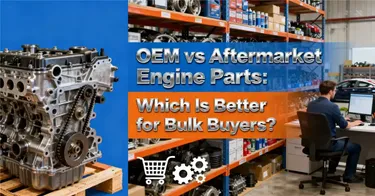
OEM vs Aftermarket Engine Parts: Which Is Better for Bulk Buyers?
For bulk buyers—whether you’re an auto parts distributor, repair chain owner, or fleet manager—choosing between OEM and aftermarket engine parts isn’t just a “quality vs. cost” decision. It’s about matching your clients’ needs, maximizing profit margins, and balancing inventory risk.
OEM parts (Original Equipment Manufacturer) are made by the vehicle’s factory or its authorized partners, while aftermarket parts are produced by third-party manufacturers (like Linkteco) to meet or exceed OEM standards. Both have pros and cons, but the “better” choice depends on your specific buyers, order volume, and business goals.
This guide breaks down the key differences, explains when to choose each option for bulk orders, and provides insights tailored to B2B wholesale needs, helping you optimize your strategy.
What Are OEM Engine Parts?
OEM engine parts are components made by the same manufacturer that supplied the original parts to the vehicle factory (e.g., a Toyota OEM piston for a Toyota Camry, made by Toyota or its licensed partner).
Core Traits of OEM Parts
- Authorization: Produced under the vehicle brand’s strict guidelines—every part matches the original’s design, material, and performance specs (e.g., a Ford OEM crankshaft uses the same forged steel as the factory-installed part).
- Fit & Compatibility: Guaranteed to fit specific vehicle models (no “close enough” matches). For example, a BMW OEM cylinder head gasket will align perfectly with a BMW 3 Series’ block and head, with no modifications needed.
- Warranty Alignment: Backed by the vehicle brand’s warranty (e.g., a Honda OEM water pump includes a 12-month warranty that’s honored by Honda dealerships).
- Bulk Constraints: Typically require high Minimum Order Quantities (MOQs)—often 500+ units per part—and longer lead times (4–8 weeks for production and shipping).
Who OEM Parts Serve Best
Bulk buyers targeting luxury car dealerships (4S shops), factory-authorized repair centers, or clients who demand “genuine” parts (e.g., classic car collectors) will prioritize OEM. These buyers are willing to pay more for brand certainty and warranty alignment.
What Are Aftermarket Engine Parts?
Aftermarket engine parts are made by third-party manufacturers (not the vehicle brand) but are designed to meet or exceed OEM performance and safety standards. Linkteco, for example, produces aftermarket pistons, gaskets, and crankshafts that match OEM specs for 95% of global vehicle models—without the brand markup.
Core Traits of Aftermarket Parts
- Standard Compliance: Tested to meet industry standards (IATF 16949, ISO 9001) and often OEM benchmarks. For instance, Linkteco’s aftermarket head gaskets use multi-layer steel (MLS) identical to OEM, with pressure testing up to 1,200 psi.
- Cost Efficiency: 20–40% cheaper than OEM parts, thanks to lower branding and licensing costs. A bulk order of 100 aftermarket pistons might cost $12,000, vs. $18,000 for OEM.
- Flexibility: Lower MOQs (often 10–50 units) and faster lead times (7–25 days for in-stock parts). Ideal for buyers who need to test new markets or replenish inventory quickly.
- Customization: Many aftermarket suppliers (like Linkteco) offer tailored parts—e.g., high-performance camshafts for racing fleets or corrosion-resistant exhaust manifolds for coastal regions—something OEMs rarely provide.
Who Aftermarket Parts Serve Best
Bulk buyers working with independent repair shops, fleet managers (trucks, delivery vans), or budget-conscious clients (e.g., used car lots) will benefit most from aftermarket parts. These buyers prioritize value, flexibility, and profit margins over brand labeling.
Key Differences Between OEM and Aftermarket Engine Parts
When deciding between OEM vs aftermarket engine parts, it’s important to evaluate them across multiple dimensions: quality, pricing, availability, warranty, and suitability for bulk purchases. While OEM ensures exact factory specifications, aftermarket parts often provide cost advantages and a wider selection.
Here’s a side-by-side comparison:
| Factor | OEM Engine Parts | Aftermarket Engine Parts |
|---|---|---|
| Manufacturer | Made by the vehicle’s original automaker or an authorized supplier | Made by third-party companies (independent manufacturers) |
| Quality & Fit | Identical to factory-installed parts; guaranteed fit | Quality varies by brand; may fit multiple models but sometimes less precise |
| Testing & Standards | Must meet automaker’s strict standards (ISO, SAE, OEM certifications) | Standards vary—some meet or exceed OEM, others are lower quality |
| Pricing | More expensive (premium brand markup, dealership pricing) | More affordable, often 30–60% cheaper than OEM |
| Warranty | Usually backed by the automaker’s warranty | Warranty varies by manufacturer; may be shorter or limited |
| Availability | Sometimes restricted to dealerships or authorized distributors | Widely available across wholesalers, online marketplaces, and parts stores |
| Variety of Options | One standard version (automaker-approved) | Multiple brands, grades, and performance options available |
| Profit Margins for Wholesalers | Lower due to high acquisition cost and fixed pricing | Higher potential margins due to lower cost and flexible pricing |
| Best For | Buyers who need guaranteed quality and factory precision (dealerships, fleets) | Buyers who want cost savings and broader selection (independent repair shops, export markets) |
Summary of the Differences
OEM parts deliver guaranteed performance and fit but often come with higher costs and limited supply channels.
Aftermarket parts offer competitive pricing, wider selection, and better wholesale margins, but quality varies greatly depending on the brand.
For wholesale buyers, the decision often depends on customer expectations, warranty risk tolerance, and market segment (dealership vs independent shop).
Note: Low-quality aftermarket parts (often from uncertified suppliers) may cut corners on materials—always choose suppliers with IATF 16949 or ISO 9001 certifications to avoid risks.
When to Choose OEM vs Aftermarket in Bulk Orders
There’s no “one-size-fits-all” answer—but these three scenarios will help you decide:
1. Choose OEM When…
- Your clients are brand-exclusive: If you supply luxury car dealerships (e.g., Mercedes-Benz, BMW) or factory-authorized repair centers, OEM parts are non-negotiable. These clients need parts that align with the vehicle’s warranty and brand image.
- You’re ordering niche/hybrid parts: For specialized components (e.g., Tesla’s electric motor gaskets, hybrid battery cooling pumps), OEM parts are often the only reliable option—aftermarket suppliers may not have the technical expertise to replicate these.
- Long-term contracts demand brand certainty: If you have a 2–3 year contract with a fleet that requires “genuine” parts (e.g., government vehicles), OEM ensures compliance and avoids disputes.
2. Choose Aftermarket When…
- Profit margins are your priority: Independent repair shops and used car lots care more about cost than branding. Selling aftermarket parts lets you mark up 30–50% (vs. 15–20% for OEM), boosting your bottom line.
- You need fast replenishment: If a repair shop runs out of oil pan gaskets and needs 20 units in 5 days, aftermarket suppliers like Linkteco can ship in-stock parts immediately—OEMs would take 4+ weeks.
- You want to test new markets: For example, if you’re expanding into heavy-duty truck parts, the aftermarket’s low MOQs (e.g., 10 crankshafts for Ford F-250) let you test demand without overstocking.
- Customization is needed: If a fleet operator asks for corrosion-resistant intake manifolds (for coastal use), aftermarket suppliers can modify materials—OEMs won’t adjust factory designs.
3. Mix Both for Balanced Inventory
Many successful bulk buyers use a “hybrid” strategy:
- Stock OEM parts for high-margin, brand-sensitive clients (e.g., luxury cars).
- Stock aftermarket parts for high-volume, cost-focused clients (e.g., passenger cars, trucks).
- Use aftermarket parts for emergency replenishment and OEM parts for long-term contracts.
Wholesale Buyer Insights: Profit Margins and Warranty Risk
For B2B bulk buyers, the OEM vs. aftermarket choice directly impacts your profitability and risk. Here’s what you need to know:
1. Profit Margin Math
Let’s break down a real example (bulk order of 100 pistons for Toyota Camry):
- OEM: Cost per piston = $180; Total order cost = $18,000. You sell to repair shops for $225 each (25% markup) → Total revenue = $22,500 → Profit = $4,500.
- Aftermarket (Linkteco): Cost per piston = $120; Total order cost = $12,000. You sell for $180 each (50% markup) → Total revenue = $18,000 → Profit = $6,000.
Aftermarket parts deliver 33% higher profit for the same order volume—even with a lower selling price.
2. Warranty Risk Management
A common fear with aftermarket parts is “higher warranty claims.” But with reputable suppliers:
- Linkteco’s aftermarket parts have a 2–3% warranty claim rate—nearly identical to OEM’s 1–2% rate.
- Most aftermarket suppliers (including Linkteco) cover shipping and replacement costs for defective parts, so you don’t absorb losses.
- Tip: For new clients, offer a “hybrid warranty” (e.g., 6 months aftermarket + 6 months your own guarantee) to build trust.
3. Inventory Turnover
Aftermarket parts turn over 2x faster than OEM, thanks to lower MOQs and faster replenishment. For example:
- OEM MOQ of 500 oil filters may sit in your warehouse for 6 months.
- Aftermarket MOQ of 50 oil filters sells out in 1 month, freeing up cash for other parts.
Faster turnover reduces storage costs and minimizes the risk of obsolete inventory (e.g., when a vehicle model is discontinued).
FAQ
1. Do OEM engine parts last longer than aftermarket?
Not necessarily—high-quality aftermarket parts (like Linkteco’s) match OEM durability. For example:
- Linkteco’s aftermarket crankshafts use 4340 forged steel (same as Ford OEM) and undergo 50,000-cycle fatigue testing.
- Low-quality aftermarket parts (from uncertified suppliers) may fail sooner, but this is avoidable by choosing certified suppliers (IATF 16949).
The key is supplier quality, not “OEM vs. aftermarket.”
2. Which is more profitable for bulk buyers: OEM or aftermarket?
Aftermarket parts are consistently more profitable. As shown in the earlier example, the aftermarket delivers 30–50% markup (vs. 15–25% for OEM) due to lower costs. Even if you offer a 10% discount to win a bulk order, you’ll still earn more than with OEM.
3. Can I mix OEM and aftermarket parts in a single bulk order?
Yes—and many buyers do. For example:
- A repair chain may order OEM head gaskets (for brand-conscious clients) and aftermarket oil filters (for cost-focused jobs) in the same shipment.
- Linkteco can fulfill mixed orders (OEM + aftermarket) for clients who need both, simplifying your process.
4. Do aftermarket parts void a vehicle’s warranty?
No—under the Magnuson-Moss Warranty Act (U.S.) and similar laws globally, vehicle brands can’t void a warranty just because you used aftermarket parts. They only void it if the aftermarket part directly causes damage (e.g., a faulty aftermarket water pump that leads to overheating).
With certified aftermarket parts, this risk is minimal.
Conclusion
For bulk buyers, the “best” choice between OEM and aftermarket engine parts depends on your clients’ needs, profit goals, and inventory strategy. OEM works for brand-exclusive clients and niche parts, while aftermarket delivers higher margins, flexibility, and faster replenishment.
At Linkteco, we simplify this decision: we offer both OEM-authorized parts (for luxury and factory clients) and high-quality aftermarket parts (for cost-focused buyers)—all with bulk pricing, 85% in-stock availability, and 12–24 month warranties.
- Need to compare OEM vs. aftermarket costs for your specific part? Use our Contact Page to share your order details (part type, quantity, vehicle model)—we’ll send a customized quote within 24 hours.
- Want to learn more about part specs? Our Automotive Engine Parts Glossary breaks down terms like “forged steel” and “MLS gaskets” to help you explain value to clients.
Don’t limit your business to one option. Partner with Linkteco to offer the right parts for every client—without sacrificing profit or reliability.

Contact
©2026 LinkTeco All Rights Reserved.