

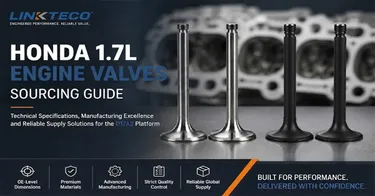
Sourcing Guide for Honda 1.7L Engine Valves: Supply Programs and Manufacturing Standards
A practical procurement and engineering guide for warehouse distributors, engine remanufacturers, and procurement managers evaluating Honda 1.7L engine valve suppliers based on specifications, factory production capacity, and manufacturing quality control.
Summary
- Application Fitment: Covers Honda 1.7L D17A2 valve dimensions, valvetrain compatibility, and geometric verification data.
- Manufacturing Control: Details upset forging, precision grinding processes, induction hardening, and batch-level traceability.
- Quality Assurance: Outlines inspection methodologies, laboratory equipment metrics, and batch sampling criteria.
- Supply Programs: Compares standard OE Replacement and Severe-Duty programs to match different distribution and rebuilding requirements.
- Commercial Support: Details private label laser-etching, custom boxing, export logistics compliance, and technical RFQ assessment processes.
Sourcing Honda 1.7L engine valves requires a rigorous focus on dimensional tolerance, material certification, and batch-level consistency to ensure long-term valvetrain durability. For warehouse distributors and engine remanufacturers, the selection process extends beyond simple fitting; it involves evaluating metallurgical standards—such as Martensitic alloy or 21-4N austenitic steel—and verifying critical geometries like keeper groove spacing. This guide details the technical requirements for the Honda SOHC VTEC platform, providing a framework for evaluating manufacturing traceability, quality compliance, and segmented supply programs tailored to both high-turnover repair channels and professional-grade remanufacturing operations.
1. Honda D17A2 Valve Specifications
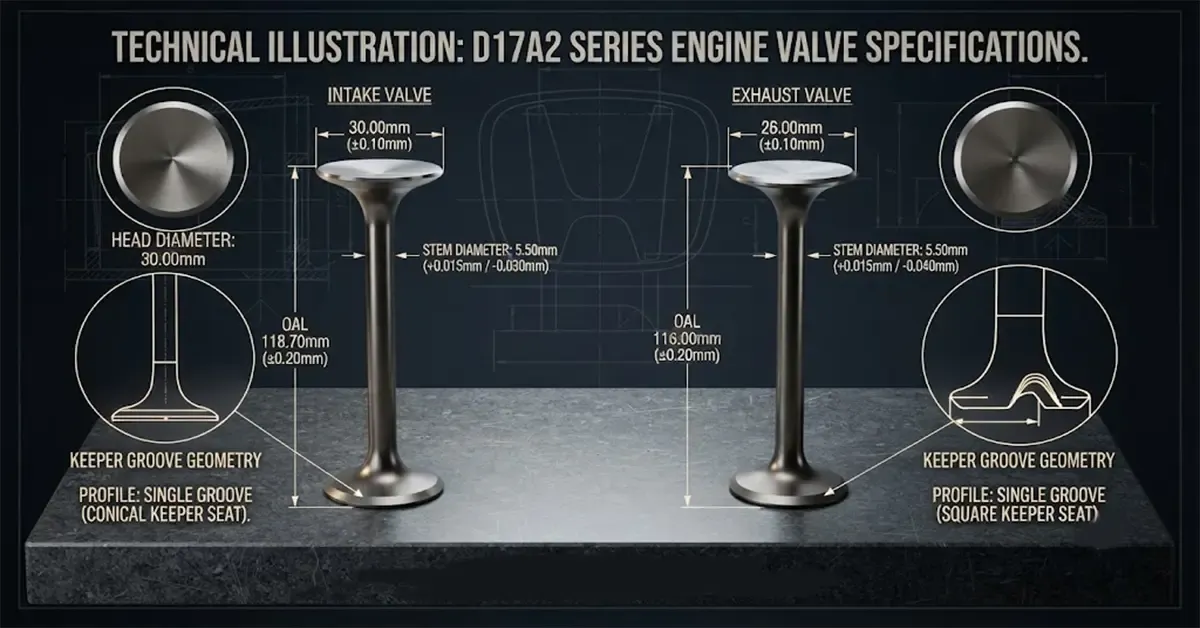
For the Honda 1.7L SOHC 16V VTEC platform (specifically the D17A2 engine profile utilized widely across global passenger car applications), our production lines operate within the following engineering baselines for Honda Cylinder Head Valves:
Intake Valve: Head Diameter: 30.00mm (±0.10mm) | Stem Diameter: 5.50mm (-0.015mm / -0.030mm) | Overall Length (OAL): 118.70mm (±0.20mm) | Single Groove Geometry
Exhaust Valve: Head Diameter: 26.00mm (±0.10mm) | Stem Diameter: 5.50mm (-0.025mm / -0.040mm) | Overall Length (OAL): 116.00mm (±0.20mm) | Single Groove Geometry
Why Accurate Valve Matching Matters for Honda D17A2 Applications
For aftermarket distributors and engine rebuilders, valve sourcing is not only a dimensional matching process. Minute variances in overall length, keeper groove location, or tip height can alter valvetrain geometry and affect hydraulic lash adjustment after a cylinder head rebuild.
On the Honda 1.7L SOHC platform, distinguishing between the D17A2 (VTEC) and the D17A1 (Non-VTEC) cylinder heads is critical. While the 5.50mm stem diameter is identical across both platforms, the overall lengths and valve tip configurations differ to accommodate the distinctive rocker arm assemblies and cam lobe layouts of the VTEC system.
Before production approval, our engineering team systematically verifies:
Engine code compatibility profiles
OEM cross-reference numbers
Critical geometric dimensions
Keeper groove configurations
Customer-specific application requirements
This rigorous pre-production verification protocol helps volume buyers reduce incorrect fitment claims, cross-contamination of inventory, and unnecessary replacement costs.
2. Factory Capability Snapshot
To establish immediate transparency for procurement teams evaluating manufacturing depth, the table below provides a structural overview of Linkteco's production capabilities and plant equipment profiles:
Factory Production & Capability Profile
3. OE Replacement vs. Severe-Duty Supply Programs
To satisfy distinct commercial positioning tiers within the global automotive aftermarket, we run two separate engineering and metallurgical options for the Honda 1.7L platform:
OE Replacement Program
Tailored for traditional wholesale distribution and high-volume jobber networks, this program focuses on cost optimization and alignment with original equipment geometric specifications. These valves are manufactured utilizing proven Martensitic or Ferritic alloy steels (such as 4Cr9Si2 or equivalent), undergoing full-body hardening and centerless cylindrical grinding. This program is optimized for standard passenger vehicle service, typical engine overhauls, and regional distribution setups where cost competitiveness and volume turnover are the primary metrics.
Severe-Duty Program
Engineered for engine remanufacturers, professional machine shops, and high-load commercial fleet operations, this program is designed for applications involving elevated exhaust temperatures and demanding operating conditions. The exhaust valves in this line are forged from premium EV8 (21-4N) Austenitic Stainless Steel, a high-chromium, high-nickel alloy selected for enhanced thermal stability under prolonged load profiles.
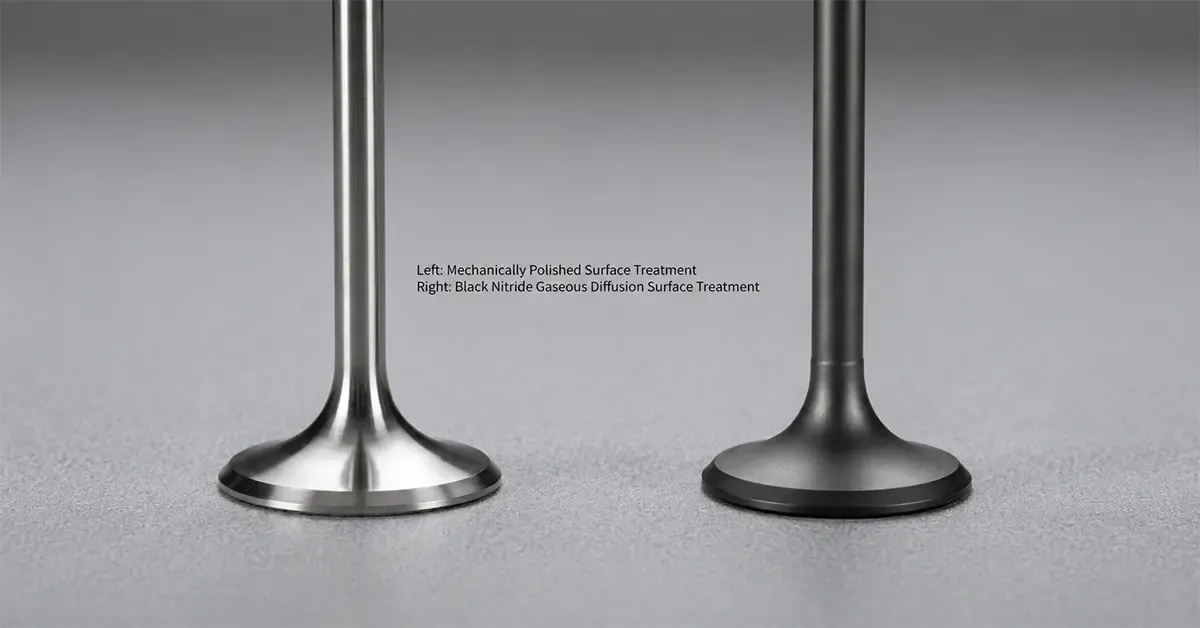
Furthermore, these valves receive an advanced Black Nitride surface treatment. This gas-nitriding diffusion process alters the outermost crystalline structure of the valve stem, creating a high-hardness compound zone that lowers sliding friction and minimizes stem wear inside the valve guide interface.
Structural Supply Program Comparison Matrix:
| Sourcing Vector | OE Replacement Program | Severe-Duty Program |
|---|---|---|
| Market Focus | Aftermarket repair / High-turnover distribution | Certified remanufacturing / Heavy-duty application |
| Material Base | Martensitic alloy steel (e.g., 4Cr9Si2) | Premium Austenitic Stainless Steel (EV8 / 21-4N) |
| Surface Treatment | Polished stem, localized induction tip hardening | Full-body Black Nitride gaseous diffusion layer |
| Operational Intent | Aligns with standard passenger vehicle duty cycles | Designed for applications involving elevated exhaust temperatures and demanding conditions |
| Traceability Tier | Batch-level dimensional verification logging | Full material heat-treat logging with archived mill certificates |
| Logistics Structure | Flexible volume thresholds for optimal stock rotation | Specialized batch runs with precision custom packaging options |
4. Engine Valve Manufacturing Process & Traceability
Production batches are manufactured through monitored process stages, with inspection records maintained according to internal quality procedures. Component tracking is systematically indexed against material heat numbers to maintain an unbroken quality trail from steel mill to final export box:
[Material Spectrometry Check] ➔ [Induction Heating Control] ➔ [Upset Forging & Die Pressing]
│
[Stress Relief & Tempering] [Precision CNC Stem Turning] ──────────┘
│
[Localized Valve Tip Hardening] ➔ [Centerless Grinding & Super-Finish] ➔ [Nitriding / Final Audit]
Material Inspection: Round steel bars undergo direct-reading spectroscopic analysis upon arrival to verify alloy element compliance. Material sheets are digitally filed and referenced directly to the foundry lot numbers.
Electrical Upset Forging: Automated induction heaters bring the raw blanks to specific, uniform forging temperatures to maintain grain size consistency. The valve head is formed through a combined upset forging and mechanical press sequence, establishing a continuous grain flow line along the valve fillet profile.
Rough CNC Turning: Computer-controlled turning centers face the head and cut the initial stem profiles, ensuring tight concentricity limits relative to the stem axis before final grinding.
Localized Tip Hardening: High-frequency induction systems treat the valve stem tip, rapidly quenching it to build a hardened mechanical zone capable of resisting continuous valvetrain actuation impacts.
Thermal Processing: Valves undergo controlled stress-relieving and tempering cycles within atmosphere-regulated furnaces to relieve internal stresses and stabilize the material structure.
Centerless Grinding & Super-Finishing: Specialized cylindrical grinders finish the valve stem diameter to precise tolerances, meeting strict surface finish thresholds to protect valve guide oil seals.
Surface Nitriding (Severe-Duty Runs): Finished batches are loaded into gas-nitriding chambers to diffuse nitrogen into the surface layers, maximizing wear resistance along the sliding axis.
Ultrasonic Wash & Preservation: Parts pass through multi-stage ultrasonic washing channels to eliminate residual processing fluids, followed by an application of rust-preventative oil to safeguard the parts during ocean transit.
5. Quality Inspection & Documentation
To maintain structural consistency across volume production schedules, Linkteco's quality control lab relies on industry-standard metrology equipment. Final batch approvals are verified through laboratory validation, where typical production targets include:
Total Indicator Runout (TIR): Concentricity between the valve head seat profile and the stem center axis is verified to be $\le$ 0.03mm to support secure valvetrain sealing.
Stem Micro-Finish Profile: Monitored via diamond-stylus profilometers to maintain surface finishes within Ra $\le$ 0.20µm, managing friction trends within the valvetrain guide assembly.
Coordinate Measuring Machine (CMM): Multi-axis geometric checking isolates and verifies critical dimensions, including keeper groove angles and critical taper dimensions.
Direct-Reading Spectrometer: Verifies elemental chemistry layout on all incoming bar stock to confirm material grade purity before production setup.
Hardness Testing Matrix: Rockwell (HRC) and Vickers (HV) equipment charts hardness limits across the induction-hardened stem tip, internal stem core, and valve head face.
Batch Inspection & Sampling Methodology
Our quality assurance framework controls manufacturing drift through a structured batch inspection approach:
Material Receipt Audit: Spectroscopic identification testing for every steel lot delivery.
In-Process Geometric Audits: Scheduled dimensional monitoring at critical grinding, machining, and hardening stations.
Final QC Release Protocol: Finished product inspections against master engineering drawings, verifying surface roughness and total indicator runout profiles.
Sampling Standard Reference: Sampling levels are determined according to production volume, customer requirements, and internal quality procedures to ensure reliable batch verification.
Quality Control Documentation Packages Available for Archival:
- Material Test Reports (MTR via Optical Emission Spectrometry)
- Batch Microhardness Mapping and Depth Profile Charts
- Dimensional Inspection Reports (Full GD&T coordinate metrics)
6. Packaging, Private Label & Export Support
We support the operational logistics, branding guidelines, and supply chain timelines of volume aftermarket importers through full-service export coordination, including private label solutions.:
Private Label Identification: High-contrast fiber lasers etch custom part numbers, brand logos, and traceability lot numbers directly onto the valve stems. We also handle custom brand box printing, customized barcoding layouts, and packaging designs tailored to your internal system SKUs.
Export Packing Standards: Individual valves are sealed inside Vapor Corrosion Inhibitor (VCI) anti-rust sleeves, placed into internal boxes, and enclosed within heavy-duty corrugated outer cartons. All cartons are palletized on ISPM-15 heat-treated or heavy-duty plastic pallets, wrapped with multi-layer stretch film, and bound with tension banding to ensure stable ocean transit.
Logistics Transparency Packet: Shipments go out with complete customs documentation, including certified Material Test Reports, Dimensional Inspection Certificates, and Certificates of Origin. For strategic contracts requiring formalized validation data, PPAP (Production Part Approval Process) Level 3 documentation packages can be organized during project setup.
7. Application Example: Distribution Strategy
Typical Buyer Challenge
North American aftermarket distributors often manage multiple customer groups, including general repair shops, engine rebuilders, and machine shops. Different applications require different valve specifications, material options, and purchasing strategies. Applying a single generic component specification across all distinct operational segments can create commercial friction, as standard unit acquisition costs may align poorly with high-volume competitive markets, while heavy-duty rebuilders require enhanced material baselines.
Supply Approach
Instead of applying one single component specification across all distribution applications, Linkteco supports distributors through structured, segmented sourcing programs:
OE Replacement Program: Configured for high-turnover general maintenance, allowing distributors to maintain a highly competitive cost-per-unit structure within regional jobber channels.
Severe-Duty Configurations: For premium remanufacturing and machine shop accounts requiring elevated alloy performance (EV8) and specific wear-resistant surface modifications.
Inventory Flexibility: Supporting mixed-model ordering protocols to help procurement managers balance stocking levels against actual local demand trends.
Operational Benefit
This structured supply division enables distributors to simplify purchasing decisions across different aftermarket customer segments, manage stock exposure, and limit cross-contamination across their branch networks.
8. Request Engineering Review & Supply Assessment
We do not believe in over-engineering or inflating technical parameters. We provide dependable, transparent manufacturing programs that align with your sales network and brand reputation.
Our technical support team is ready to review your application data before rendering a commercial quotation. To discuss your engine valve supply requirements and obtain a direct factory evaluation, please provide our engineering desk with your specific operational parameters:
Technical Evaluation & Sourcing Requirements
- Target Engine Model / Platform Profiles (e.g., Honda D17A2 VTEC)
- OEM Cross-Reference Part Numbers
- Projected Annual Volume / Batch Demand Requirements
- Specific Material, Packaging, or Surface Treatment Criteria
9. FAQ
How do you verify Honda valve compatibility before production?
Prior to finalizing a production run, our engineering desk cross-checks your target engine codes, OEM part numbers, and dimensional blueprints. For the Honda 1.7L platform, we verify keeper groove spacing and overall length (OAL) to ensure clear differentiation between VTEC and non-VTEC configurations.
What quality documents are included with bulk shipments?
All standard export documentation—including commercial invoices, packing lists, and bills of lading with applicable HS code classifications—is provided. Upon request, we also include the specific lot’s Material Test Report (MTR) and factory dimensional test data to satisfy your internal QA workflows.
Can samples be provided before bulk orders for laboratory evaluation?
Yes. We supply pre-production sample batches accompanied by dimensional inspection sheets and material chemistry profiles for your internal quality control desk to audit, cross-measure, and evaluate before committing to full production schedules.
What is the standard Minimum Order Quantity (MOQ) per part number for production?
MOQ requirements depend on part number complexity, production planning configurations, and annual demand forecasts. For initial program rollouts or evaluating warehouse distributor trials, our sales office provides flexible structural options when integrated into a broader mixed-model container order.
Can multiple part numbers be combined in one shipment?
Yes. We primarily serve aftermarket warehouse distributors and wholesalers. To help you manage your inventory costs and optimize container space, we support mixed-model orders, allowing you to combine different engine valve numbers into a single shipment.
What is the typical production lead time from order placement to port delivery?
Production lead time varies depending on material requirements, order quantity parameters, and seasonal production scheduling. For items maintained within our factory buffer stock program, fast-tracked shipping readiness can be coordinated.
Do you support private label manufacturing and custom branding?
Yes. We support international distributors with private labeling, neutral packaging, and custom brand box manufacturing based on customer design specifications, managed completely through our B2B logistical support framework.

Contact
©2026 LinkTeco All Rights Reserved.