

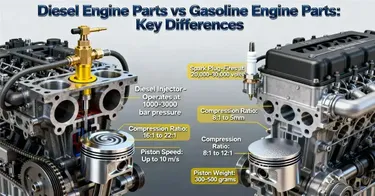
Diesel Engine Parts vs Gasoline Engine Parts: Key Differences
Similarities Between Diesel and Gasoline Engines
- Engine block: The rigid foundation that houses cylinders and crankshafts (though materials differ).
- Pistons and connecting rods: Translate combustion force into linear motion (again, with design tweaks for each fuel type).
- Crankshaft: Converts linear piston motion into rotational torque for the transmission.
- Cylinder head: Seals the top of the engine block, with passages for coolant and oil.
- Cooling and lubrication systems: Radiators, water pumps, oil pans, and filters keep both engines running at safe temperatures.
Key Component Differences (Table)
Here’s a quick breakdown of how diesel and gasoline engine parts differ:
| Component | Gasoline Engine Parts | Diesel Engine Parts |
|---|---|---|
| Pistons | Lightweight aluminum alloys | Heavier, reinforced pistons to handle high compression |
| Fuel Injectors | Operate at lower pressure | High-pressure injectors (20,000+ psi) for precise atomization |
| Spark Plugs | Essential for ignition | Not used (diesels ignite via compression heat) |
| Glow Plugs | Not used | Aid in cold starts |
| Crankshaft & Rods | Lighter construction | Forged, stronger steel to handle torque loads |
| Cylinder Head | Designed for spark plugs and intake valves | Designed for injectors, often more robust |
| Turbochargers | Optional, performance-focused | Common, improves efficiency and power in smaller diesel engines |
| Exhaust System | Standard catalytic converter | Diesel particulate filters (DPF) + selective catalytic reduction |
Why Diesel Engines Use Stronger Parts
1. Extreme Compression Ratios
2. Higher Torque Output
3. Longer Operating Life Expectations
- Diesel turbochargers are built with ceramic turbine wheels (which resist heat and wear) vs. steel wheels in gasoline turbos.
- Diesel oil filters have thicker media to trap more soot (a byproduct of diesel combustion) and last longer between changes.
Maintenance and Wholesale Insights
For wholesale buyers and mechanics, understanding part requirements helps in making informed decisions:
Maintenance Cost
Gasoline engines: Generally cheaper to maintain because parts are lighter and less expensive.
Diesel engines: More costly due to expensive injectors, turbos, and emissions systems.
Longevity
Diesel engines typically last longer (up to 500,000 miles in trucks) due to stronger internal parts.
Gasoline engines usually offer 150,000–250,000 miles before major overhauls.
Wholesale Demand
Diesel engine parts are in high demand for commercial fleets, heavy trucks, and industrial vehicles.
Gasoline parts dominate in passenger car markets worldwide.
For distributors, stocking both categories ensures coverage of consumer cars (gasoline) and commercial fleets (diesel).
FAQ
Q1: What are the main differences between diesel and gasoline engine parts?
Diesel engines use heavier, reinforced parts like forged crankshafts and high-pressure injectors, while gasoline engines use lighter components designed for lower compression and higher RPM performance.
Q2: Which engine type typically lasts longer?
Diesel engines usually last longer because they’re engineered to handle extreme compression and heavy-duty use. Many diesel engines in trucks can exceed 400,000–500,000 miles, while gasoline engines often require major repairs by 200,000 miles.
Q3: Which engine is cheaper to maintain?
Gasoline engines are usually cheaper to maintain because parts like spark plugs, injectors, and exhaust components are less expensive. Diesel engines can have higher repair costs, especially for injectors, turbochargers, and emission systems.
Q4: Do all diesel engines have glow plugs?
Most modern diesel engines use glow plugs to help with cold starts, but once the engine is warm, combustion happens naturally through high compression. Gasoline engines don’t need glow plugs since they rely on spark plugs for ignition.
Q5: Are diesel engines always turbocharged?
Nearly all modern diesel engines include turbochargers to increase efficiency and reduce emissions. In gasoline engines, turbos are often optional and used mainly to boost performance.
Q6: Which type of engine is better for wholesale buyers?
It depends on the target market:
Diesel parts are in high demand for fleets, trucks, and industrial machinery.
Gasoline parts dominate in passenger vehicle markets.
Many wholesalers stock both to serve a wider range of customers.
Conclusion
- Diesel parts: Forged steel crankshafts, CGI pistons, high-pressure injectors.
- Gasoline parts: Aluminum pistons, spark plugs, low-pressure injectors.
- Shared parts: Oil filters, radiators, and alternators.

Contact
©2026 LinkTeco All Rights Reserved.