

Signs You Need to Replace Your Car's Cylinder Head
What a Cylinder Head Does in an Engine
- Seal the combustion chamber: It traps high-pressure gases from fuel ignition (up to 1,000 psi in gasoline engines) to ensure power transfers to the pistons—no leaks, no lost performance.
- Control airflow: It houses intake and exhaust valves, which open/close to let air-fuel in and waste gases out. Timing here is precise—even a 1mm valve gap can cause misfires.
- Manage cooling and lubrication: Built-in coolant channels pull heat from the combustion chamber (temperatures reach 2,500°C), while oil passages lubricate the valve train (camshaft, lifters).
Early Warning Signs of Cylinder Head Damage
A cylinder head rarely fails suddenly — most issues start small and worsen over time. Recognizing the early warning signs can prevent a full-blown engine failure and save you from costly repairs. Here are the most common symptoms that indicate your cylinder head may be compromised.
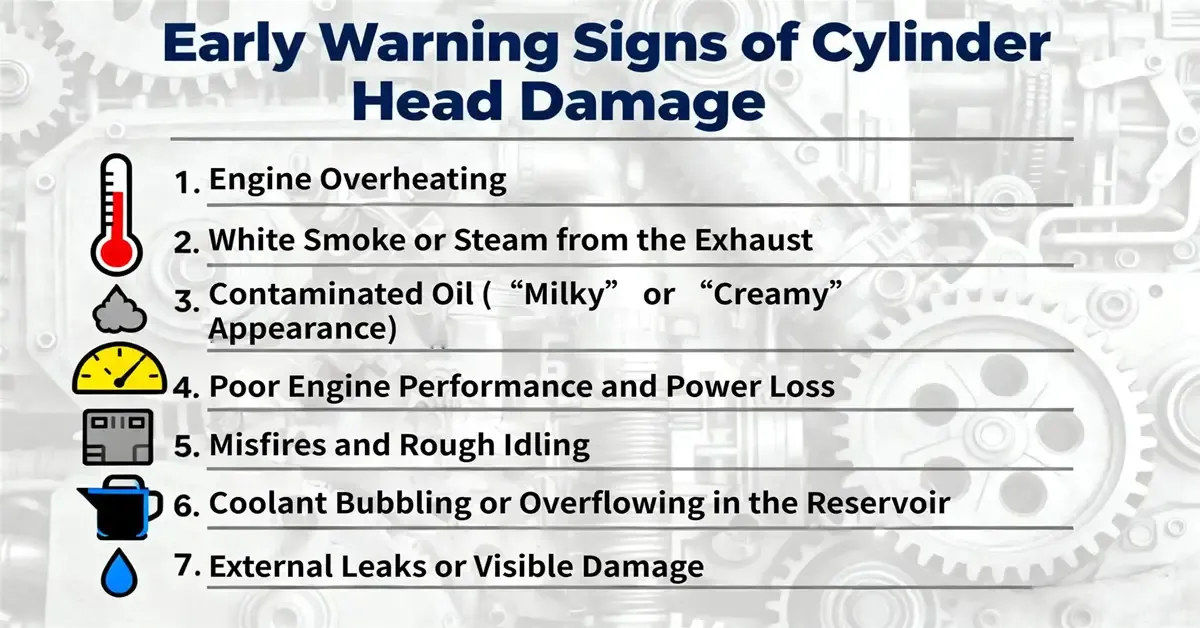
1. Engine Overheating
Overheating is one of the earliest and most serious red flags. A damaged or warped cylinder head can restrict coolant flow or cause leaks between the coolant and combustion chambers. Once temperatures climb too high, aluminum heads in particular can warp, creating an uneven surface that no longer seals properly with the head gasket.
Tip: If your temperature gauge spikes frequently or you notice coolant loss without visible leaks, check the cylinder head and gasket area.
2. White Smoke or Steam from the Exhaust
White smoke usually means coolant is entering the combustion chamber — a telltale sign of a cracked cylinder head or blown head gasket. This smoke is actually vaporized coolant exiting through the exhaust system. Over time, this issue can lead to poor fuel economy, spark plug fouling, and complete gasket failure.
Note: Continuous white smoke after the engine warms up is rarely harmless condensation — it’s a strong indicator of internal leakage.
3. Contaminated Oil (“Milky” or “Creamy” Appearance)
When coolant mixes with engine oil, it turns the oil into a milky, foamy substance. This mixture loses its lubricating properties, leading to increased friction, bearing wear, and potential engine seizure.
Check: Remove the oil filler cap or dipstick — if you see a thick beige or white sludge, coolant is likely leaking through a crack in the cylinder head or a failed gasket.
4. Poor Engine Performance and Power Loss
A damaged cylinder head can lead to loss of compression in one or more cylinders. When this happens, the air-fuel mixture can’t ignite efficiently, reducing power and acceleration. The engine may also feel sluggish, hesitate during acceleration, or fail to reach normal RPMs.
Diagnostic clue: A compression or leak-down test can confirm uneven cylinder pressures — often pointing directly to a faulty head.
5. Misfires and Rough Idling
When cracks develop near the valve seats or spark plug ports, they can disrupt the combustion process. The engine may misfire, run unevenly, or idle roughly — especially noticeable at cold start. Over time, misfires can cause unburned fuel to damage the catalytic converter.
Tip: If a misfire persists after changing plugs, wires, and coils, a cylinder head inspection is warranted.
6. Coolant Bubbling or Overflowing in the Reservoir
If you notice bubbling in the coolant tank while the engine runs, combustion gases may be escaping through a cracked head or blown gasket into the cooling system. This not only causes overheating but can also introduce air pockets that reduce coolant circulation.
Watch for: Repeated coolant overflow, unexplained coolant loss, or a strong exhaust smell in the reservoir — all signs of combustion leakage.
7. External Leaks or Visible Damage
Sometimes, the signs are visible. Cracks or oil seepage along the cylinder head’s surface or between the head and block can indicate warping or a sealing failure. Even small leaks can expand rapidly once the engine reaches operating temperature.
Summary Table — Early Warning Signs of Cylinder Head Damage
| Symptom | Likely Cause | Action Needed |
|---|---|---|
| Overheating | Warped or cracked head, poor coolant flow | Inspect head surface and coolant passages |
| White exhaust smoke | Coolant leaking into cylinders | Pressure test cooling system, inspect gasket |
| Milky oil | Coolant contamination | Stop engine, flush system, inspect for cracks |
| Power loss | Low compression from sealing issues | Perform compression or leak-down test |
| Misfires / rough idle | Cracks near valves or spark plug ports | Inspect combustion chambers and valve seats |
| Bubbling coolant | Combustion gas leak into cooling system | Test for exhaust gases in coolant |
| Visible cracks or leaks | Warped or damaged head surface | Replace or resurface cylinder head |
Severe Symptoms That Require Replacement
1. Visible Cracks in the Cylinder Head
- On the top surface of the head (where the valve cover attaches).
- Around the spark plug wells (in gasoline engines) or injector ports (in diesel engines).
2. Warped Cylinder Head Surface
3. Damaged Valves or Valve Seats
- Loud ticking or tapping noises from the top of the engine (valves not closing properly).
- Low compression (even after a head gasket replacement).
- Oil is leaking into the combustion chamber (blue smoke from the exhaust, as oil burns).
4. Engine Overheating (Even After Coolant Repairs)
Repair vs Replacement: How to Decide
Once you’ve identified damage in your cylinder head, the next critical decision is whether to repair or replace it. While minor damage can often be repaired through resurfacing, welding, or valve reconditioning, more extensive wear or cracking may make replacement the smarter long-term choice. The right option depends on damage severity, repair costs, material type, and vehicle usage.
1. When Cylinder Head Repair Makes Sense
Cylinder head repair is feasible when the damage is limited, the head material is still structurally sound, and OEM machining tolerances can be restored.
Common repairable issues include:
Minor surface warping that can be corrected by milling.
Small cracks in non-critical areas, such as near bolt holes or coolant ports.
Worn valve guides or seats that can be replaced or machined.
Gasket surface corrosion that hasn’t penetrated deeply.
Professional testing methods — such as pressure testing, magnetic particle inspection (for cast iron), or dye penetrant inspection (for aluminum) — can determine if the head is suitable for repair.
Note: Repairs are most cost-effective for vehicles with moderate mileage or for engines where OEM replacement heads are expensive or difficult to source.
2. When Cylinder Head Replacement Is the Smarter Option
Replacement becomes the logical choice when the cost of repair approaches or exceeds the cost of a new or remanufactured head — or when damage compromises engine reliability.
Replacement is recommended if you encounter:
Deep or multiple cracks extending into combustion chambers.
Warping that exceeds the manufacturer’s maximum machining limit.
Severe corrosion or erosion in coolant or oil passages.
Repeated head gasket failures even after machining.
Valve seat recession or damage that cannot be re-cut or replaced.
In these cases, replacing the cylinder head not only ensures long-term reliability but also prevents recurring issues like overheating, misfires, and oil contamination that could damage the block or bottom end.
Cylinder Head Repair vs. Replacement — Quick Comparison Table
| Factor | Repair Cylinder Head | Replace Cylinder Head |
|---|---|---|
| Type of Damage | Minor warping, surface corrosion, light cracking | Deep cracks, severe warping, internal corrosion |
| Machining Tolerance | Within OEM specs after resurfacing | Beyond allowable tolerance or uneven across deck |
| Cost | Lower initial cost (labor + machining) | Higher upfront cost but includes new components |
| Reliability | May last 2–5 years depending on condition | Comparable to new engine lifespan |
| Downtime | Usually 2–5 days (machine shop lead time) | Faster if replacement head is in stock |
| Risk of Recurrence | Possible if head structure is weakened | Minimal — new head eliminates structural defects |
| Material Type | Often practical for cast-iron heads | Preferred for aluminum heads with thermal damage |
| Warranty Coverage | Limited (shop-based) | Full OEM or supplier warranty (1–2 years typical) |
| Long-Term Cost Efficiency | Lower short-term cost | Better long-term value for high-mileage engines |
3. Cost Considerations and Decision Factors
When evaluating repair vs replacement, consider the total cost of ownership, not just the upfront expense. A repaired head might save several hundred dollars now but could fail again within months if the underlying damage is severe. Conversely, a brand-new or remanufactured head ensures reliability and performance that align with OEM standards.
Key decision factors include:
Vehicle age and value: If the car is relatively new or has a rebuilt short block, replacement provides better ROI.
Availability of replacement heads: For common engines, replacement may be cheaper and faster than complex repair work.
Usage demands: Fleet vehicles, performance cars, and high-mileage daily drivers benefit from replacement due to reliability needs.
Warranty needs: Replacement heads often include manufacturer-backed warranties, while repairs usually don’t.
4. Professional Recommendation
As a general rule, if the cost of repair exceeds 60–70% of the cost of a new or remanufactured cylinder head, replacement is the better investment.
A professional machine shop or engine builder can perform pressure testing and surface flatness checks to confirm whether the head is within tolerance. When in doubt, err on the side of replacement — it ensures structural integrity, restores full compression, and minimizes future engine downtime.
FAQ
1. How long does a car’s cylinder head typically last?
- Chronic overheating (e.g., ignoring coolant leaks).
- Using low-quality coolant (causes corrosion).
- Poor oil maintenance (leads to valve train wear).
2. Can a cracked cylinder head be repaired, or do I need to replace it?
3. How much does it cost to replace a cylinder head?
- Retail (end-user): 800–2,500 for the part (OEM) + 500–1,200 for labor (total: 1,300–3,700).
- Wholesale (repair shops): 200–800 per head (Linkteco’s Cylinder Head Wholesale pricing) + labor—savings of 30–50% on parts.
4. What happens if I keep driving with a bad cylinder head?
- Engine seizure: Coolant or oil loss leads to overheating and friction—seizing the engine (cost: 3,000–8,000 to replace).
- Cracked engine block: Extreme heat from overheating can crack the block (a $5,000+ repair).
- Catalytic converter failure: Burned coolant or oil damages the converter (cost: 800–2,500 to replace).
Conclusion
- 85% in-stock availability (7–25 day global shipping).
- 24-month warranties (covering defects in materials and workmanship).
- Custom options (e.g., diesel-specific heads, performance valve seats) for niche needs.
- Browse our Cylinder Head Wholesale page to view our full lineup.
- Visit our Contact Page to request a custom quote (we offer volume discounts for 50+ units).
- Learn more about cylinder head terminology in our Automotive Engine Parts Glossary.

Contact
©2026 LinkTeco All Rights Reserved.