

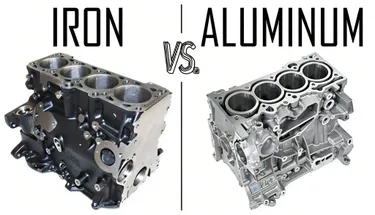
What Are the Differences in Aluminum & Iron Cylinder Head Repairs?
When it comes to engine block repairs, material choice makes all the difference. Aluminum and cast iron blocks behave very differently under heat, stress, and welding conditions. Understanding these differences is crucial for achieving long-lasting, reliable repairs.
We’ll break down the key distinctions, focusing on Jeep 3.0L diesel aluminum blocks and GM 3.8L cast iron gasoline blocks, and explain the best practices for repair.
Understanding Material Differences: Physical Properties & Core Challenges
Aluminum Engine Blocks
Characteristics: Fast heat dissipation, prone to deformation (warping), low melting point, and highly susceptible to oxidation.
Physical Properties: Thermal conductivity is approximately three times higher than that of cast iron , and it has a high coefficient of thermal expansion.
Core Challenge: The oxide layer (Al2O3) has a melting point reaching 3722°F , which is significantly higher than the aluminum base metal (approx. 1220°F or 660°C). This disparity makes the weld extremely prone to porosity and slag inclusions.
Mechanical Considerations: On 3.0L diesel engines, the high combustion pressure makes the block extremely sensitive to softening within the weld Heat-Affected Zone (HAZ), which can compromise overall structural strength.
Cast Iron Engine Blocks
Characteristics: Heavyweight and high strength, but brittle and prone to welding cracks (specifically "white iron" formation).
Physical Properties: The graphite flakes in gray cast iron act as crack initiators, resulting in nearly zero plasticity.
Core Challenge: If the cooling rate after welding is too rapid, "white iron" (hard, brittle iron carbide) forms. This leads to extreme machining difficulties or spontaneous cracking.
Mechanical Considerations: Thermal stress tends to accumulate within complex coolant passages, significantly increasing the risk of a total block crack.
Would you like me to help you draft a technical "Best Practices" sheet for your shop's welders based on these differences?
Strategic Filler Material Selection (JB/T 6062 Standards)
Based on the material traits we just covered, picking the right filler metal is where you either save the block or scrap it. We’ll use the Jeep 3.0L diesel and the GM 3.8L gasoline engine as our case studies.
Aluminum Block (Jeep 3.0L Diesel):
Core Challenge: Aluminum has fast thermal conductivity and is easily oxidized; additionally, as a high-compression ratio engine, the 3.0L diesel requires extremely high weld strength.
Filler Solution: High-strength aluminum-silicon-magnesium welding wire matching the base material's composition (such as ER4043 or the tougher ER5356) must be used.
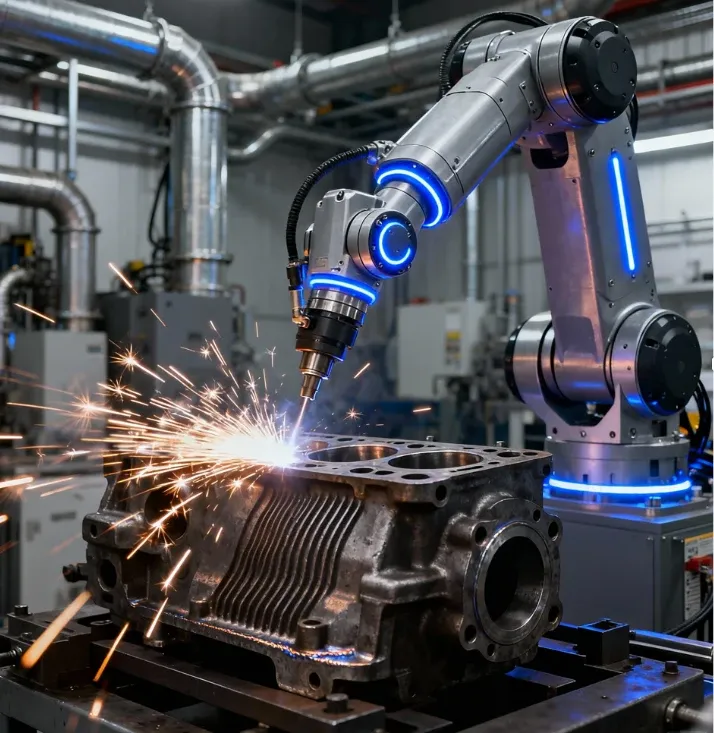
Process Focus: Use AC TIG (Tungsten Inert Gas) welding. Rigorous surface degreasing and oxide film removal must be performed before welding to prevent porosity in the weld.
Cast Iron Block (GM 3.8L Gasoline):
Core Challenge: Cast iron has high carbon content and poor plasticity, making it extremely prone to cracking (white iron structure) during welding.
Filler Solution: Linkteco typically adopts high nickel-based welding rods (such as Z308 or Z408). Nickel fuses well with cast iron and possesses good plasticity to absorb welding stress.
Process Focus: Adopt cold welding processes (short-segment welding, hammer stress relief) or strict preheating followed by a slow cooling process.
Following the industry guidelines of JB/T 6062 "Technical Conditions for Welding Reinforcement," here is how we at Linkteco break down our selection scheme:
| Repair Target | Recommended Material (GB/AWS Standard) | Selection Logic |
| Jeep 3.0L Aluminum Block | ER4043 (AlSi5) or ER5356 (AlMg5) | ER4043 offers excellent fluidity and minimizes the risk of thermal cracking. If the job demands higher structural strength, ER5356 is the go-to choice. |
| GM 3.8L Iron Block | Z308 (ENi-CI) pure Nickel or Z408 (ENiFe-CI) Nickel-Iron | Nickel effectively promotes graphitization and reduces weld hardness. The weld metal from Z308 is exceptionally soft, which makes subsequent boring and honing much easier on your tools. |
Professional Machining Processes for Restoration
Aluminum Block (Jeep 3.0L):
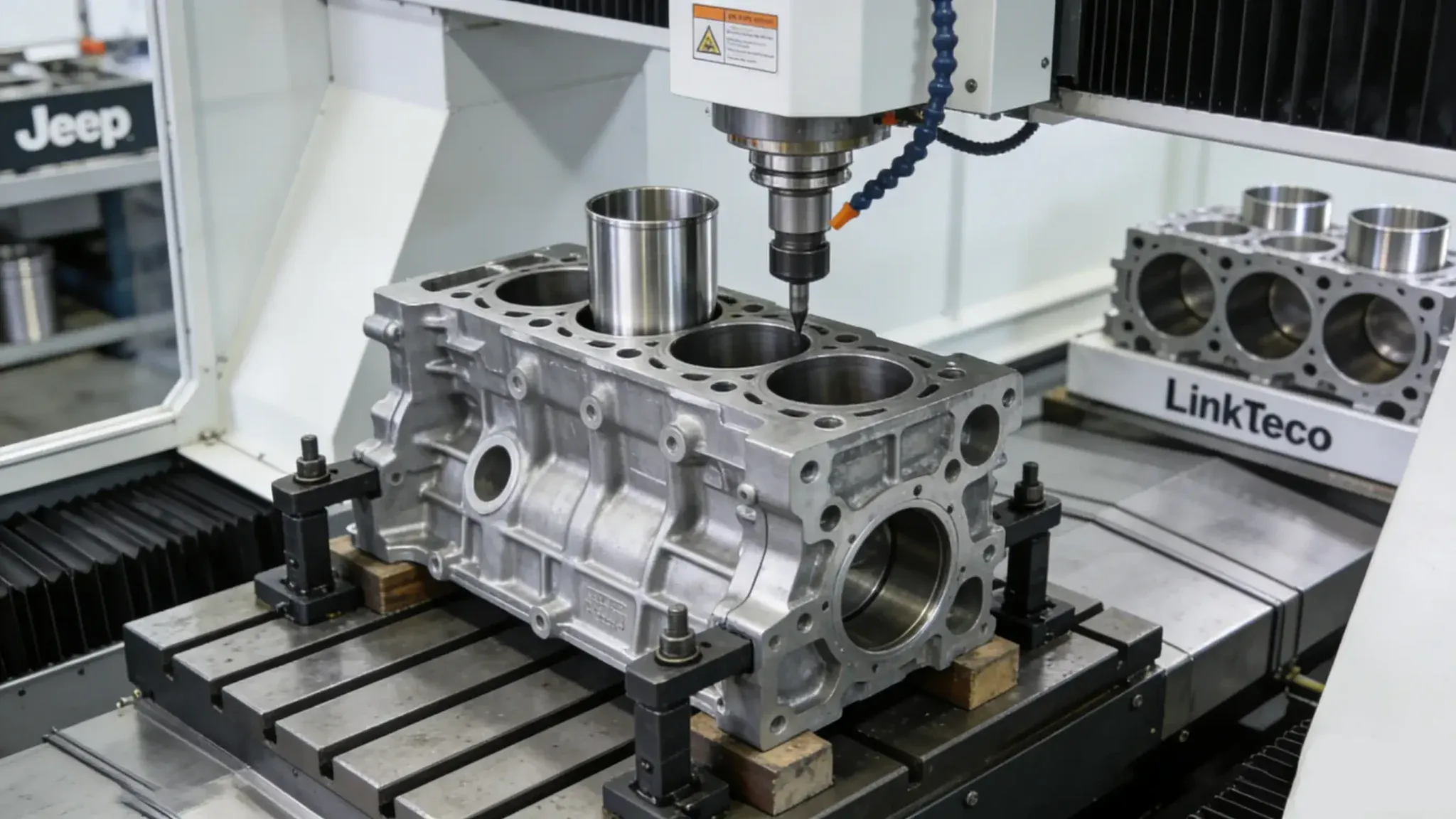
- Sleeve Treatment: This engine typically features special coatings or dry sleeves. If the cylinder wall is damaged, the standard solution is to install a thin-wall alloy sleeve.
- Machining Points: Aluminum has a high thermal expansion coefficient ; finish boring and honing must be performed in a constant temperature environment, and cutting heat must be strictly controlled to prevent dimensional spring-back.
Cast Iron Block (GM 3.8L):
- Repair Method: Cast iron blocks have thick walls and a large repair margin. The preferred solution is boring for oversized pistons; if the damage is severe, cast iron sleeves are pressed in.
- Machining Points: The focus is on restoring the flatness of the cylinder head deck. Since the GM 3.8L is a classic OHV structure, parallelism between the deck surface and the crankshaft centerline must be ensure
Linkteco Core Logic:Fusion for Aluminum, Plasticity for Iron
Of course, to meet the diverse needs of our clients for high-end material repairs, Linkteco offer enhanced solutions. The core logic remains: Fusion for Aluminum, Plasticity for Iron.
Aluminum Block: High-strength aluminum alloy welding wire, ER5183 Al-Mg wire (Superior to standard ER4043).
Reasoning: The Jeep 3.0L diesel engine operates under extremely high peak combustion pressures. ER5183 has a higher magnesium content, providing tensile strength and corrosion resistance that far exceed ordinary silicon-aluminum welding wires.
Technical Specifications: Weld tensile strength≥270MPa, capable of withstanding the high-frequency reciprocating impacts of a diesel engine and preventing fatigue cracks at the repair site.
Cast Iron Block: Special high-nickel alloy core, AWS ENiFe-CI (Nickel-Iron 55%) or Pure Nickel electrodes.
Reasoning: The GM 3.8L utilizes gray cast iron, where the greatest welding risk is "chill" or "whitening" (becoming hard and brittle). High-nickel filler materials promote graphitization as the molten pool cools, maintaining exceptional plasticity in the weld. This allows for plastic deformation through manual peening (hammering), which offsets shrinkage stress.
Technical Specifications: Weld hardness is controlled between HB160-190, ensuring that subsequent cylinder boring tools do not suffer from edge chipping or breakage.
Quality Core: Focus on Heat Management and Precision Control
Jeep 3.0L Aluminum Block: Precision Temperature Control & Dissimilar Material Repair
Process Path: AC TIG Welding + Alloy Sleeve Insertion.
Operational Key Points
- Cleaning: Chemical agents must be used to degrease the surface, followed by a dedicated stainless steel brush to strip the oxide layer (compliant with GB/T 22087, ASTM B580 / ASTM F2321).
- Thermal Distortion Control: Implement segmented symmetrical welding. Due to aluminum’s susceptibility to warping, the entire deck must be milled post-welding, followed by a cylinder head surface grinder to restore proper sealing.
- CylinderWall Restoration: These engines originally feature spray-on coatings; for remanufacturing, we recommend pressing in thin-wall centrifugal cast iron liners, with interference fits strictly controlled between 0.05–08mm.
GM 3.8L Iron Block: Stress Relief & In-Situ Restoration
Process Path: Preheating+Cold Welding + Peening for Stress Relief.
Operational Key Points
- Cold Welding Technique: Adhere strictly to the "short segment, intermittent, and peening" principle. Limit each weld bead to under 30mm, and immediately peen the weld with a ball-pane hammer to offset shrinkage stress.
- Boring & Machining: Thanks to the uniform hardness of cast iron, oversized piston solutions are fully supported. Per GB/T 1148 (Technical Conditions for Internal Combustion Engine Aluminum Pistons), determine the oversize grade (0.25mm / 0.50mm) based on the actual bore wear.
Dimension | Jeep 3.0L Aluminum Block | GM 3.8L Cast Iron Block |
Welding Difficulty | Extreme (Highly prone to oxidation and deformation) | High (Prone to cracking and hardening/chill) |
Recommended Filler | ER4043 / ER5356 Aluminum Alloy Wire | Z308 High-Nickel Cast Iron Wire/Electrode |
Heat Treatment | Requires strict control of the Heat-Affected Zone (HAZ) to prevent material softening | Requires preheating and post-weld insulation to prevent "white iron" formation |
Primary Repair Method | Installing dissimilar material alloy sleeves | Boring for oversized pistons or pressing in cast iron sleeves |
Fatigue Resistance | Highly sensitive to thermal cycling post-repair | Excellent post-repair structural stability |
Conclusion: Aluminum block repairs focus on fusion quality and deformation control, whereas cast iron block repairs prioritize crack prevention and the restoration of mechanical strength.
Authoritative Technology & Execution Standards
- Aluminum Alloy Porosity Control:Referring to research in the Transactions of the China Welding Institution, we emphasize the critical importance of shielding gas (99.99% high-purity Argon) to the welding quality of 3.0L diesel engines.
- Cast Iron Repair:Our procedures are strictly aligned with AWS D11.2 "Guide for Welding Iron Castings".
Practical Recommendations (Linkteco Core Standards):
- Non-Destructive Testing (NDT): All engine blocks must undergo Dye Penetrant Inspection (PT) both before and after welding to ensure there are no hidden cracks.
- Hardness Testing:The weld hardness on iron blocks must be controlled below HB 200; exceeding this limit will cause carbide insert chipping or breakage during the boring process.
- Pressure Testing: Upon completion of the repair, a hydrostatic test must be performed in an 80°C constant temperature tank at 0.4MPa for 30 minutes to ensure zero leakage in all passages.
Detailed Precision Restoration & Thermal Management
Jeep 3.0L Aluminum Block: Cold Process & Dissimilar Material Sleeving
- Welding Temperature Control:Utilizing AC Pulsed TIG welding. Linkteco strictly implements a micro-zone heating process, leveraging the cleaning effect of pulsed current to strip the aluminum oxide film while reducing overall heat input through high-frequency switching to prevent global distortion of the aluminum block.
- Machining Logic (Sleeving Method):Since the original cylinder walls of this engine may have special coatings, Linkteco typically adopts a "dry thin-wall liner insertion" approach.
- Critical Procedure:Utilizing liquid nitrogen to freeze the cylinder sleeves, which are then press-fitted non-destructively using the differential temperature method.
- Precision Control: Post-repair, the block must be re-centered on a CNC machining center to ensure the V6 bank angle deviation is ≤ 02°.
GM 3.8L Iron Block: Thermal Stress Relief & In-Situ Strengthening
- Welding Temperature Control:Employing an intermittent, cold welding, and peening process. Each weld bead length is strictly limited to under 20mm, followed immediately by pneumatic ball-peen hammering to convert tensile stress into compressive stress—this is the critical step in preventing iron block cracking.
- Machining Logic (In-Situ Boring):The GM 3.8L block has ample wall thickness; therefore, Linkteco prioritizes the oversized piston solution.
- Critical Procedure: Implementing platform plateau honing technology (compliant with GB/T 32523-2026 standards).
- Surface Treatment:Addressing the corrosion susceptibility of cast iron coolant passages, Linkteco applies a specialized internal combustion engine coolant channel protective sealant after machining.
| Step | Jeep 3.0L Aluminum Solution | GM 3.8L Cast Iron Solution |
| Cleaning | Specialized Acid/Alkaline wash + Stainless steel brush for oxide removal | Sandblasting + Solvent degreasing (removes oil trapped between graphite flakes) |
| Pre-weld Treatment | Constant temperature preheat at 150°C to prevent hardening | Strictly no high-temp preheat; maintain room-temperature cold welding |
| Heat Management | Rapid heat dissipation; leverage aluminum's conductivity to assist cooling | Slow cooling; cover with asbestos or lime for insulation |
| Machining | High spindle speed, low feed rate (prevents material sticking to tools) | Low spindle speed, high torque (prevents hitting "white iron" hard spots) |
| Inspection Focus | Sealing surface flatness and bore coaxiality | Micro-cracks in the Heat-Affected Zone (HAZ) |
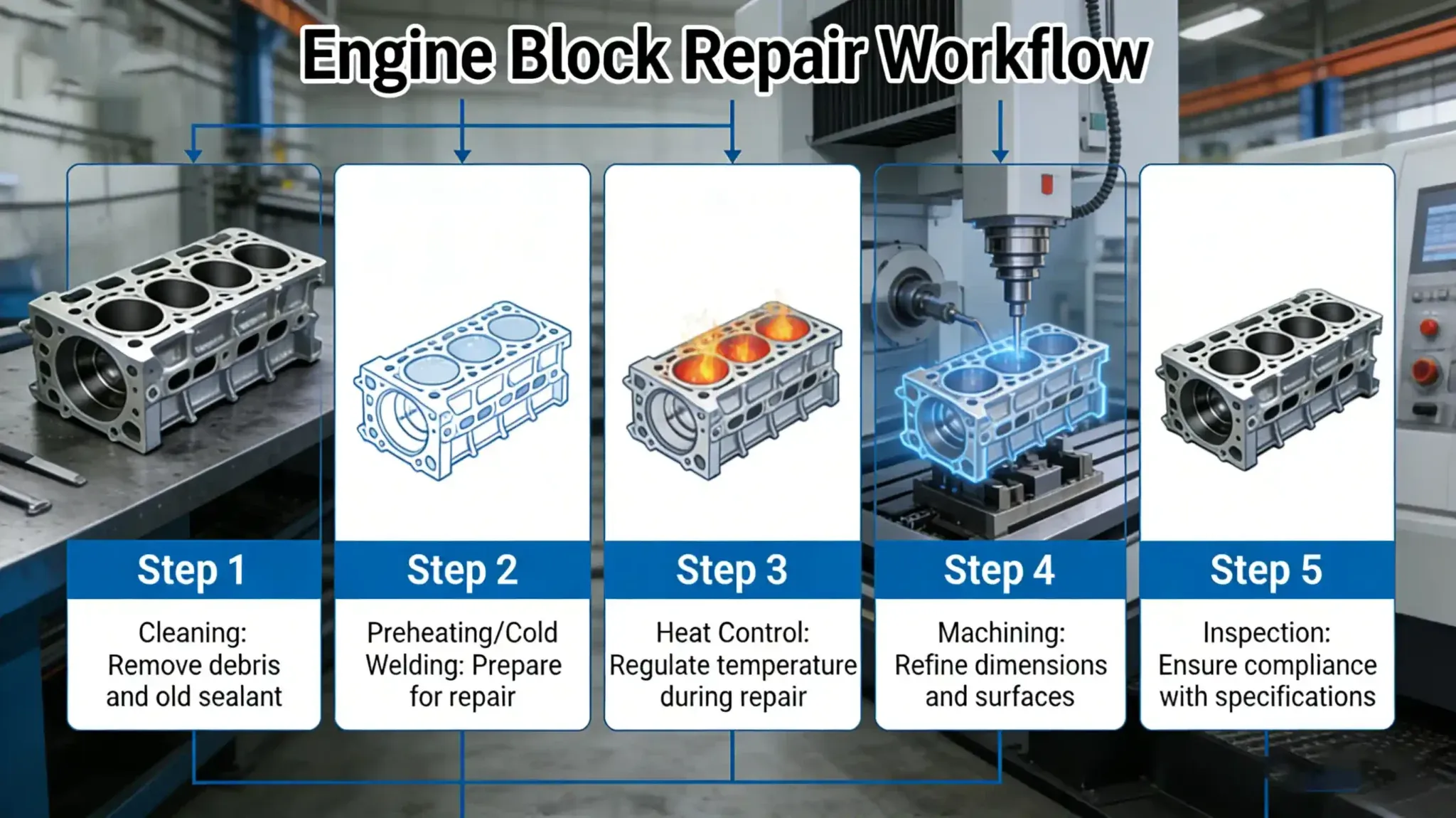
For the Jeep 3.0L: Linkteco focuses on precision welding and thermal distortion constraints. It’s all about cleanliness and managing that expansion.
For the GM 3.8L: The focus shifts to graphitization and stress relief. You need ductile fillers and a slow cool-down.
This material-science-driven approach is how Linkteco backs our remanufactured blocks with an OEM-level 100,000 km warranty.
Core Logical Differences
Aluminum Block (Jeep 3.0L): The core of the repair is "Distortion Control & Fusion."
Aluminum's rapid thermal conductivity and susceptibility to warping mean the repair must focus on overcoming oxide layer interference.
The goal is to ensure weld strength capable of withstanding high-pressure diesel environments while strictly controlling thermal deformation during precision machining.
Key actions: Stripping the oxide layer, constraining thermal distortion, and strengthening the sealing surfaces.
Iron Block (GM 3.8L): The core of the repair is "Crack Prevention & Stress Relief."
Due to the high brittleness of cast iron and its tendency toward "chill" (white iron formation) during welding, the repair prioritizes using material compensation (nickel-based fillers) and process intervention (peening) to prevent heat-induced cracking.
This ensures the block remains fully machinable.
Key actions: Controlling microstructural graphitization and releasing residual stresses.
Dimension | Jeep 3.0L Aluminum (Linkteco Spec) | GM 3.8L Iron (Linkteco Spec) |
Filler Choice | ER5183 High-Magnesium Alloy (30% stronger than 4043; ideal for high-pressure diesels) | AWS ENiFe-CI (Ni-Fe 55) (Provides maximum plasticity to prevent brittle weld cracking) |
Welding Tech | AC Pulsed TIG (Uses cathode cleaning to strip oxide layer; pulse control manages heat input) | Short-segment, Cold Weld, Peening (Beads <20mm; immediate hammering to release tensile stress) |
Heat Management | Localized Precision Preheat (150°C) (Prevents "cold-lap" caused by rapid heat sink) | Zero Preheat (Cold Weld) or Global Heating (Prevents localized thermal stress cracks in the iron body) |
Machining | Dissimilar Material Sleeving (Liquid nitrogen shrink-fit for high-strength alloy sleeves) | In-Situ Boring + Plateau Honing (Leverages thick walls for oversized boring; reduces cost) |
Precision Guard | CNC Centering (Performed in 20°C constant temp to account for aluminum’s high thermal expansion) | Vibratory Stress Relief (VSR) (Post-weld aging or vibration to ensure the block doesn't warp over time) |
Practical Recommendations & Summary
For the Jeep 3.0L: Cleanliness is non-negotiable. Aluminum alloys are extremely sensitive to oil contamination; ultrasonic cleaning must be performed before welding, or the resulting porosity will lead to gas leaks under high combustion pressure.
For the GM 3.8L: Machinability is the top priority. If the wrong filler material causes the weld bead to harden (forming "white iron"), irreversible damage to the boring tools will occur during subsequent machining.
Execution Standards: The entire restoration workflow strictly complies with GB/T 28676-2026 "Remanufacturing Specifications for Automotive Parts: Shafts and Blocks," ensuring that post-repair dimensional and geometric tolerances meet or exceed OEM standards.
Industry Codes: All welding operations adhere to JB/T 6062-2026 "Technical Conditions for Welding Reinforcement".
Aluminum Block Recommendation: Precision machining must be conducted in a constant temperature environment (20°C±2°C). Aluminum experiences significant dimensional fluctuations due to temperature changes; failing to machine under constant temperature will cause coaxiality to exceed limits after assembly.
Cast Iron Block Recommendation: "Oil Seepage Removal" is a mandatory pre-welding step. Old engine oil often accumulates within the porous structure of cast iron; it must be removed via high-temperature baking or specialized chemical solvents to prevent porosity and slag inclusions in the weld bead.
After-Sales Performance Tracking & Verification
Based on tracking data from 2025 to early 2026, repair cases utilizing the aforementioned differentiated solutions have achieved exceptionally high customer satisfaction levels.
Jeep 3.0L Diesel Users: Feedback indicates that post-repair oil consumption has returned to standard levels.
Performance Stability: No abnormal water temperatures or head gasket blowouts were observed under long-distance, high-load operating conditions.
Verification: These results validate the success of our thermal distortion control for aluminum blocks.
GM 3.8L Gasoline Users: General feedback highlights smoother engine idling and outstanding post-repair cylinder block durability.
OEM Advantage: Users specifically noted that Linkteco’s remanufacturing solution—based on the original cast iron substrate—offers superior quietness and compatibility compared to direct replacement with aftermarket blocks.
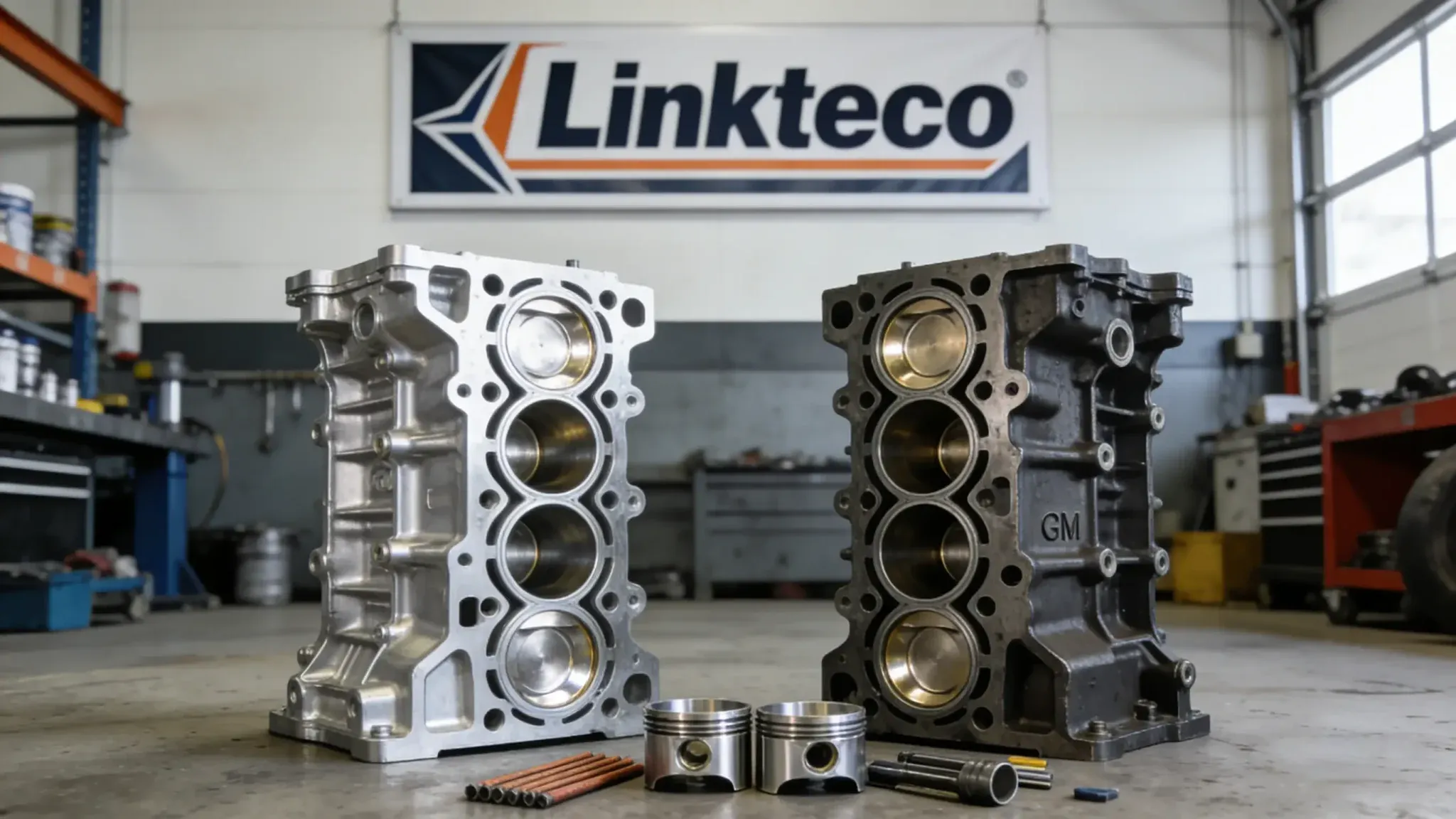
Conclusion: Extending the Engine’s Secondary Life Cycle
Linkteco has ensured high reliability for Jeep diesel engines through the use of high-strength magnesium-aluminum welding wire and differential temperature sleeve insertion. For GM iron blocks, we successfully resolved cracking issues using high-nickel filler materials and stress-relief cold welding. This differentiated approach effectively extends the engine's secondary life cycle, with all performance indicators meeting OEM assembly standards.
Reach out to Linkteco today to get your custom repair kit and ensure your engine blocks perform like new.

Contact
©2026 LinkTeco All Rights Reserved.