

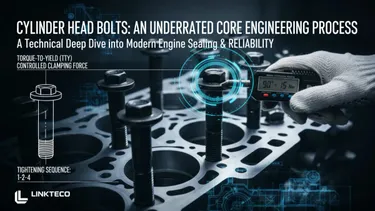
Cylinder head bolts— An Underrated Core Engineering Process
When people talk about engine reliability, they usually point to the block, the cylinder head, the head gasket, or combustion efficiency. Head bolts? They’re often treated as just tighten them in order and you’re done. That mindset is exactly why head bolts have become one of the most underestimated and most failure-prone parts in modern engines.
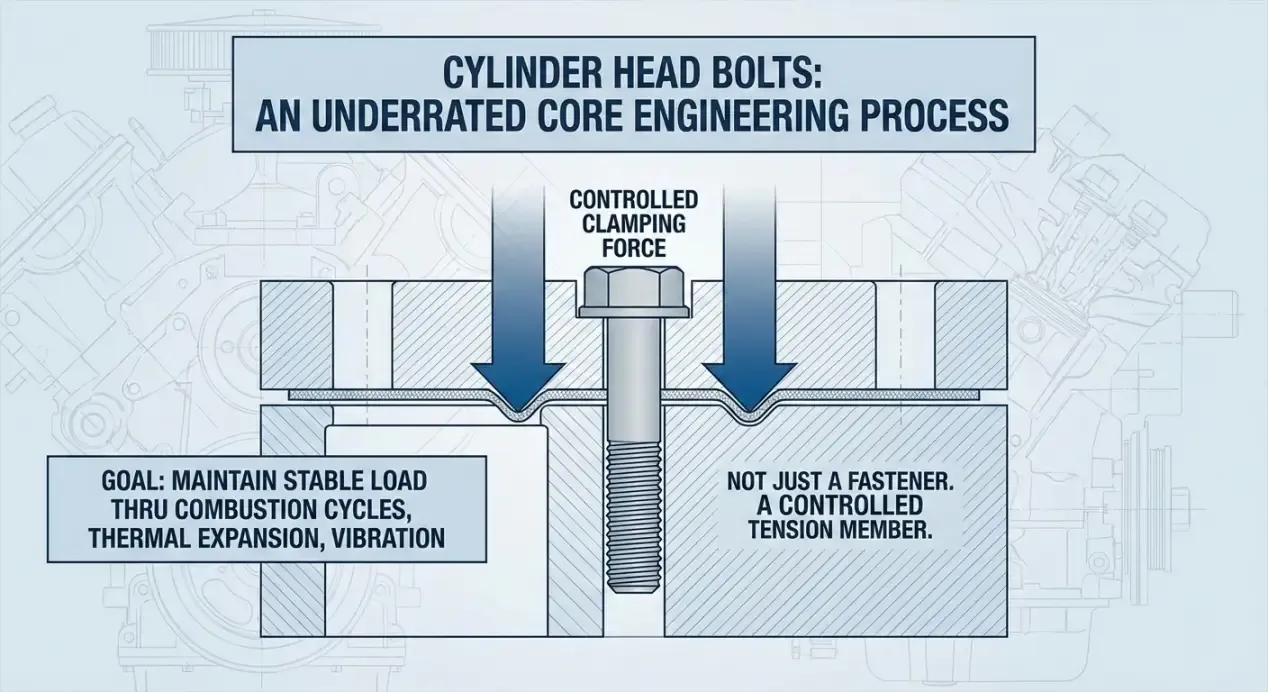
From an OEM engineering perspective, cylinder head bolts should not be viewed as conventional fasteners. They function as a load-setting system, and their design, manufacturing consistency, and installation process have a direct impact on head gasket sealing, combustion stability, thermal durability, and overall engine reliability.
A head bolt isn’t there just to hold parts together.
Its real purpose is to create and maintain a controlled clamping force between the block and the head—and keep that force stable for the life of the engine.
That load has to survive combustion pressure cycles, thermal expansion differences, heat cycling, vibration, and constantly changing mechanical loads.
From an engineering standpoint, a head bolt is a controlled tension member, not a conventional fastener.
Ignore that fact, and gasket failures, compression loss, and repeat repairs are almost inevitable.
In the field, leaks or compression issues are often blamed on the head gasket. But OEM failure analysis usually shows something else the clamping force wasn't right or wasn't evenly distributed.
Even the best MLS gasket can't seal if the load holding it in place isn't correct — or doesn't stay that way over time.
Simply the gasket carries the load, but the head bolts decide whether that load exists at all.
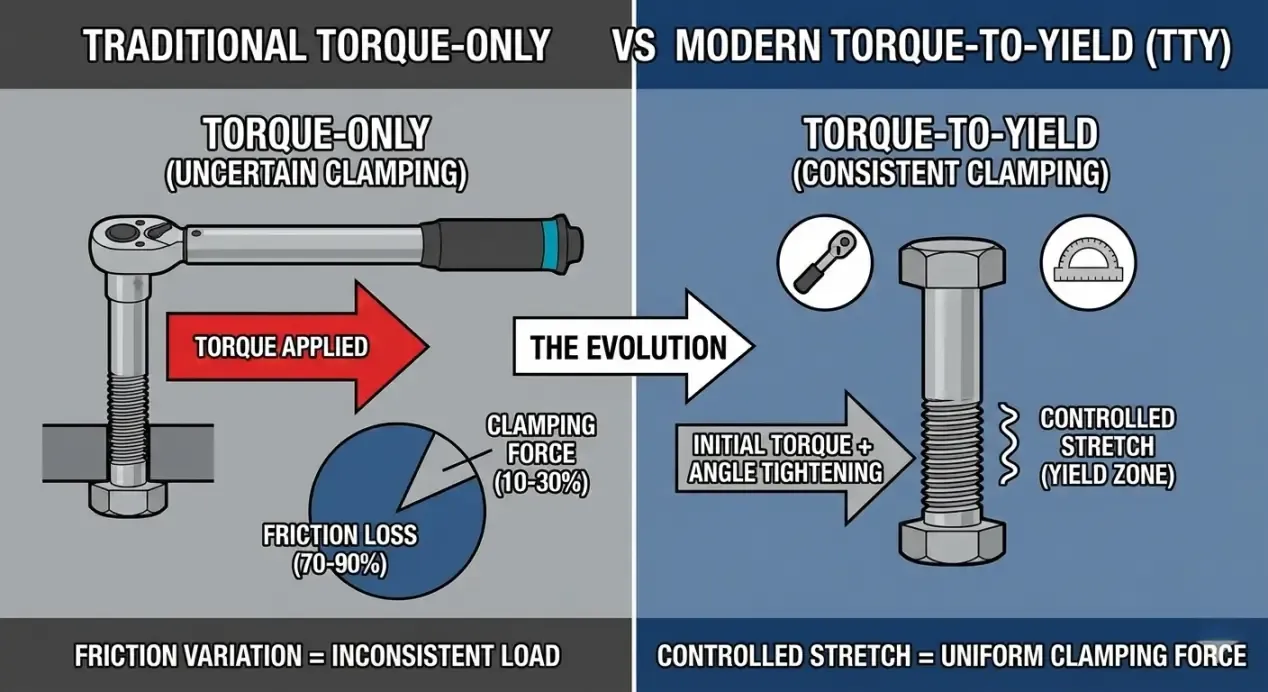
Older engines could get away with torque-only tightening. Modern engines can't. The reason is 70–90% of the applied torque is lost to friction. Small differences in lubrication or surface finish can lead to big preload changes. Two bolts at the same torque don't necessarily produce the same clamping force.In aluminum heads, thin-wall blocks, turbo engines, and high-compression designs, that kind of uncertainty just doesn't work.
This is why Torque-To-Yield (TTY) bolts became the industry standard.
The goal of TTY tightening is not more torque—it’s controlled bolt stretch.
By combining an initial torque step with angle tightening, the bolt is intentionally stretched beyond its elastic limit and into a controlled yield zone.
This dramatically reduces friction-related variation and delivers consistent clamping force across all bolts.
At that point, tightening stops being a feel-based operation and becomes a repeatable engineering process.
TTY bolts are often treated as an installation technique, but their reliability is decided long before they ever reach the engine.
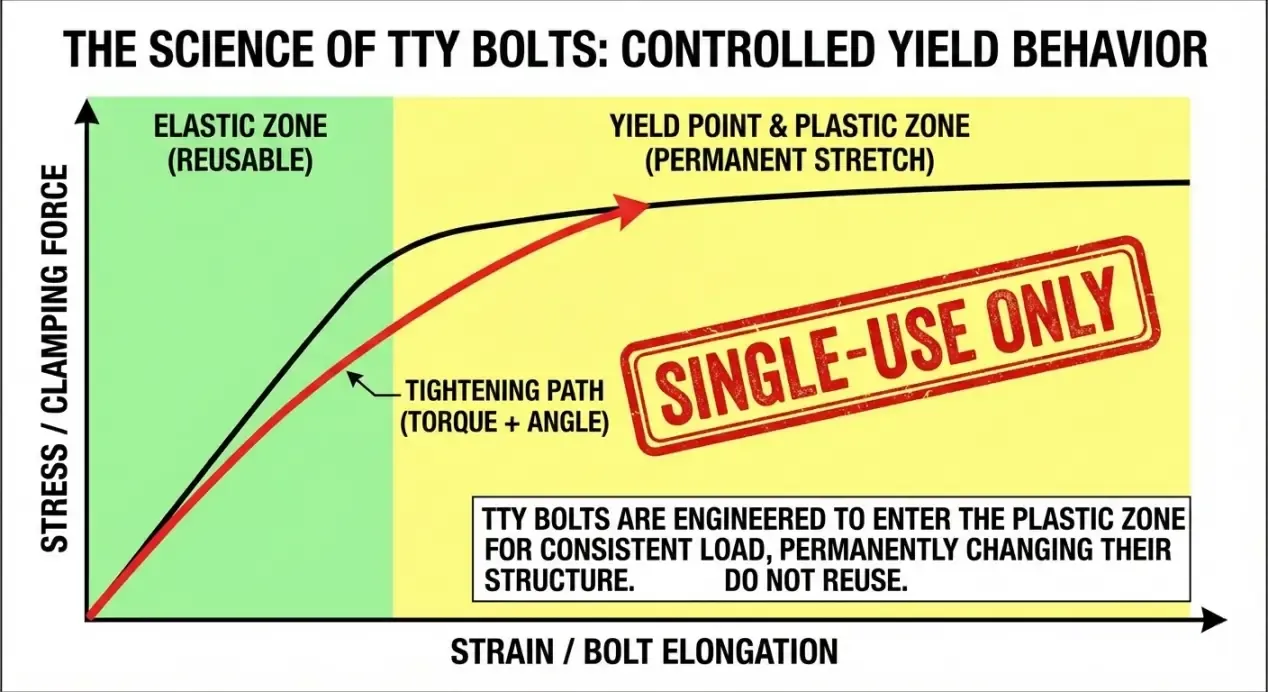
They’re made from high-strength alloy steel not to maximize strength, but to deliver consistent yield behavior and predictable elongation.
Controlled heat treatment defines the transition from elastic to plastic deformation, while cold forming, rolled threads, and engineered coatings ensure durability, stable friction, and corrosion protection.
Once a TTY bolt enters the yield zone, it is permanently changed — which is why reuse goes directly against the original design intent
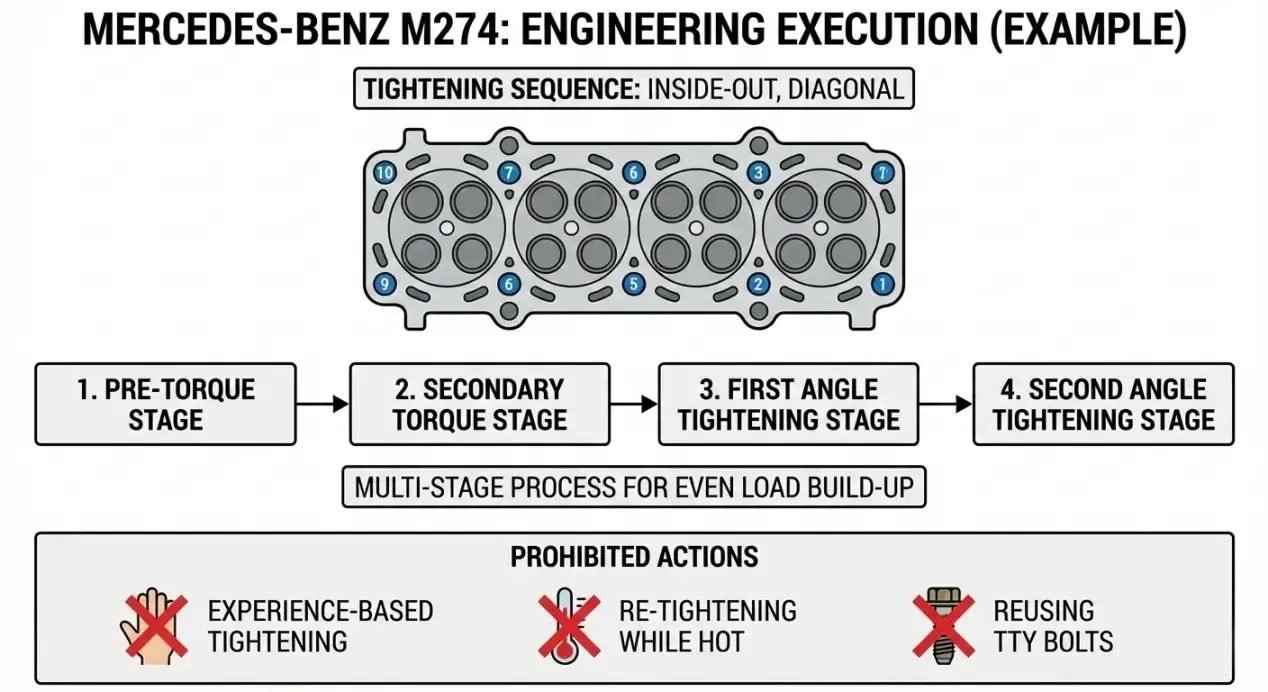
The following overview is based on Mercedes-Benz head bolt design philosophy, using the M274 engine as a representative example.
(Exact values and procedures must always come from the official service manual.)
- Bolt Type Confirmation
- The M274 engine uses single-use TTY cylinder head bolts.
- Removal is considered the completion of a full stretching life cycle.
- There is no engineering premise for "resetting" or "re-tightening."
- Bolt Condition Check
- No damage, corrosion, or coating damage to the threads and shank.
- No necking or abnormal stretching marks should be present.
- Bolt Hole Preparation
- Thoroughly clean and dry the bolt holes.
- Ensure there is no liquid residue at the bottom of the blind holes to avoid hydraulic locking effects.
- Lubrication and Friction Condition Consistency
- Strictly follow MB repair specifications.
- All bolts must be in a completely consistent friction state.
- Tightening Sequence
- Performed from the inside out, in diagonal sections.
- The goal is to evenly build up the load, not to achieve speed.
- Multi-Stage Tightening Process
- Initial pre-tightening stage
- Secondary torque stage
- First angle tightening stage
- Second angle tightening stage
- Tool Requirements
- Use calibrated torque tools and angle measuring tools.
- Tool calibration status is considered part of the process.
- Clearly Prohibited Actions
- Tightening based on experience
- Re-tightening while hot
- Reusing TTY bolts that have entered the plastic deformation zone
MB engineering stance is very clear: cylinder head bolt assembly is a one-time load setting process.
From Tightening to Engineering Execution, Head bolt problems rarely fail immediately. They usually show up after repeated heat cycles, which is why they’re often misdiagnosed as gasket or machining issues.
In reality, head bolt installation is one of the earliest—and most critical—decisions in the sealing system.Modern head bolts are not hardware. They are engineered components, and installing them correctly is a core engineering process, not a routine task. Getting this step right is the foundation for long-term sealing integrity, stable compression, and low comeback rates.
Conclusion: From Routine Task to Engineering Excellence
Head bolt installation is one of the most critical decisions in the sealing system. In reality, these bolts are highly engineered components. Getting this step right is the foundation for:
Long-term sealing integrity.
Stable engine compression.
Significantly lower comeback rates.
Partner with the Experts
Don't let an "underrated" bolt compromise your shop's reputation.
Download: Get our Universal Torque & Angle Specification Chart for leading EU and US engines.
Inquire: Contact our engineering team for OEM-grade head bolt solutions designed to eliminate rework.
Contact Us:
- Official Website Inquiry: https://linktecowholesale.com/
- Dedicated Business Email: info@linktecowholesale.com
- Technical Consultation Hotline (Chinese/English Support): +86 19168959101
- WhatsApp Business Chat: +86 19168959101

Contact
©2026 LinkTeco All Rights Reserved.