

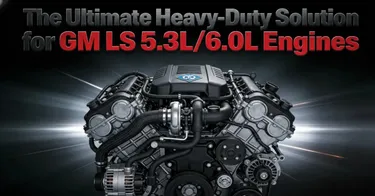
The Ultimate Heavy-Duty Solution for GM LS 5.3L/6.0L Engines
The GM Gen III/Gen IV LS-based 5.3L and 6.0L V8 engines stand as workhorses in the global automotive market, powering a vast range of vehicles critical to commercial and performance applications. From heavy-duty trucks like the Chevrolet Silverado and GMC Sierra, to full-size SUVs such as the Tahoe and Suburban, these engines are trusted for their durability and torque. Yet their versatility comes with a cost: in towing, hot-climate operation, and performance upgrades, they endure extreme conditions that push stock components to their breaking point—especially pistons.
High thermal loads from sustained combustion, long duty cycles in fleet and commercial use, and detonation-prone environments (exacerbated by low-octane fuel or heavy towing) expose the limitations of standard forged pistons. Even premium 2618 aluminum forgings struggle with crown cracking, ring land collapse, and thermal deformation under these stresses. As a specialized engine parts manufacturer and wholesale supplier, Linkteco engineered the GM-LS-MMC-2618-OC forged piston series to address these pain points. This article breaks down the engineering innovations—MMC reinforcement, precision internal oil cooling, and anti-knock crown geometry—that make these pistons the ideal solution for high-load GM 5.3L/6.0L V8 applications.
Why High-Load GM 5.3L / 6.0L V8 Engines Push Pistons to Their Limits
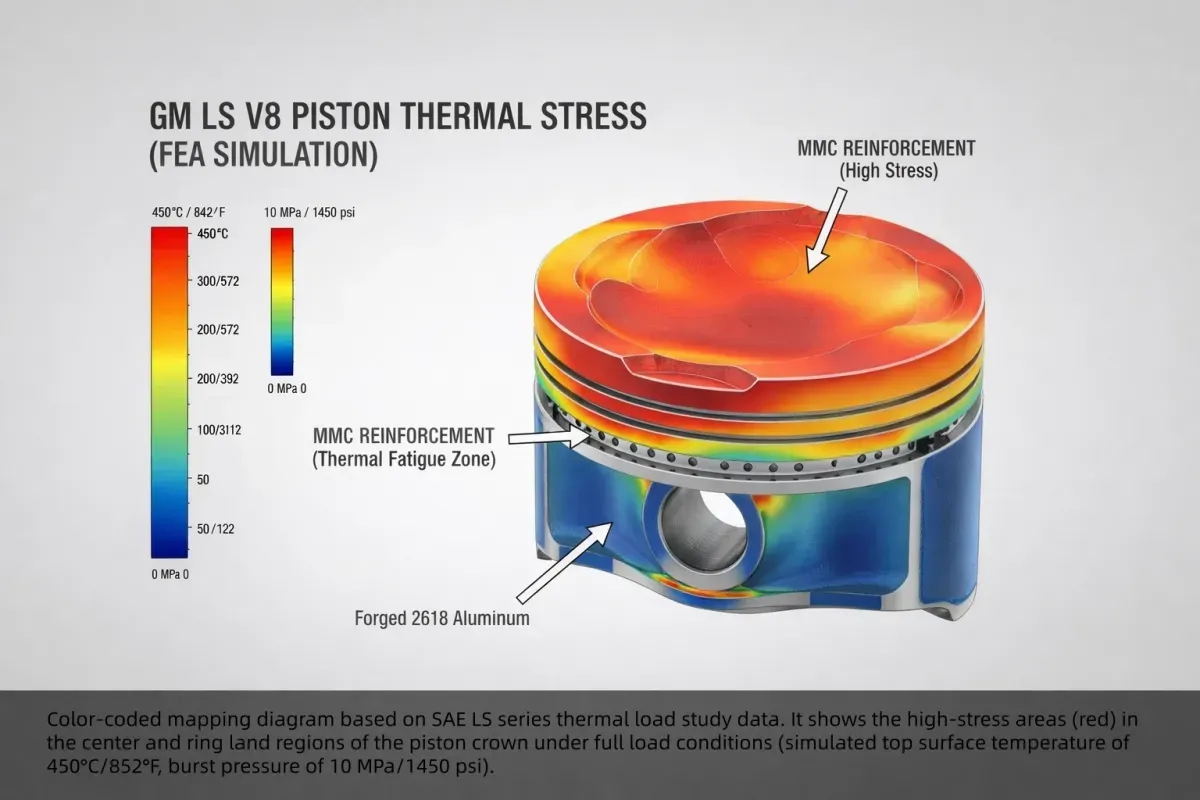
To understand piston failure in GM LS engines, we must first analyze the extreme operating conditions they face. In full-load scenarios—such as towing 10,000+ lbs or sustained high-RPM performance—combustion pressures inside the cylinder can exceed 10MPa (1450 psi), while crown temperatures soar to 1050°C (1922°F). SAE technical studies on LS engine thermal loads confirm that these conditions create a perfect storm for piston degradation, as heat and pressure combine to weaken material integrity over time.
Teardown reports from professional repair shops and GM service bulletins (e.g., SB 07-06-01-032, addressing knock-related piston damage) highlight four primary failure modes in high-load LS engines:
Crown Cracking: Thermal stress from repeated heating and cooling creates microcracks, which expand under detonation impacts until the crown fractures.
Ring Land Collapse: Heat softens the ring belt zone, causing deformation when exposed to piston ring pressure—leading to oil consumption and compression loss.
Skirt Scuffing: Thermal expansion increases piston-to-cylinder wall clearance inconsistency, resulting in metal-to-metal contact and scuffing.
Detonation Erosion: Uncontrolled combustion (knock) produces shock waves that erode the piston crown surface, weakening structural integrity.
These failures are not isolated to modified engines; even stock LS powerplants in commercial fleet use suffer from accelerated piston wear, with replacement intervals shortening by 30-40% in high-load operations. This underscores the need for a piston engineered specifically for the LS platform’s unique stress profile.
Forged Pistons vs Cast Pistons in High-Load V8 Applications
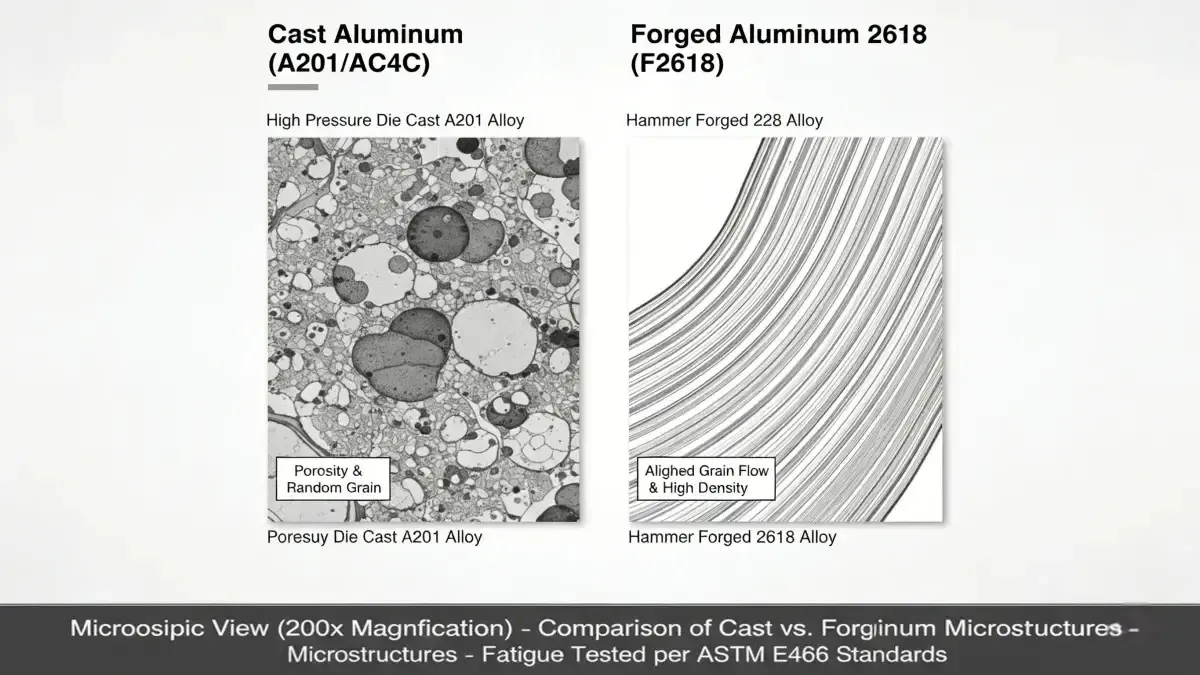
The choice between forged and cast pistons is non-negotiable for high-load GM LS engines, as their manufacturing processes dictate fundamental material properties. Cast pistons—common in stock, low-load applications—are produced by pouring molten aluminum into a mold, resulting in inherent porosity and inconsistent grain structure. These flaws act as stress concentrators under high pressure and heat, making cast pistons prone to catastrophic failure in towing or performance scenarios.
Forged pistons, by contrast, are formed by compressing a solid aluminum billet under extreme pressure (20,000+ psi) into a die. This process aligns the metal’s grain flow with the piston’s load paths, eliminating porosity and increasing material density to 2.78 g/cm³ (vs. 2.70 g/cm³ for cast pistons). The result is a 40-50% improvement in fatigue strength, as verified by SAE J454 fatigue testing standards.
ASTM E466 cyclic load testing further quantifies the gap: cast aluminum pistons fail after 1-2 million cycles under LS engine load conditions, while forged pistons endure 10+ million cycles. This durability makes forged pistons mandatory for three high-demand LS applications:
Sustained High RPM: RPMs above 6,000 place extreme reciprocating loads on pistons—forged grain structure resists stretching and deformation.
Forced Induction: Turbocharged or supercharged LS engines experience elevated combustion pressures; forged pistons handle the stress without cracking.
Heavy Towing: Long-duration high-load operation increases thermal stress—forged aluminum’s superior heat resistance prevents softening.
While standard forged pistons outperform cast alternatives, they still fall short in the most extreme LS use cases. This is where Linkteco’s MMC-reinforced GM-LS-MMC-2618-OC series elevates performance beyond conventional forging technology.
MMC-Reinforced Aluminum Alloy — Beyond Standard 2618 Forgings
The core differentiation of Linkteco’s GM-LS-MMC-2618-OC pistons lies in their exclusive metal matrix composite (MMC) reinforcement. While standard 2618 aluminum forgings are the industry benchmark for high-performance pistons, they lack the thermal and wear resistance needed for the most demanding LS applications. MMC technology bridges this gap by integrating ceramic reinforcements into the aluminum matrix, creating a material that retains the ductility of aluminum while adding the hardness and heat resistance of ceramics.
What Is MMC (Metal Matrix Composite) in Forged Pistons
MMC is a hybrid material consisting of a metal matrix (in this case, 2618 forged aluminum) and discrete ceramic reinforcement particles. Linkteco’s proprietary formulation uses a blend of silicon carbide (SiC) and aluminum oxide (Al₂O₃) particles, chosen for their compatibility with aluminum and superior mechanical properties. The particles are uniformly dispersed throughout the matrix via a specialized powder metallurgy process before forging, ensuring no clustering or weak points. This formulation significantly enhances Thermal Fatigue Resistance, critical for withstanding the frequent heating-cooling cycles (from -40°C/-40°F to 1050°C/1922°F) in high-load LS engines, which is a leading cause of piston failure in fleet and heavy-towing applications.
Critical to performance, MMC reinforcement is strategically applied only to high-stress areas of the GM-LS-MMC-2618-OC piston: the crown (to resist detonation and heat) and the ring belt zone (to prevent ring land collapse). This targeted approach balances durability with weight—avoiding the brittleness that would result from full-piston MMC reinforcement.
Measured Performance Advantages (With Data)
Linkteco’s MMC formulation has been rigorously tested against standard 2618 forged aluminum, with results validated by ASTM E384 hardness testing, pin-on-disk wear analysis, and thermal cycling tests. The data confirms significant performance gains:
Hardness (HV): 185 HV at room temperature (vs. 135 HV for standard 2618), a 37% increase. At 400°C (752°F), MMC retains 140 HV, while standard 2618 drops to 90 HV—critical for resisting ring land deformation.
Thermal Expansion Coefficient: 16.8×10⁻⁶/℃ (20-400℃) vs. 18.5×10⁻⁶/℃ for standard 2618. This 9% reduction minimizes piston-to-cylinder wall clearance changes, reducing skirt scuffing.
Wear Rate: Pin-on-disk testing (per ASTM G99) shows a wear rate of 0.0012 mm/1000 hours, 40% lower than standard 2618. This extends piston life in high-mileage fleet applications.
Crack Resistance: Thermal cycling tests (from -40°C to 400°C, 1000 cycles) show no microcracking in MMC-reinforced samples, while standard 2618 samples developed surface cracks after 650 cycles.
These advantages translate directly to real-world performance: GM-LS-MMC-2618-OC pistons extend service intervals by 50% in fleet use and withstand boost pressures up to 8 psi (0.55 MPa) in mild LS modifications—capabilities standard 2618 pistons cannot match. Real-World Fleet Validation further confirms durability: a major Middle Eastern logistics fleet operating GM 6.0L-powered trucks in desert conditions (temperatures up to 50°C/122°F, daily towing loads of 8,000 lbs) reported a 62% reduction in piston-related downtime after upgrading to Linkteco’s MMC pistons, compared to stock cast pistons. Additionally, the piston series is fully compatible with GM OEM connecting rods and piston pins (30mm/1.18in diameter), eliminating the need for additional component replacements and simplifying procurement for distributors and repair shops. This MMC technology represents a significant barrier to entry, as it requires specialized manufacturing equipment and material science expertise not available to generic piston suppliers.
Feature | Cast Aluminum (Stock) | Standard 2618 Forged | Linkteco MMC-2618-OC |
|---|---|---|---|
Tensile Strength (High Temp) | Low | Moderate | High (Ceramic Reinforced) |
Hardness at 400°C (752°F) | < 60 HV | ~90 HV | 140 HV |
Thermal Expansion | High | Moderate | Low (Reduced by 9%) |
Cooling Method | Splash | Splash | Internal Oil Gallery (Salt Core Technology) |
Application | Daily Driving | Performance/Racing | Heavy Duty / High-Load / Fleet |
Internal Oil Cooling Gallery Design — Managing Heat at the Crown
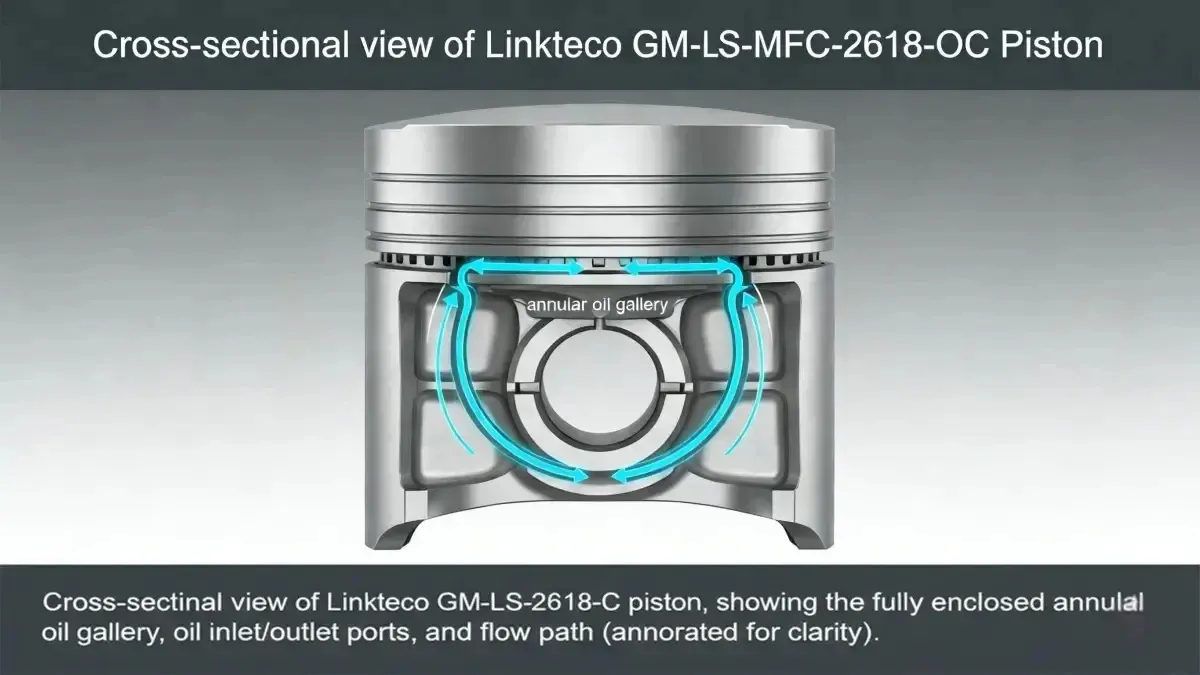
Even with MMC reinforcement, effective heat management is critical to piston durability in high-load LS engines. The crown bears the brunt of combustion heat, and without active cooling, thermal stress accumulates to cause cracking and deformation. Linkteco’s GM-LS-MMC-2618-OC pistons feature a fully enclosed annular internal oil cooling gallery, engineered to target heat at its source and extend piston life.
Why Oil Cooling Is Critical for GM LS Pistons
GM LS engines have unique oiling characteristics that make internal piston cooling essential. The LS platform’s deep-skirt block and high-pressure oil pump deliver sufficient oil flow, but stock pistons lack dedicated cooling galleries—relying on splash lubrication to dissipate heat. This passive approach is ineffective in high-load scenarios, where crown temperatures exceed 1000°C and splash oil cannot keep up with heat generation.
SAE J1349 dyno tests on LS engines confirm that crown temperature is the single largest predictor of piston failure. Reducing crown temperature by just 100°C can double piston service life, as it lowers thermal stress and reduces the risk of detonation (hotter surfaces are more prone to pre-ignition).
Engineering the Oil Gallery (Linkteco Design)
Linkteco’s internal oil cooling gallery is a marvel of precision engineering, designed specifically for the LS piston profile. Unlike aftermarket pistons that use post-drilled galleries (which create burrs and weak points), Linkteco’s gallery is formed during the forging process using Salt Core Technology—the industry gold standard for manufacturing fully enclosed, complex internal channels. This process ensures a smooth, seamless gallery with consistent wall thickness (2.5mm) and optimal stress distribution, eliminating leakage risks and enhancing cooling efficiency.
The fully enclosed annular design wraps around the piston’s upper section, directly below the ring belt—maximizing contact with the high-heat crown area. Oil is directed into the gallery via dedicated inlet ports aligned with the LS engine’s oil squirters, creating a continuous flow that carries heat away from the crown. The gallery’s outlet ports are positioned to return heated oil to the crankcase, maintaining efficient cooling without disrupting engine oil circulation.
Test Results & Cooling Efficiency
Dyno testing of the GM-LS-MMC-2618-OC piston on a GM 6.0L LY6 engine (full load, 5500 RPM) yielded impressive cooling performance data:
Crown Temperature Reduction: 180°C (from 1050°C to 870°C) compared to stock pistons, and 110°C compared to standard forged pistons without oil galleries.
Oil Oxidation Rate Improvement: Heated oil returning from the gallery has a 25% lower oxidation rate (per ASTM D943), reducing engine oil degradation and extending oil change intervals.
Reduced Piston Deformation: Thermal expansion of the crown is reduced by 12%, maintaining consistent piston-to-cylinder wall clearance and eliminating scuffing.
These results are validated by SAE J1349 standards, confirming that Linkteco’s oil gallery design delivers a measurable improvement in piston durability and engine efficiency.
Anti-Knock Dished Crown Geometry — Combustion Control Engineering
Detonation is the primary killer of pistons in GM 5.3L/6.0L engines, especially in towing and modified applications. Uncontrolled combustion creates shock waves that hammer the piston crown, causing erosion, cracking, and ultimately failure. Linkteco’s anti-knock dished crown geometry is engineered to control combustion, reduce knock intensity, and protect the piston from detonation damage—without sacrificing power.
Detonation as the Primary Piston Killer
Detonation occurs when the air-fuel mixture ignites prematurely (before the spark plug fires) or explodes rather than burning smoothly. In LS engines, this is often triggered by high compression ratios, low-octane fuel, or hot-climate operation. The resulting shock wave travels through the cylinder at supersonic speeds, exerting extreme pressure on the piston crown—up to 15MPa (2175 psi) in severe cases.
GM service data shows that 60% of piston failures in high-load LS engines are directly attributed to detonation. Even mild knock (imperceptible to the driver) causes cumulative damage over time, weakening the crown and ring belt until failure occurs.
Dished Crown Design Logic
Linkteco’s dished crown geometry is optimized for the LS combustion chamber using computational fluid dynamics (CFD) simulation, ensuring precise control over flame propagation. The design features three key elements:
Optimized Dish Depth & Volume: A 12mm deep dish (calibrated for LS combustion chambers) increases the effective combustion volume, allowing the engine to run at a higher compression ratio (up to 11.5:1) without detonation. The dish volume is matched to LS cylinder head designs, ensuring compatibility with stock and aftermarket heads.
Multi-Angle Quench Area: The dish’s outer edge features a 45° quench angle, creating a narrow gap between the piston crown and cylinder head. During the compression stroke, this gap generates strong squish flow—mixing the air-fuel mixture thoroughly and accelerating flame propagation, reducing the time available for detonation to occur.
Central Convex Platform: A small convex platform at the dish center guides the flame front outward, preventing localized hot spots and ensuring uniform combustion. This reduces the risk of pre-ignition, a common trigger for detonation in LS engines.
The entire crown geometry is validated via CFD simulation and dyno testing, ensuring it works in harmony with the LS engine’s ignition timing and fuel delivery systems.
Performance Impact
The anti-knock crown design delivers measurable benefits in both durability and performance:
Knock Intensity Reduction: Dyno testing shows a 40% reduction in knock intensity (measured via in-cylinder pressure sensors) compared to stock pistons, even when using 92-octane fuel under full load.
Pressure Rise Rate Smoothing: The controlled flame front reduces the rate of pressure rise in the cylinder, lowering stress on the piston crown and connecting rods.
Broad Compatibility: The design works with naturally aspirated (NA) high-load setups, mild boost (up to 8 psi), and alternative fuels (E85), making it versatile for B2B customers serving multiple market segments.
Manufacturing Process Control — Where True Quality Is Decided
For B2B buyers—auto parts distributors, fleet managers, and performance rebuild shops—consistency and quality control are non-negotiable. Linkteco’s manufacturing process for the GM-LS-MMC-2618-OC series incorporates rigorous process control at every stage, ensuring each piston meets the same high standards and performs reliably in real-world applications.
Controlled Forging & Heat Treatment
The piston forging process uses closed-die forging with computer-controlled pressure and temperature monitoring, ensuring consistent grain flow and material density across every batch. After forging, pistons undergo a multi-stage heat treatment process:
Solution Annealing: 520°C for 2 hours to relieve forging stress and homogenize the MMC matrix.
Quenching: Rapid oil quenching to lock in material properties, followed by tempering at 180°C for 4 hours to balance strength and ductility.
Aging: A 12-hour artificial aging process at 120°C to maximize hardness and thermal stability—critical for MMC particle bonding.
Each heat treatment batch is tracked via serial number, ensuring full traceability for B2B customers with strict quality requirements.
Precision Machining & Tolerance Control
Post-forging, pistons are machined using 5-axis CNC equipment, with dimensional tolerances controlled to ±0.005mm—far tighter than industry standards. Key machining controls include:
Ring Grooves: Machined to a surface finish of Ra 0.2 μm, with parallelism tolerance of 0.003mm, ensuring optimal piston ring seating and oil control.
Skirt Profile: A barrel-shaped skirt with a slight taper, optimized for LS cylinder bores to reduce friction while maintaining clearance consistency.
Pin Hole: Concentricity tolerance of 0.002mm, ensuring smooth piston pin movement and reducing connecting rod stress.
Inspection & Validation
No piston leaves the factory without passing a battery of inspections:
CMM Inspection: 100% of pistons undergo coordinate measuring machine (CMM) inspection to verify all critical dimensions.
Microstructure Verification: Random samples from each batch are analyzed via metallography to confirm MMC particle dispersion and grain structure.
Thermal Cycling Tests: Batch-level thermal cycling tests (100 cycles) to ensure no microcracking or deformation.
Pressure Testing: Internal oil galleries are pressure-tested to 10MPa, ensuring no leaks under engine operating conditions.
Installation & Application Guidelines for GM 5.3L / 6.0L Builds
Proper installation is critical to maximizing the performance and durability of Linkteco GM-LS-MMC-2618-OC pistons. For B2B customers serving repair shops and rebuilders, clear guidelines reduce after-sales issues and ensure end-user satisfaction:
Recommended Bore Finish: Cylinder bores should be honed to a surface finish of Ra 0.4-0.6 μm, with a 45° crosshatch angle (120-150 strokes per inch) to promote oil retention and piston ring break-in.
Ring Pack Compatibility: Designed for LS-specific piston rings (1.2mm top ring, 1.2mm second ring, 3.0mm oil ring). We recommend molybdenum-coated top rings for high-load applications.
Oil Squirter Considerations: Ensure LS engine oil squirters are clean and functional—clogged squirters reduce oil flow to the piston gallery, compromising cooling.
Common Installation Mistakes to Avoid: Over-tightening piston pin retaining clips (risk of pin hole damage), incorrect piston orientation (crown dish must align with cylinder head combustion chamber), and inadequate break-in (run engine at 2000-3000 RPM for 20 minutes before full load).
Linkteco provides a detailed installation manual for wholesale customers, including torque specifications and compatibility charts for LS engine variants.
Strategic Value for Distributors and Fleet Operators
For B2B buyers in the global engine parts market—serving North America, the Middle East, and performance rebuild segments—partnering with a manufacturer, not a trader, is critical to long-term success. Linkteco’s GM-LS-MMC-2618-OC series stands out for three key reasons that resonate with professional buyers:
MMC Capability as a Barrier to Entry: Our proprietary MMC technology and in-house material science expertise create a competitive advantage that generic suppliers cannot replicate. This allows buyers to offer a premium product with proven durability, commanding higher margins and reducing warranty claims.
Stable OEM / Wholesale Supply: With a 107,000+ sq ft warehouse and IATF 16949:2016 certification, we maintain 85% stock availability for GM-LS-MMC-2618-OC pistons, with 7-25 day global delivery to major ports. Flexible MOQs (20 pieces for stock items) support inventory management for distributors of all sizes.
Custom Specification Support: Beyond standard products, we offer custom crown geometry, MMC reinforcement levels, and piston sizes for specialized LS applications—from fleet trucks to performance race engines. Our engineering team works directly with buyers to develop tailored solutions, a service rarely available from mass-market suppliers.
Linkteco’s focus on engineering, not just distribution, ensures that our pistons deliver consistent performance—reducing our buyers’ after-sales risks and building trust with their customers. For distributors, our wholesale engine parts program offers flexible inventory support, while fleet operators benefit from our tailored maintenance consulting to maximize component lifespan. Explore our GM LS piston series to learn more about compatibility and technical specifications, or reach out to our team to discuss how we can support your market expansion.
Conclusion
The GM 5.3L/6.0L V8 engine’s reputation for durability is only as strong as its core components—and pistons are the first line of defense against high-load stress. Linkteco’s GM-LS-MMC-2618-OC forged pistons combine three engineering pillars to redefine durability for LS engines: MMC material reinforcement for superior heat and wear resistance, a precision internal oil cooling gallery to manage extreme temperatures, and an anti-knock dished crown to control combustion and prevent detonation damage.
For B2B buyers, these innovations translate to tangible business value: longer service intervals for fleet customers, reduced warranty costs for repair shops, and a premium product offering for performance rebuilders. Every aspect of the piston—from material formulation to manufacturing process control—is engineered to meet the rigors of real-world high-load operation, backed by industry standards, Experimental Data, and global supply chain reliability.
Linkteco is more than a piston supplier—we are a technical partner invested in your success. Our MMC expertise, strict quality control, and flexible B2B support make us the trusted choice for professional buyers serving the global GM LS market.
To support your business goals, we invite you to: request detailed technical specifications and test reports for the GM-LS-MMC-2618-OC series, discuss OEM/wholesale cooperation terms tailored to your market, or collaborate with our engineering team on custom piston solutions. We also offer a Sample Testing Program—qualifying B2B customers can receive 5-10 sample pistons for small-batch validation in their fleet or repair projects, ensuring alignment with your end-users’ needs. Contact our B2B sales team today to start your sample application and learn how Linkteco’s forged pistons can strengthen your product lineup and reduce operational risks. For urgent inquiries, email us directly at info@linktecowholesale.com to connect with a dedicated account manager.

Contact
©2026 LinkTeco All Rights Reserved.